
Idaho experienced the second-warmest winter since 1896, March was the second warmest on record and the state had record-low snowpack as of April 1.
IDAHO, USA — All 44 counties across Idaho are now under an emergency drought declaration, approved by the state’s Department of Water Resources (IDWR) and Governor Brad Little.
Mathew Weaver, director of the IDWR, issued the declaration Monday; Governor Little approved it the same day.
An emergency drought declaration provides a powerful tool for agricultural water users to cope with drought by allowing temporary water right changes for the remainder of the year, IDWR said. An emergency drought declaration may also help with eligibility requirements for federal drought assistance.
“Upon approval of a drought emergency by Gov. Little and Director Weaver, IDWR is authorized to consider applications for temporary changes in the point of diversion, place of use, and purpose of use for valid, existing water rights and temporary exchanges of water rights, when it is determined that such changes can be accomplished without harming existing water rights,” the department said Tuesday.
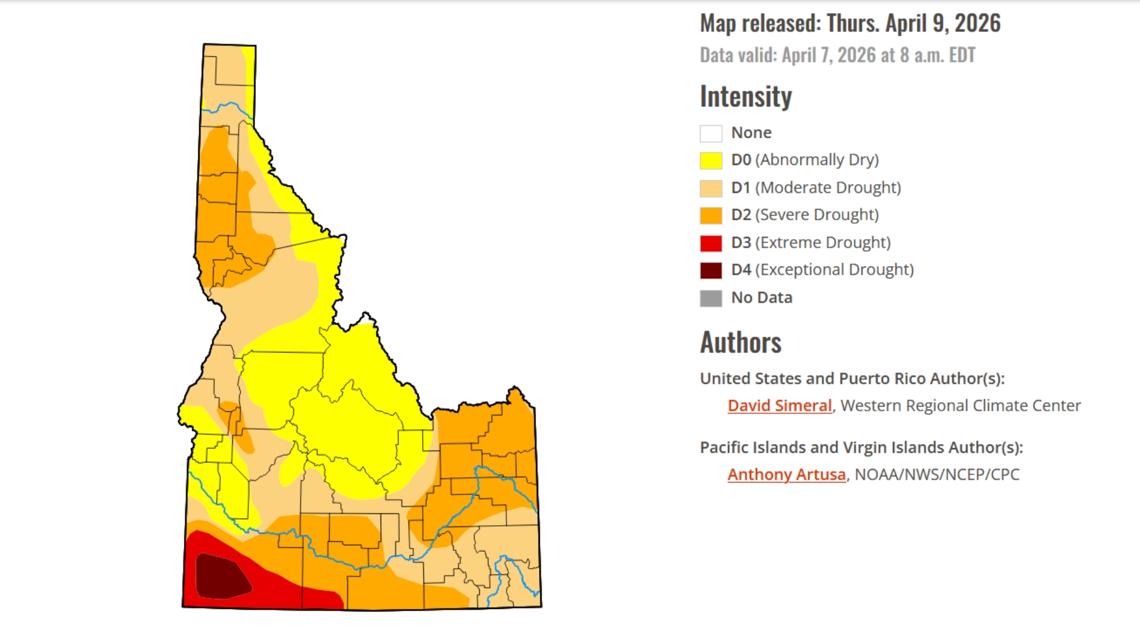
Director Weaver says Idaho experienced the second-warmest winter since 1896, this March was the second warmest on record, and the state had record-low snowpack as of April 1.
At the beginning of April, 54 snow course locations and 45 SNOTEL sites in the Snake River Basin reported record low Snow Water Equivalent (SWE) values. The Surface Water Supply Index calculations performed by the Natural Resources Conservation Service indicate that under normal hydrology from April 1 to September 30, there is a 50% chance of irrigation shortages on the Boise and Snake Rivers.
The conservation service also found water supplies are short:
– 14% in the Big Lost Basin
– 44% in the Oakley (Goose Creek) Basin
– 53% in the Big Wood Basin
– 58% in the Salmon Falls Creek basin
If water users are interested in filing an application for a temporary change in water right, they should follow IDWR guidelines.
For more information they can contact IDWR by phone at (208) 287-4800, or visit IDWR’s Drought Declarations web page.