
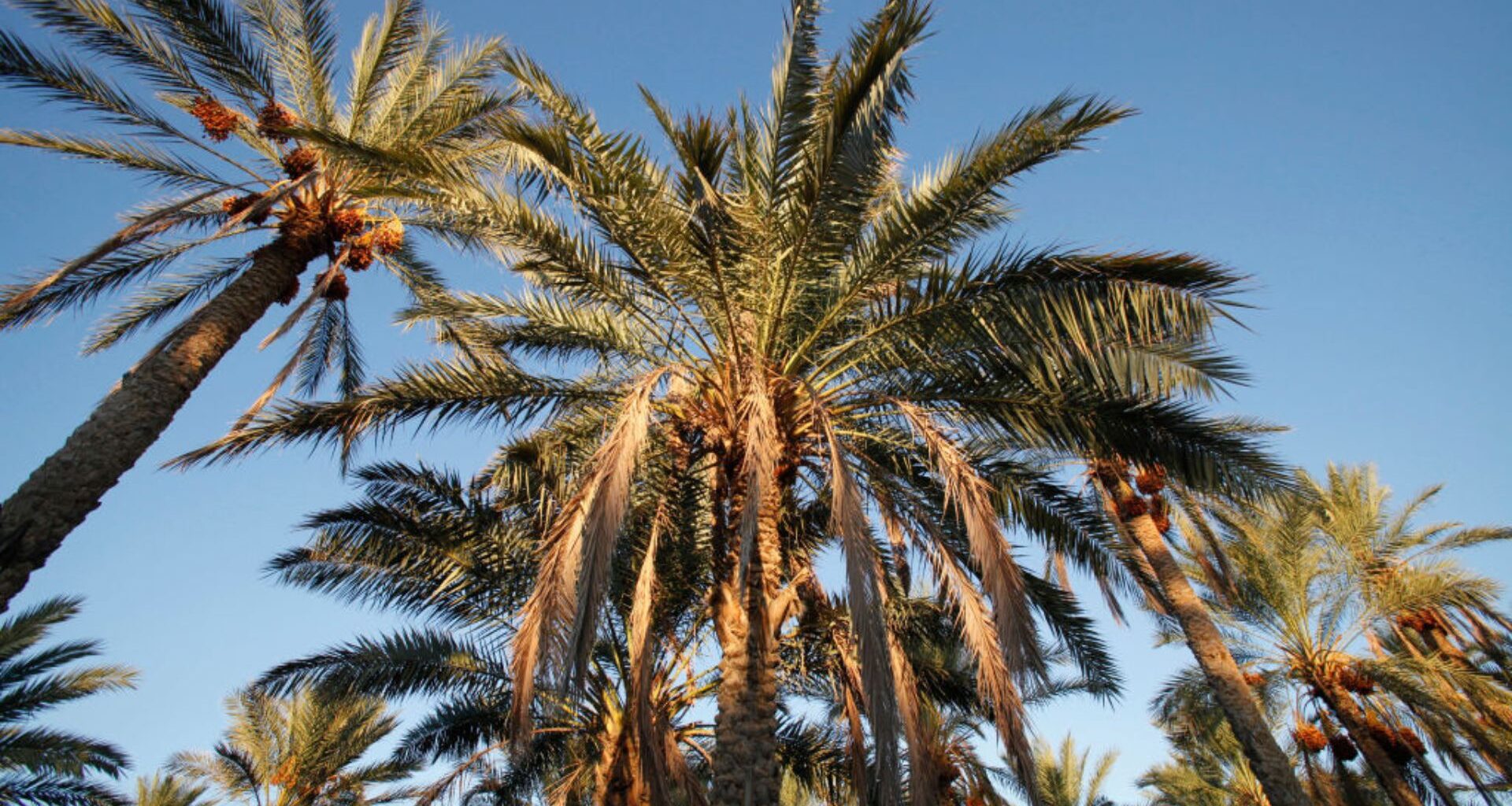
The date palm has been a “Tree of Life” in the Middle East, providing shade, shelter, and sustenance.
But every year, after the harvest, the region faces a massive, dusty problem: a huge amount of leftover surface fibers that usually end up as smoke in the sky.
Now, researchers from a multi-university coalition (led by institutions in the UAE, Oman, and Malaysia) have identified a sustainable method to convert date palm surface fiber waste into biofuel or bio-oil.
The study positions this abundant agricultural waste as a viable, carbon-neutral feedstock for renewable energy.
The problem in the palms
There are approximately 150 million date palm trees on Earth.
Each one sheds about 44 pounds (20 kilograms) of waste — seeds, fronds, and fibers — annually. In the UAE alone, where 45 million trees stand tall, the biomass waste is huge.
However, farmers have had little choice but to burn this waste in open fields. It’s a messy solution. It chokes the air with harmful gases that could contribute to respiratory illness and turns a potential resource into a climate liability.
Researchers have identified date palm surface fibers (DPSFs) as a high-potential, sustainable feedstock for bioenergy via pyrolysis.
As a form of lignocellulosic waste harvested from the tree’s exterior, DPSFs possess a lightweight, fibrous structure high in lignin and cellulose.
These specific chemical properties render the material an ideal candidate for pyrolysis and facilitate the production of both bio-oil and biochar.
“Suitable disposal of these millions of tons of lignocellulosic biomass waste requires an expensive waste management system. If not handled correctly by the municipalities, the incineration or burning in the field causes environmental dangers of greenhouse gases such as CO₂ and nitric oxides (NOₓ),” the researchers stated.
Through this process, a bio-oil rich in hydrocarbons was extracted by heating the material in the absence of oxygen.
The chemistry of the extracted bio-oil is characterized by a high concentration of hydrocarbons, making it an ideal candidate for industrial use.
It consists primarily of aliphatics (42.28 percent), which are essential for fuel production, and aromatics (38.68 percent), which enable the recovery of valuable compounds such as BTX and phenolics.
With an additional 13.47 percent comprised of oxygenates, the resulting liquid serves as a chemical base, proving that date palm waste can be transformed into a high-value resource for both energy and manufacturing.
Challenges to scaling
To make the process more efficient, the team used complex model-free kinetic models — specifically the Ozawa–Flynn–Wall (OFW) and Starink (STK) methods — to pinpoint exactly how much energy is required to break down the tough lignin and cellulose within the fibers.
Furthermore, the pyrolysis method is potentially carbon-neutral, as the carbon released during energy production is limited to what the palm trees originally absorbed from the atmosphere.
The study notes that long-term economic viability depends on optimizing specific cost drivers, including operating labor, nitrogen consumption, and feedstock logistics.
Moreover, the authors note that realizing this potential on a global scale will require investment in advanced technology and coordinated infrastructure to replace current disposal habits with a sustainable energy economy.
The findings were published in the journal ACS Omega.