
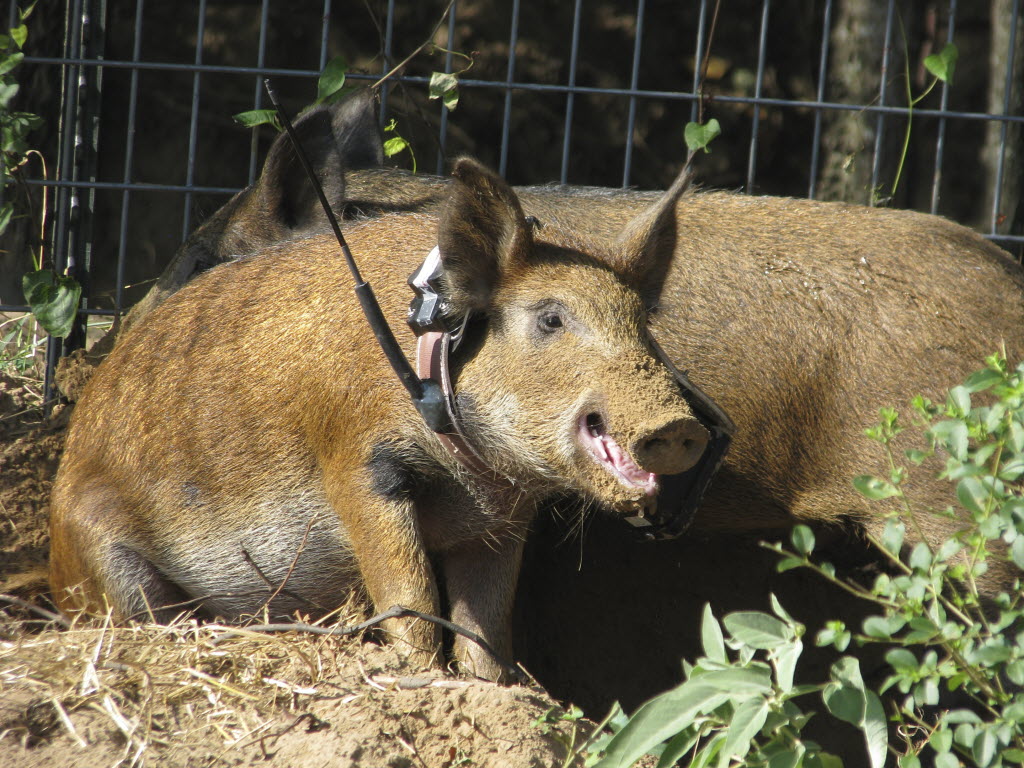
More feral hogs recently trapped as part of the city’s pilot program
Feral hogs are increasingly showing up in North Texas neighborhoods — not as a new threat, but as a growing one as the animals migrate from mostly rural land into city greenbelts and residential streets, according to Texas Wildlife Services.

What’s behind the sightings
This female wild hog was equipped with a telemetry collar so her movements could be documented.
Billy Higginbotham/Texas AgriLife Extension Service
Feral hogs are among the most destructive invasive species in the United States, known to eat a wide range of plants and animals, according to Texas Parks and Wildlife.
Article continues below this ad
Their population has grown significantly over the past few decades. Since the early 1980s, the U.S. population has roughly tripled to about 6.9 million, with an estimated 2.6 million in Texas alone, according to Texas Parks and Wildlife officials. Wildlife experts say sightings in places like Mesquite are not unusual.
“They’re in every county in the state,” said Randy Smith, district supervisor for Wildlife Services. “We’ve got feral hogs that have moved into urban areas, into the greenbelts traveling between every city in the Metroplex.”
Why hogs are entering neighborhoods
Hogs are typically drawn into residential areas by food sources and accessible terrain, Smith said.
Article continues below this ad
Make Dallas News a preferred source so your search results prioritize writing by actual people, not AI.
Add Preferred Source
They often dig up lawns in search of grubs, worms or plant roots. Well-watered yards and certain grass types can make home lawns especially attractive because they are easier to dig and more likely to contain food, according to Smith.
Greenbelts, creeks and nearby undeveloped land can serve as travel corridors, allowing hogs to move easily between rural areas and into subdivision neighborhoods.
What residents can do
Officials say eliminating food sources is one of the most effective ways to reduce damage. Treating lawns for grubs and limiting over watering can make properties less appealing. Fencing can also help, though it may not be practical in all areas.
Article continues below this ad
In some cases, cities may work with wildlife agencies or private trappers to remove hogs.
“There’s nowhere in Texas that doesn’t already have feral hogs,” Smith said, adding that the animals are euthanized when removed by animal control officials.
Are feral hogs dangerous?
Encounters with feral hogs can be alarming, but attacks are rare, according to Smith.
Article continues below this ad
Officials say hogs are more likely to run away when approached. However, they can become aggressive if they feel threatened, especially if a person gets between a sow and her piglets. And some local animal services departments may not respond to hog sightings because they are not equipped to handle wildlife, Smith said.
Mesquite officials recommend the following precautions if you see a feral hog:

By signing up, you agree to our Terms Of Use and acknowledge that your information will be used as described in our Privacy Policy.
Avoid dense undergrowth, especially in spring when hogs may be young.
Do not approach a hog; leave the area or take a different route to avoid them.
Keep pets in secure areas or on a leash.
Consider fencing or deterrents such as motion-activated lights or sprinklers.
Treat lawns for grubs to reduce food sources.
Residents can report feral hog sightings online or by calling Mesquite Animal Services at 972-216-6283. If a hog poses an immediate danger, call 911.
Reporter Sarah Bahari contributed to this report.
Article continues below this ad
What’s behind the sightings