
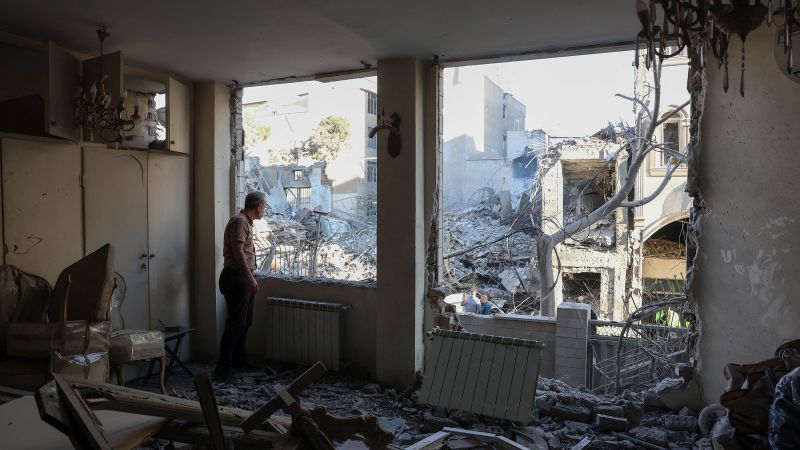
The International Monetary Fund has modestly reduced its forecast for global economic growth this year due to the Iran war but warned of more severe potential impacts of the conflict, the latest global economic body to do so.
“The global outlook has abruptly darkened following the outbreak of war in the Middle East,” Pierre-Olivier Gourinchas, economic counsellor at the IMF, wrote in the fund’s latest World Economic Outlook report, published Tuesday.
The conflict could still cause a global “energy crisis on an unprecedented scale,” he added.
The IMF now expects global growth of 3.1% in 2026, a 0.2 percentage point downgrade from its January forecast. This modest revision assumes that the war will be “relatively short-lived,” it said. Global inflation is also seen rising to 4.4% this year.
However, the fund also outlined two scenarios for a longer-lasting conflict. Under the more severe of these — in which oil and natural gas prices spike 100-200% relative to January and stay at that level into 2027 — global economic growth would come in at only 2% this year.
That would amount to “a close call for a global recession,” defined as economic growth below 2%, which has happened only four times since 1980, the IMF said.
Before the war, the global economy was performing better than expected, with growth on track to be revised upward this year, it noted. In one positive development, the downward revision was partly offset by reduced US tariff rates compared with last year, the IMF said.
The IMF prediction is the latest from a growing cohort of economists and organizations, including the Asian Development Bank and the United Nations, warning of the economic toll of a lengthy war in Iran.
Those warnings lay out the increasingly stark consequences of a war the US and Israel embarked on, including among friendly or allied nations who now face the prospect of economic chaos.
Iran has effectively closed the Strait of Hormuz, stopping about one-fifth of the world’s crude oil supply, as well as supplies of other commodities like natural gas, helium and fertilizer. Some countries are starting to run low on fuel supplies, particularly in the Asia-Pacific region, and prices for goods made with petroleum products are starting to climb.
On Wednesday, Australian Treasurer Jim Chalmers warned that the US-Israeli war with Iran had launched the global economy into a “really dangerous time.” Speaking to reporters, Chalmers pointed to the IMF forecast as evidence of the serious economic impact.
“The IMF is sounding the alarm on some pretty severe scenarios,” Chalmers said. “This is a very serious, very dangerous time for the world. Now, Australia is better placed and better prepared than a number of other countries, but we won’t be spared the fallout from this very substantial economic shock.”
Chalmers was on his way to Washington for a G20 meeting of finance ministers this week, as well as meetings with the IMF and World Bank, during which he said he would join other officials in calling for an end to the war.
“From an economic point of view, the end of the war can’t come soon enough, but even when the strait is properly reopened and even when the hostilities formally end in an enduring way we still expect the consequences of this war in the Middle East to be felt for some time now,” he said.
CNN’s Olesya Dmitracova contributed reporting.