

In our series “The Age of Work,” Marketplace is looking at how labor force dynamics are changing the way the economy works.
The population of the United States and other wealthy nations is getting older. That means the global economy is relying more and more on developing countries, many of which have younger populations and, thus, younger workers.
One example is Vietnam. “We’re seeing a country at its peak,” said ADP chief economist Nela Richardson, “Marketplace’s” partner on this series. “This is a country where there are two working-age adults for every dependent, either over 65 or under 15.” That workforce has attracted a lot of attention from American companies looking for workers. And that demand, in turn, is creating opportunities for Vietnam.
“In every other advanced, wealthy country, that ‘golden spot’ led to wealth creation, economic growth, and it led to technological advancement,” said Richardson. “However, it’s not going to last forever. We have about 10 years before that sweet spot, that ‘golden age,’ turns into another aging population.”
All this week, we’re bringing you stories from Ho Chi Minh City, Vietnam, about the growing role that workers there are playing in the global economy. For this installment, “Marketplace” host Kai Ryssdal and Richardson reported from an indoor market and a garment factory that’s caught in the crosswinds of geopolitics.
In a historic market, vendors adjust to a changing economy
Binh Tay Market, located in Ho Chi Minh City’s Chinatown, is frequented by both wholesale customers and regular people. When Ryssdal and Richardson visited on a weekday morning, it was buzzing with activity: people on motorbikes delivering goods and shoppers perusing the stalls.
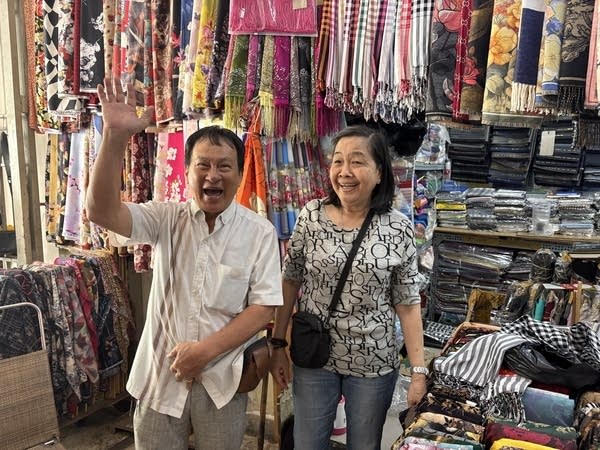
Married couple Dũng Anh Nguyễn (left) and Vân Thanh Mai (right) have been running their textile stall in Ho Chi Minh City’s Binh Tay Market for 38 years.
Maria Hollenhorst/Marketplace
Married couple Dũng Anh Nguyễn and Vân Thanh Mai have been running one such stall for 38 years. They sell bolts of fabric and, more recently, have started selling scarves in order to cater to tourists. As they’ve gotten older, they’ve considered what might happen to their business. According to Mai, their children are unlikely to take it over.
“They are white-collar workers. They have office jobs,” said Mai. “A day at the market, it’s not stable like an office job.”
A garment factory weathers uncertainty
About seven miles away from Binh Tay Market, on the outskirts of Ho Chi Minh City, workers in a sewing factory put together dresses that end up in U.S. retailers like Target and Anthropologie.
“Right now, around 90% of our total product, we export,” said Henry Pham, CEO of Dony Garment and the owner of the factory. “And 10% is local.”
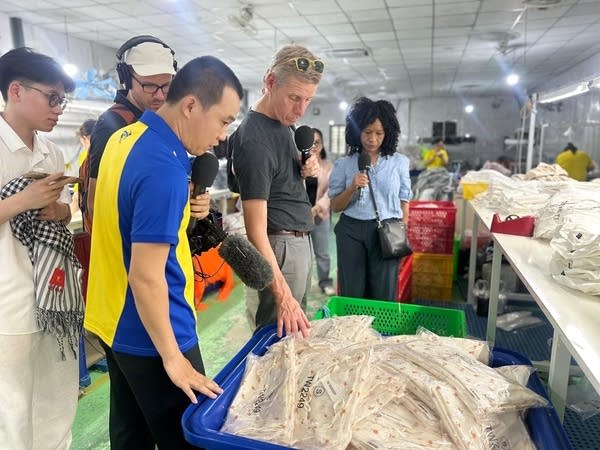
Dony Garment CEO Henry Pham (left), “Marketplace” host Kai Ryssdal (center), and ADP chief economist Nela Richardson (right) look at a bin of clothes in the Dony Garment sewing factory in Ho Chi Minh City.
Andy Vũ/Marketplace
Pham employs around 300 people. He said one of his priorities is to invest back into those workers and make their lives a little easier by, for example, installing air conditioning in his factory. But sudden changes in U.S. tariff policy have thwarted his plans, leaving his factory only partially air-conditioned.
“I’m most worried about policy change,” said Pham. “We have to prepare around a minimum of two months for one [clothing] order. And you see that right now, the policy can change after two weeks.”
To hear more, use the play button at the top of the page.
Related Topics