
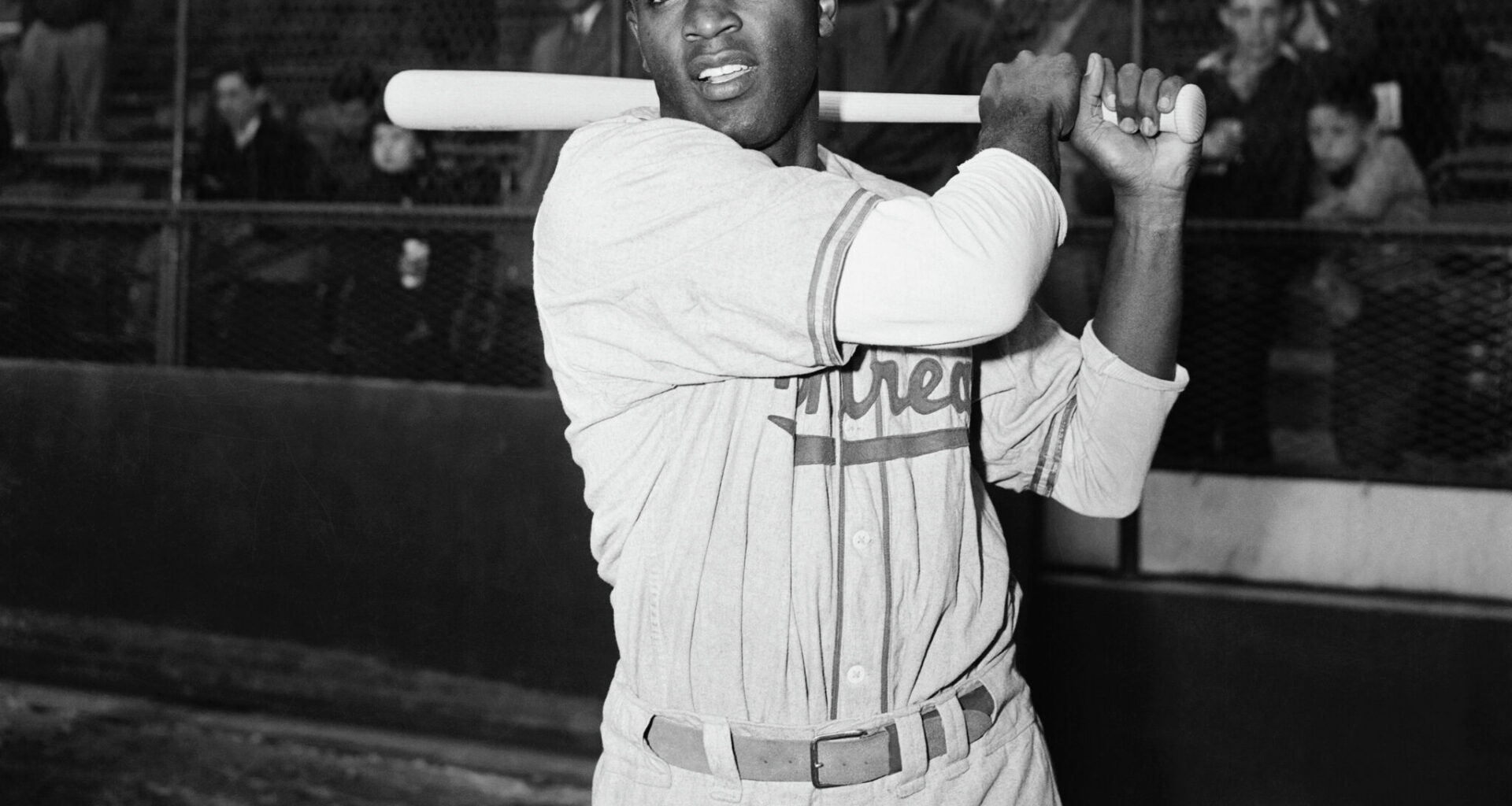
Jackie Robinson warms up before a game while playing with Montreal, a Brooklyn Dodgers minor league team, on April 10, 1947. Five days later, the Dodgers called him up, and he became the first Black player in Major League Baseball.
Bettmann Archive via Getty Images
On April 15, every player in Major League Baseball takes the field wearing the same number: 42. It is one of the most powerful traditions in American sports. Different teams, different names, different histories — but for one day, the number is the same. Jackie Robinson’s number becomes everyone’s number.
But while it’s easy to honor a number, it’s harder to fully appreciate what it signifies.
Jackie Robinson did not simply break baseball’s color barrier on April 15, 1947. He stepped into a country that had not yet decided whether it was ready for him. His presence on the field carried meaning far beyond the game. Every at-bat, every stolen base, every insult he refused to answer became part of a larger test — not only of his character, but of that of the nation watching him.
Article continues below this ad
Robinson’s impact did not end at the foul lines. He challenged segregation in housing, pushed for fair employment and spoke openly about injustice even when doing so risked the fragile acceptance he had earned. He understood that visibility without advocacy could too easily become performance. The uniform gave him a platform; he chose to use it.
We tend to remember Robinson in ways that feel settled. Courage. Dignity. Strength. All of it true, and all of it necessary. But over time, even the most difficult stories can begin to feel inevitable, as if progress arrives on its own schedule.
San Francisco Chronicle Logo
Make us a Preferred Source to get more of our news when you search.
Add Preferred Source
Robinson knew better. He understood that the promise of America, while real, does not fulfill itself. It must be pressed forward, often by those asked to carry more than their share. Writing in his autobiography years after he broke the color barrier, he gave voice to that truth with a clarity that still resonates: “I won’t ‘have it made’ until the most underprivileged Negro in Mississippi can live in equal dignity with anyone else in America.”
There is no sense of arrival in that statement. No claim that the work had been completed. Only a recognition that progress, if it is to mean anything, must extend beyond the individual and reach those still waiting for its benefits.
Article continues below this ad
That perspective gives April 15 its weight.
For one day, we replicate the symbol. We wear 42 and honor the breakthrough it represents. But symbols, by themselves, are not the same as continuation. They point backward, yet they also ask something of the present.
What does it mean to carry forward a legacy that was never meant to be comfortable? What does it require of us to inherit a story that is still unfinished?
In Robinson’s time, the barriers to racial equality were explicit, codified and enforced in plain sight. Today, barriers to equality are often less visible but no less consequential — embedded in access, opportunity and expectation. The challenge is not only to recognize inequity when it is obvious, but to confront it when it is subtle, systemic or inconvenient.
And there is a further challenge: not to confuse representation with resolution. A milestone can open a door, but it does not guarantee who will be able to walk through it or what awaits on the other side. Progress, left unattended, can stall or even recede. Robinson’s legacy reminds us that vigilance is not a posture of the past — it is a requirement of the present.
Article continues below this ad
Robinson’s life offers one answer. His career did not end with full acceptance, nor did it quiet his sense of urgency. If anything, it sharpened it. He remained deeply committed to the idea that America could live up to its ideals, even as he refused to ignore how far it still had to go.
That tension feels familiar today. We are quick to recognize milestones, less certain about how to build on them. It is easier to commemorate progress than to extend it, easier to celebrate firsts than to ensure they are not isolated.
Robinson understood that being first was never the point. The point was what followed.
His example does not call for grand gestures as much as it calls for consistency — the kind of persistence that turns moments into movement and recognition into responsibility. It’s a commitment that shows up not only in history, but in daily choices: Who is included, who is supported and whether the opportunities we praise are actually within reach.
Guest opinions in Open Forum and Insight are produced by writers with expertise, personal experience or original insights on a subject of interest to our readers. Their views do not necessarily reflect the opinion of The Chronicle editorial board, which is committed to providing a diversity of ideas to our readership.
Read more about our transparency and ethics policies
It also asks something quieter but no less important: a willingness to listen, to learn and to confront truths that may unsettle us. The work of carrying a legacy forward is not only external — it is internal, measured in honesty as much as action.
Article continues below this ad
That is what makes April 15 more than a tribute. It is a reminder that progress is not self-sustaining, and that symbols only endure when they are matched by action.
Scott Reich is a historian, attorney, nonprofit leader and the author of “The Power of Citizenship: Why John F. Kennedy Matters to a New Generation.” His forthcoming book, “One Day in September: Baseball, Brotherhood, and the Birth of the All-Star Game,” explores a pivotal moment in baseball history and the game’s role as a civic institution.