
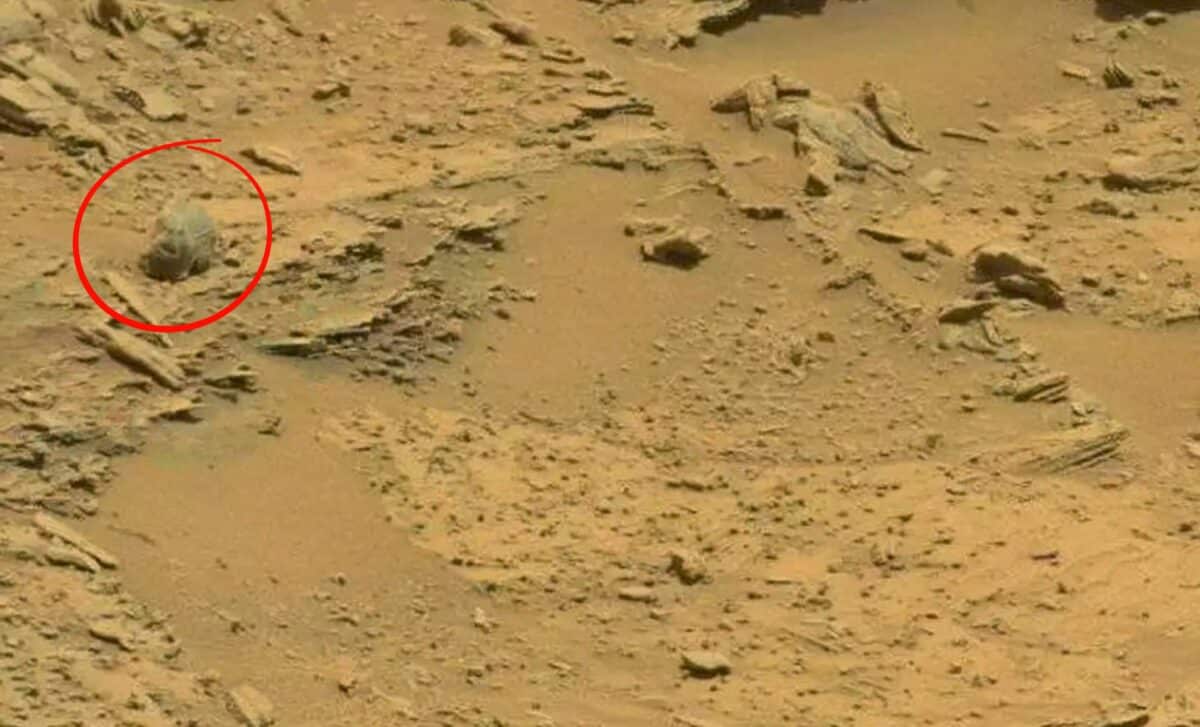
The bees appear to vary in size. Some show wings. Others display segmented bodies and what look like jointed legs frozen mid-stride across the rust-colored regolith of Gale Crater.
William Romoser, an entomologist who spent decades studying arthropods, has spent years examining publicly available imagery from NASA’s Curiosity rover. What he sees is unambiguous: insect-like creatures in flight, arthropod forms sheltering in burrows, and the fossilized remains of reptile-like organisms scattered across the Martian surface.
His analysis, presented at the 2019 National Meeting of the Entomological Society of America, has recently resurfaced in science media coverage, reviving a debate about what the rover’s cameras may have actually captured.
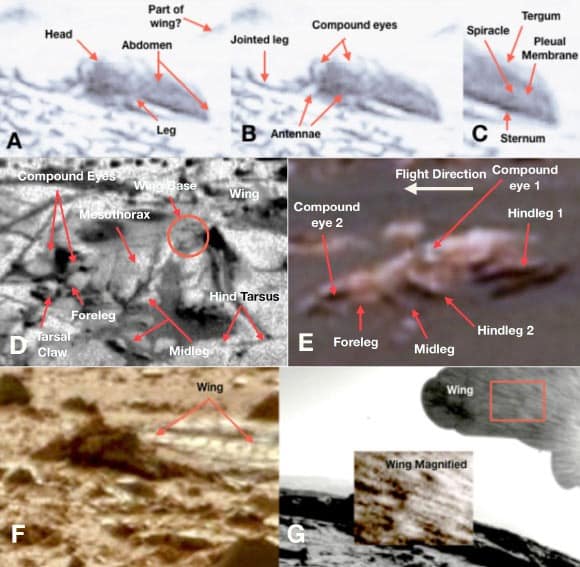 NASA rover captures possible insect-like life on Mars, showing wings and legs. Credit: William Romoser
Romoser’s claims are not subtle. He identifies specific anatomical features across multiple rover images, including what he describes as compound eyes, wing venation patterns, and specialized appendages consistent with terrestrial arthropods.
“The ‘bees’ appear to vary in size and type,” Romoser stated during his presentation. “Several characteristic insect/arthropod anatomical features were identifiable, not all on the same individual, but as a mosaic among individuals.”
One image sequence, he contends, captures an organism performing an acrobatic flight maneuver that begins with a steep dive and ends with a level trajectory, a motion pattern familiar to anyone who has watched insects navigate open air. He further argues that the insect-like fauna he has catalogued appear to be sheltering in caves, nesting in burrows beneath the surface, and occupying specialized structures carved into the Martian terrain.
Flight Maneuvers and Fossilized Predators in Rover Imagery
The Curiosity rover images that Romoser analyzed extend beyond winged forms. He points to additional photographs that he interprets as reptile-like fossils, including one specimen that bears what he describes as a distinct head structure with bilateral symmetry resembling an Eastern King Snake. The fossilized form, according to his presentation, shows evidence of a large mouth capable of gaping, a feature he associates with predatory behavior.
In some of the rover photographs he examined, Romoser suggests the reptile-like organisms appear to be preying upon the smaller insect-like forms. This interpretation implies a functioning ecosystem with trophic relationships, a claim that would require extraordinary evidence to substantiate.
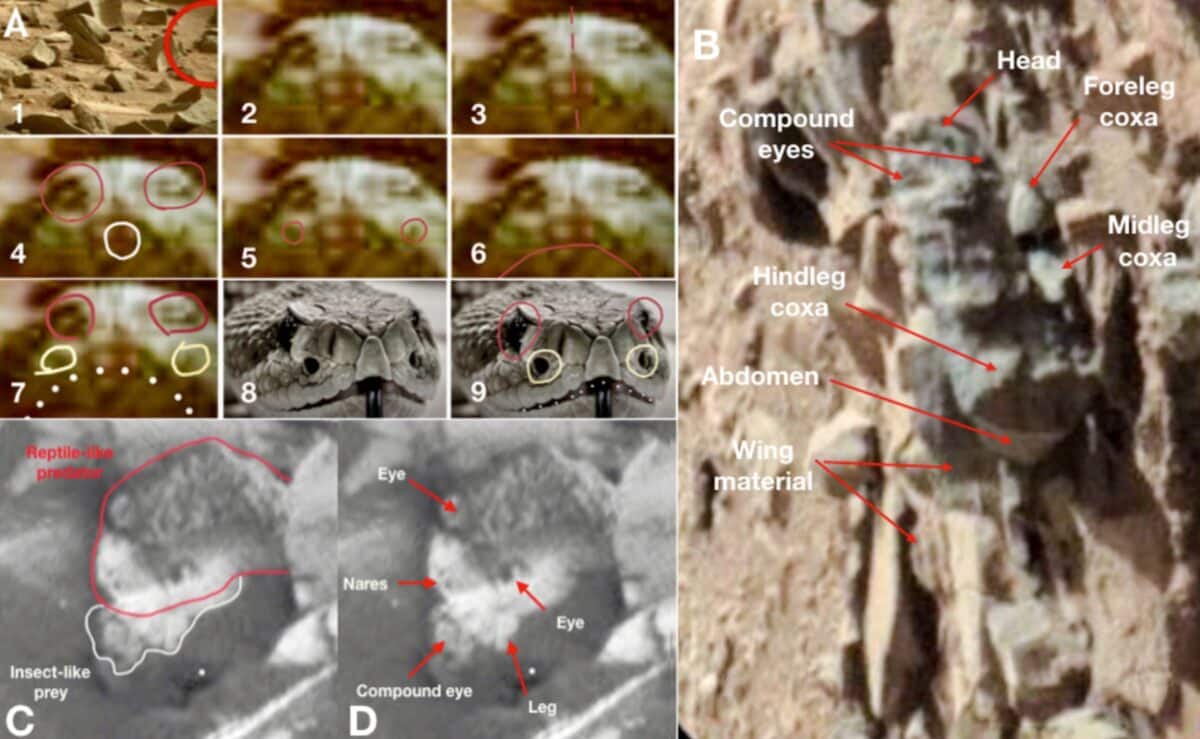 Insect and reptile resemblances on Mars. Credit: William Romoser
The entomologist acknowledged that his findings could open new avenues of scientific inquiry. “Given evidence for the presence of insect/arthropod and reptile-like organisms beyond the confines of Earth, perhaps ‘astroentomology’ and ‘astroherpetology’ will emerge as important topics within the field of astrobiology,” he said.
The researcher behind the claims joined the Ohio University faculty in 1965 and built a career focused on medical entomology and tropical disease research. His documented expertise does not include planetary geology or remote sensing analysis. The Mars research represents a departure from the mosquito and arbovirus work that defined his academic career.
What Curiosity Actually Found in Gale Crater
Curiosity landed in Gale Crater on August 6, 2012, carrying the most sophisticated suite of scientific instruments ever deployed to another planet. The rover’s 10 instruments include 17 cameras, a laser that vaporizes rock from a distance to analyze chemical composition, and a drill that has now collected 42 powdered rock samples from the Martian surface.
The mission’s core objective is straightforward: determine whether Gale Crater ever possessed environmental conditions suitable for microbial life. Curiosity has delivered definitive answers. It found ancient streambeds, identified long-lived lake systems, and detected organic molecules preserved in billion-year-old mudstone. In February 2026, researchers reported that non-biological processes could not fully explain the abundance of organic compounds detected in Martian samples.
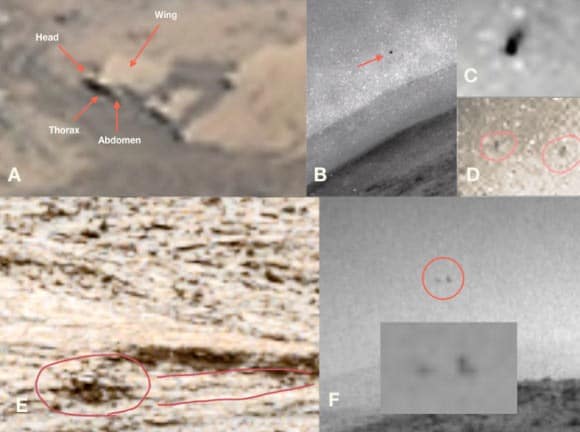 NASA rover images show possible insect-like creatures on Mars, with labeled features such as wings, thorax, and abdomen. Credit: William Romoser
Nowhere in Curiosity’s published scientific findings does the mission team report visual confirmation of macroscopic organisms. The rover continues its traverse across Gale Crater, recently spending six months examining boxwork formations, a type of fractured geologic structure that resembles spiderwebs when viewed from above. The rover’s cameras have captured thousands of images showing sedimentary layers, wind-sculpted rocks, and mineral veins left behind by ancient groundwater.
Pareidolia and the Search for Patterns in Martian Rocks
Scientists who evaluate claims of Martian life in rover imagery consistently point to pareidolia as the most plausible explanation. The phenomenon describes the brain’s tendency to impose familiar patterns on random visual information. It explains why people see faces in electrical outlets, animals in cloud formations, and, in this case, insects in wind-eroded rocks.
Mars possesses no shortage of oddly shaped geology. Billions of years of volcanic activity, impact cratering, ancient water flow, and relentless wind abrasion have sculpted the surface into forms that can trick the eye under certain lighting conditions. Features that appear organized or biological in one rover image often resolve into ordinary rock when photographed from a different angle or with higher-resolution instruments.
Readers responding to the resurfaced research noted the pattern recognition phenomenon at work. One observer remarked that seeing shapes in Martian rocks is “like seeing sheep in the clouds.” Others drew comparisons to blurry Bigfoot photographs, where ambiguous visual information invites the mind to fill in missing details.