
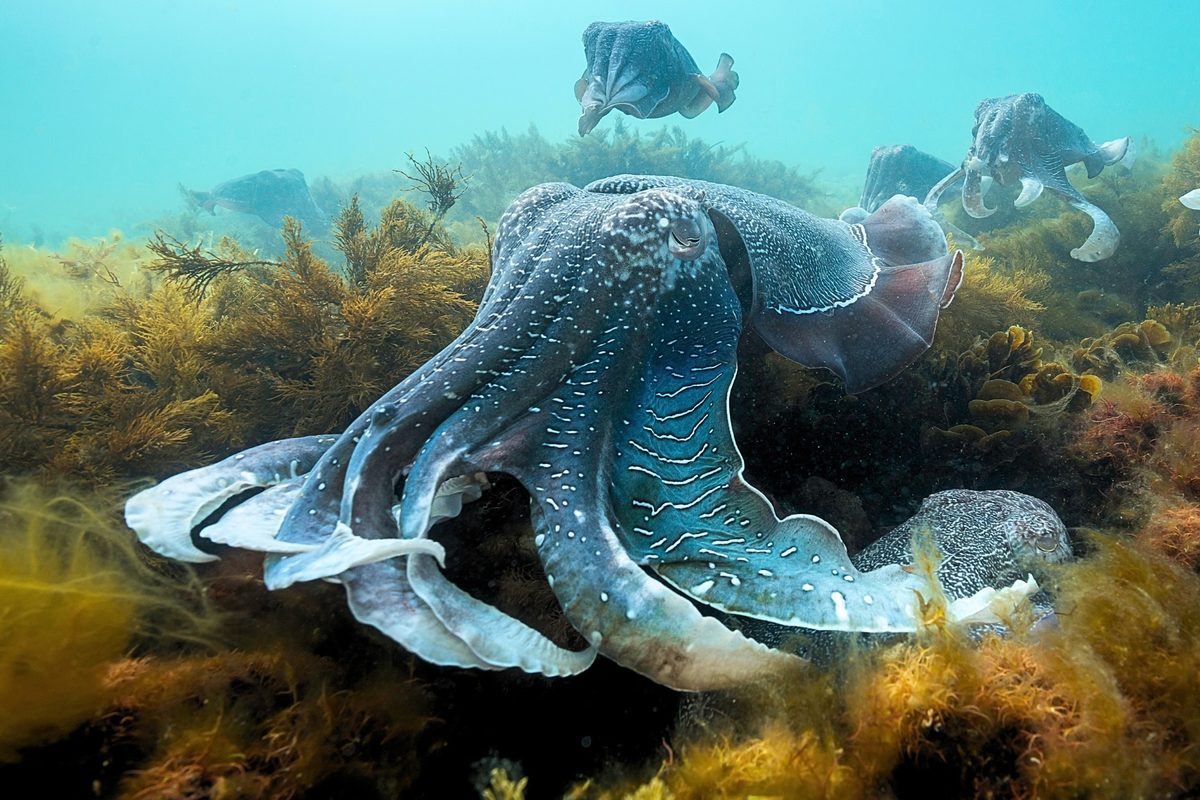
The world’s largest cuttlefish – the aptly named giant cuttlefish (Sepia apama) – can grow to the length of a cricket bat and weigh as much as a corgi.
Every year, tens of thousands of these massive cephalopods arrive in the waters off Point Lowly, Whyalla, South Australia, to mate.
Giant cuttlefish can grow up to 1m in length and can weigh more than 10.5 kg, according to Guinness World Records. In contrast, one of the world’s smallest cuttlefish – the adorable flamboyant cuttlefish (Metasepia pfefferi) – is a teensy 8cm long (around the size of a pack of playing cards).
Giant cuttlefish are usually solitary but they come together in vast numbers every May and June. They’re all here for one reason: mating season.
Two male giant cuttlefish fight for the right to mate with a female in the shallow waters just south of Point Lowly in South Australia. Credit: wildestanimal/Getty Images
It’s a unique phenomenon. These waters off South Australia “are the only place in the world where the cuttlefish congregate annually en masse and with such great predictability,” says the Department for Environment and Water on its Good Living website.
When giant cuttlefish come together in such large numbers, you can expect one thing: drama.
Males vastly outnumber females: there are sometimes around seven males for every female. Because of this, competition is fierce and males can become embroiled in epic fights with rivals, grappling with each other and spurting clouds of angry black ink into the water around them.
Male giant cuttlefish gather at Point Lowly. Credit: wildestanimal/Getty Images
The giant cuttlefish also put on trippy light shows. Like octopus, they can change the colour and patterns displayed on their skin in an instant. While this is useful for camouflage, they also use this as a way of communicating. Individuals send messages to each other through the vibrant patterns that pulse across their skin.
These signals might be to woo a mate or warn off a rival.
The victor gets the prize of mating with his chosen female. “Mating takes place with the cuttlefish linking their eight arms and two tentacles for head-to-head contact, with the males slipping their sperm packages into the female’s mouth and fertilising her eggs,” says the Whyalla website.
“The female lays tear-shaped eggs and attaches them to the underside of the rocky ledges and in rock cavities where they hatch three to five months later.”
Giant cuttlefish mating. Credit: wildestanimal/Getty Images
Wildlife lovers can witness this astonishing phenomenon as it’s possible to dive or snorkel with the giant cuttlefish during mating season.
Of course, anyone lucky enough to witness this incredible show should make sure they’re not disturbing the animals. The Department for Environment and Water advises: “Remember to respect their space – look but don’t touch. If they react to your presence, ensure your retreat. After all, it’s next year’s population that are being produced at this time.”
More amazing wildlife stories from around the world