
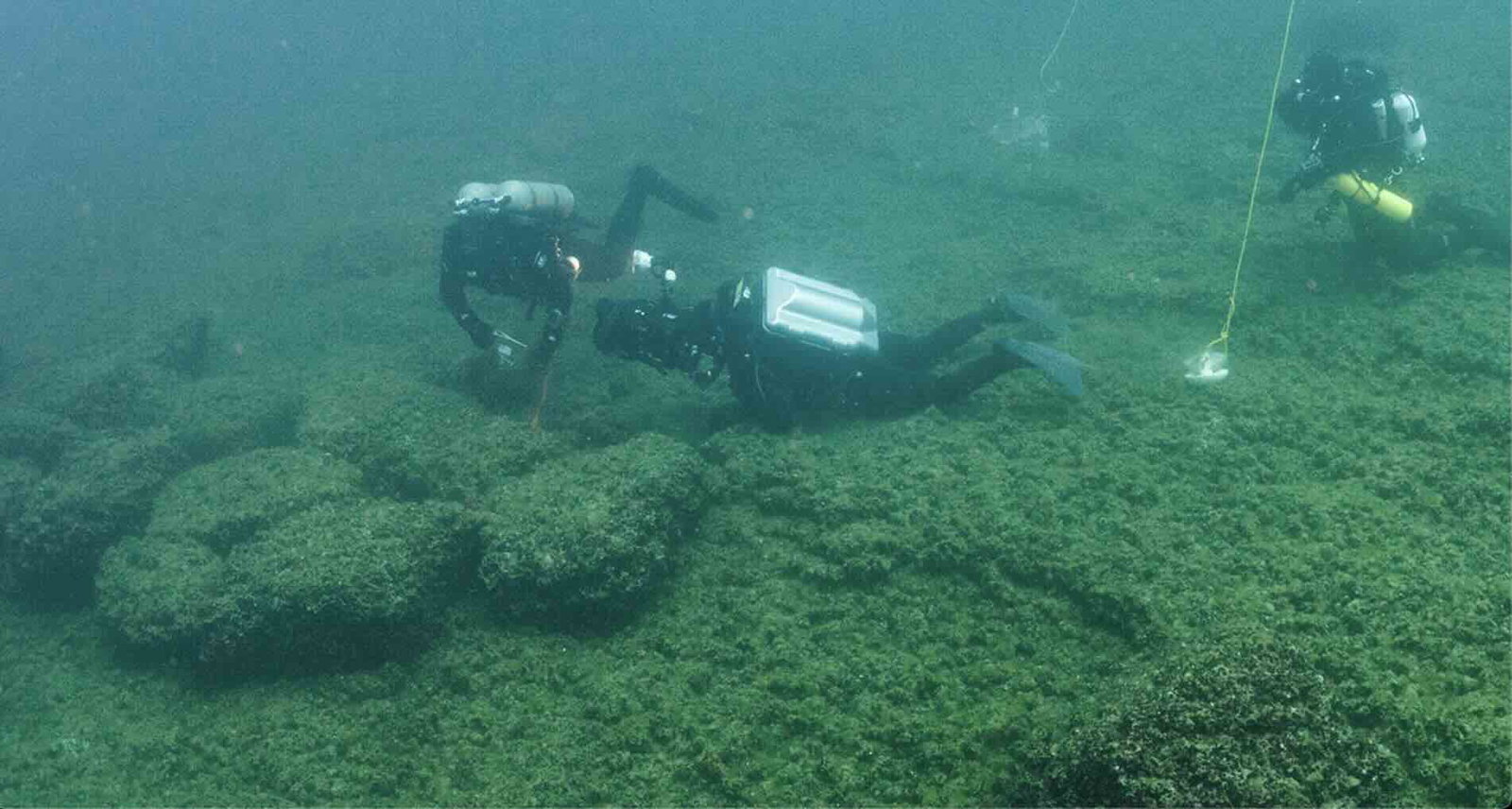
It began with a curious discovery: a series of unusual structures located more than 100 feet below the surface of Lake Huron, first detected in 2008.
What resulted was an ongoing investigation of curious sunken features beneath the Great Lakes, which are helping to reveal clues to a lost chapter in the prehistory of the ancient Americas, and the lives of its late Paleoindian-period inhabitants.
Close to 9,000 years ago, humans who once thrived on a land bridge that existed in a now submerged region deep within Lake Huron were assembling campsites, hunting pits, and “drive lanes” to aid in hunting caribou using the region’s local stone.
Following their discovery nearly two decades ago, researchers at the University of Michigan have continued to document these remarkable archaeological features, which are regarded as the earliest evidence of human activity ever discovered at the bottom of the Great Lakes.
Lost World of the Ancient Caribou Hunters
Since their initial detection, John O’Shea, curator of Great Lakes Archaeology in the Museum of Anthropology and professor in the Department of Anthropology, has become something of an evangelist for the remarkable discoveries preserved at the bottom of Lake Huron, frequently giving talks to historical societies and archaeology groups about their significance.
“We have been working continuously out in Lake Huron since 2008, and will be continuing the work this summer,” O’Shea recently told The Debrief. Since the initial detection of stone structures on the lake’s bottom, O’Shea says that several additional features have been identified, adding to the expanding picture of what the lives of the region’s ancient caribou hunters must have been like.
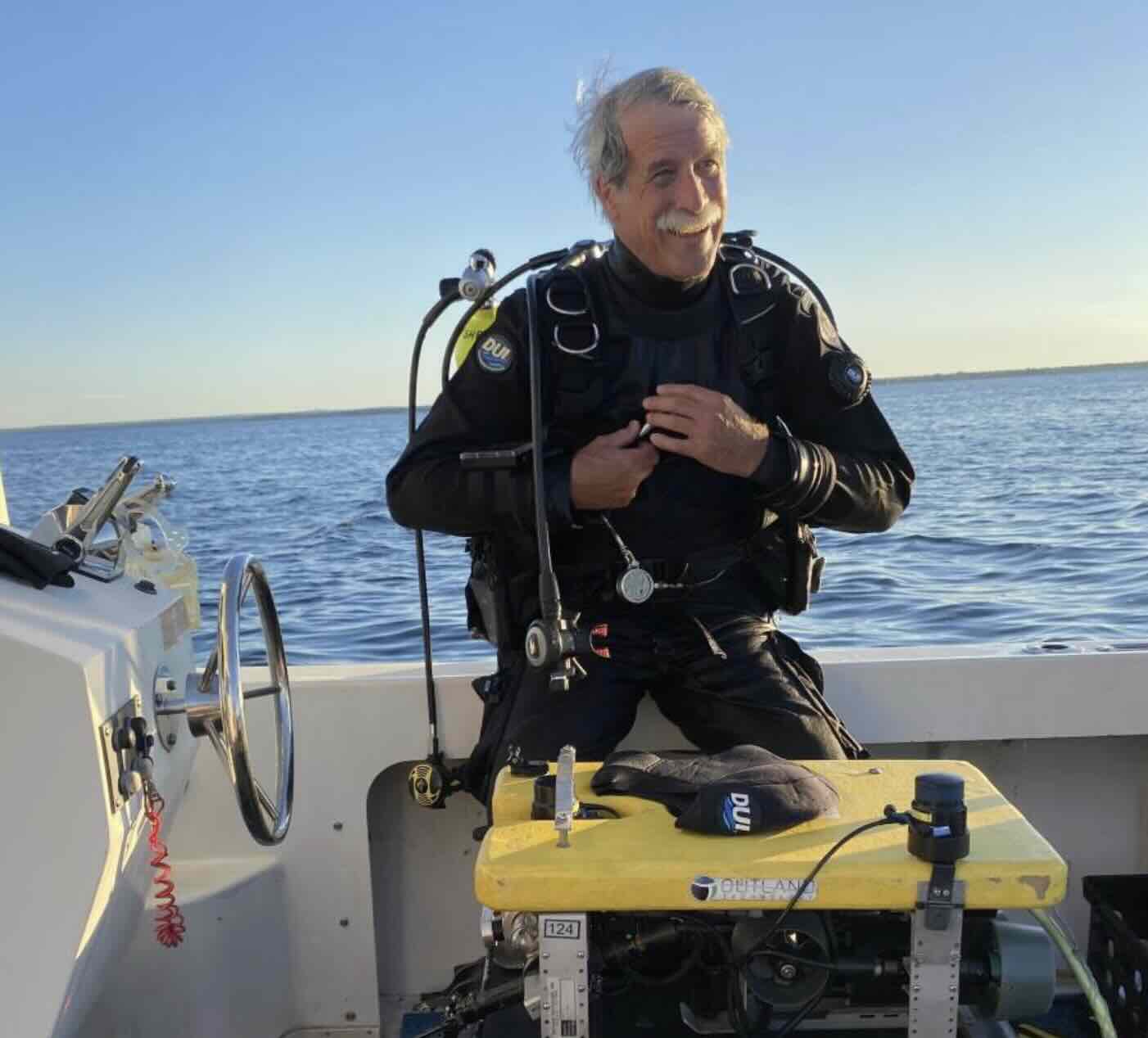 Professor John O’Shea, shown while working in the field (Image Credit: John O’Shea)
“To date, we have identified 80 locations with likely stone constructions,” O’Shea says. Most of these newly identified structures include drive lanes like those initially discovered in 2008, in addition to hunting blinds, and also caches of stone where ancient hunters had left behind material that could later be used to fashion lithic tools needed for hunting and processing caribou.
O’Shea says these 9,000-year-old features are mainly associated with the Lake Stanley low stand in Lake Huron.
“A summary of the research current to 2015 is published in the Museum of Anthropology Memoir series,” O’Shea told The Debrief. “I recently presented an update of developments since that time at the recent Society for Historical Archaeology meetings in Detroit this past January.”
A Sunken World Resurfaces
Involved since their initial discovery in the early 2000s, O’Shea said in a statement in 2009 that the discovery marked “the first time we’ve identified structures like these on the lake bottom,” adding that they were of great importance “because the entire ancient landscape has been preserved and has not been modified by farming, or modern development.”
“That has implications for ecology, archaeology and environmental modeling,” O’Shea said.
Reflecting on how the research initially came about during a 2023 lecture, O’Shea said the two factors that led to the discoveries had been the initial publication of data about the subsurface features of the Great Lakes by NOAA. Around this same time, O’Shea had been reading a book about the methods used by modern-day Siberian reindeer herders.
“In that book they were talking about how do these very small groups of families manage a herd of thousands of semi-domesticated reindeer?” he said. “And it turns out when they wanted the reindeer to move from one pasture to another, they went out … and cut brush, and laid it on the ground, and this was enough to deflect the movement of the animals.”
“And it was kind of seeing these two things together,” O’Shea says. “You know, out there, there’s gonna be rock. Maybe they were doing this.” What followed was a high-risk National Science Foundation-funded research effort, and soon afterward, the confirmation that such practices had indeed once occurred on portions of the ancient landscape now submerged.
Those discoveries also led to the publication of a paper, in which O’Shea and his co-author Guy Meadows, the director of the Marine Hydrodynamics Laboratories and a professor in the departments of Naval Architecture and Marine Engineering, and Atmospheric, Oceanic and Space Sciences at the University of Michigan, detailed the ancient features which had been preserved on the lake bottom for thousands of years.
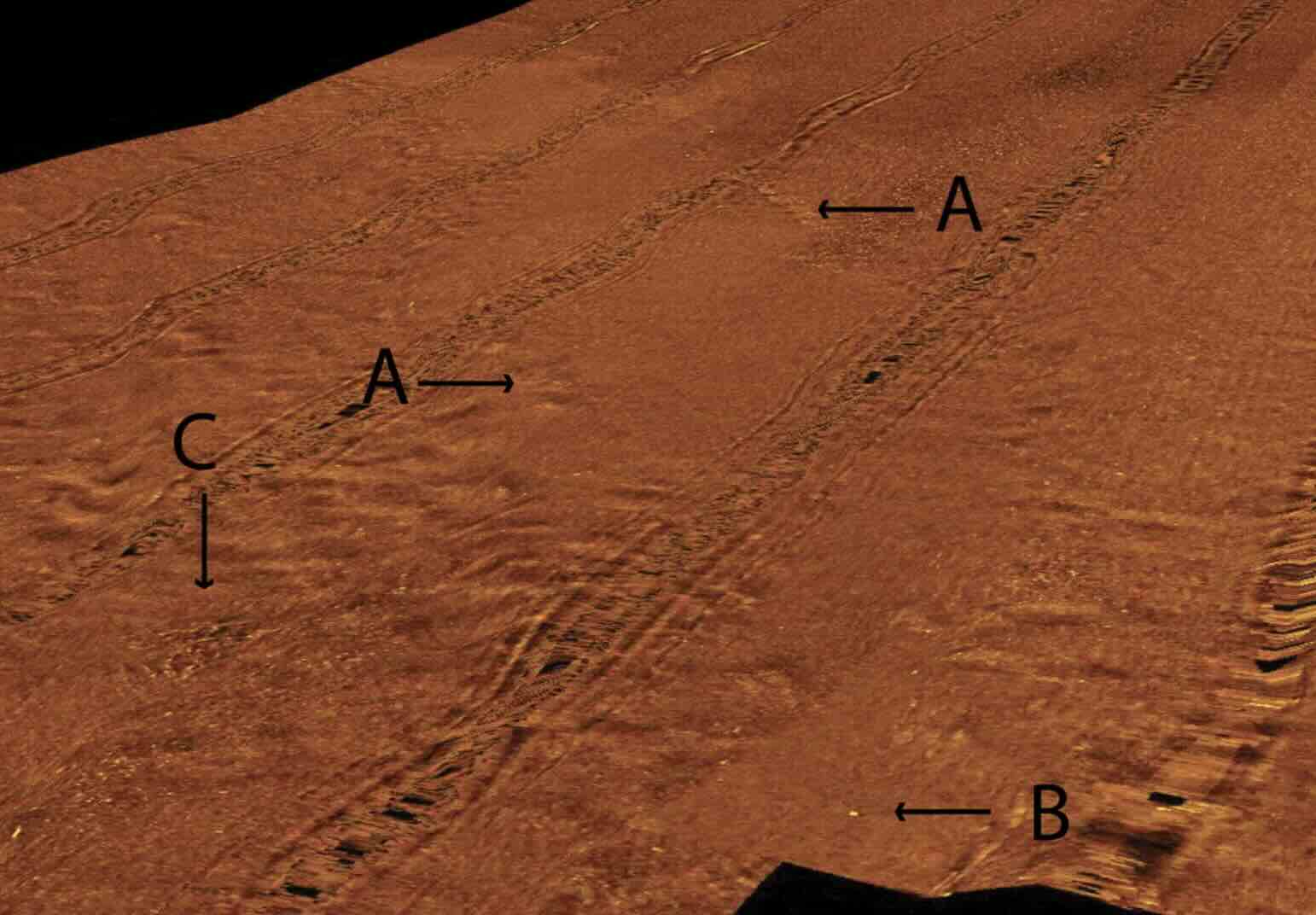 Above: Acoustic images of the base of Lake Huron revealing a Lake Stanley-age watercourse, along with possible hunting structures and camp sites (Image Credit: O’Shea, Meadows/PNAS/https://www.pnas.org/doi/full/10.1073/pnas.0902785106)
One of the most significant features of their study was a 1,148-foot structure that appears to be the remnants of an ancient caribou drive lane, not unlike the Siberian varieties O’Shea had read about, and also similar to ones still seen today on Victoria Island and in other locations in subarctic Canada.
A Lost Land Bridge is Revealed
Stretching for more than 100 miles between Presque Isle, Michigan, and Point Clark, Ontario, the 9000-year-old features are located on the surface of an ancient ridge that was still exposed many thousands of years ago.
This ten-mile-wide feature, formally known as the Alpena-Amberley ridge, once formed a natural bridge across the region, where water from melting glaciers at the end of the last Ice Age steadily began filling the region’s basins more than 10,000 years ago. For a time, the ridge offered a unique opportunity for the region’s ancient hunters, whose mark was left in stone on the ancient landscape long before it was consumed by Lake Huron’s rising waters.
Many similar sites from this period are believed to exist along coastal regions as well, although, unlike the Great Lakes, those areas have been so covered by sediment over time that their rediscovery now would be almost impossible. By contrast, the archaeological features on the base of Lake Huron are almost devoid of the sediments that entomb their coastal counterparts and are also remarkably well preserved.
It was long suspected that the ancient Alpena-Amberley ridge would be a prime candidate for preserved archaeological remains, but their discovery had remained elusive until 2008. By narrowing their search based on models of the ridge as it would have appeared before Huron’s water levels began rising between 10,000 and 7,500 years ago, reconstructions of the ancient land bridge soon produced several candidate locations to begin their search.
That educated guesswork paid off, and with the assistance of computer science professor Robert Reynolds from Wayne State University, the team discovered archaeological features during scans of their three primary candidate locations using sonar technologies and remote-controlled underwater vehicles equipped with cameras.
Answers to Ancient Questions
For many years, very little was known about the earliest inhabitants of the region, primarily because the archaeological evidence of their presence had been submerged by the rising waters that became the Great Lakes.
Thanks to the ongoing efforts of O’Shea and his colleagues, some of the previously unanswered questions about this mysterious period in America’s prehistory have gradually come into focus. Much of this work was chronicled in the 2015 volume Caribou Hunting in the Upper Great Lakes: Archaeological, Ethnographic, and Paleoenvironmental Perspectives, for which O’Shea was an editor, and which offers a comprehensive overview of the underwater Paleoindian archaeology of the Great Lakes.
“Without the archeological sites from this intermediate time period, you can’t tell how they got from point A to point B, or Paleo-Indian to Archaic,” O’Shea said of the 2009 research.
“This is why the discovery of sites preserved beneath the lakes is so significant.”
O’Shea and Meadows’ study, “Evidence for early hunters beneath the Great Lakes,” appeared in Proceedings of the National Academy of Sciences.
Micah Hanks is the Editor-in-Chief and Co-Founder of The Debrief. A longtime reporter on science, defense, and technology with a focus on space and astronomy, he can be reached at micah@thedebrief.org. Follow him on X @MicahHanks, and at micahhanks.com.