
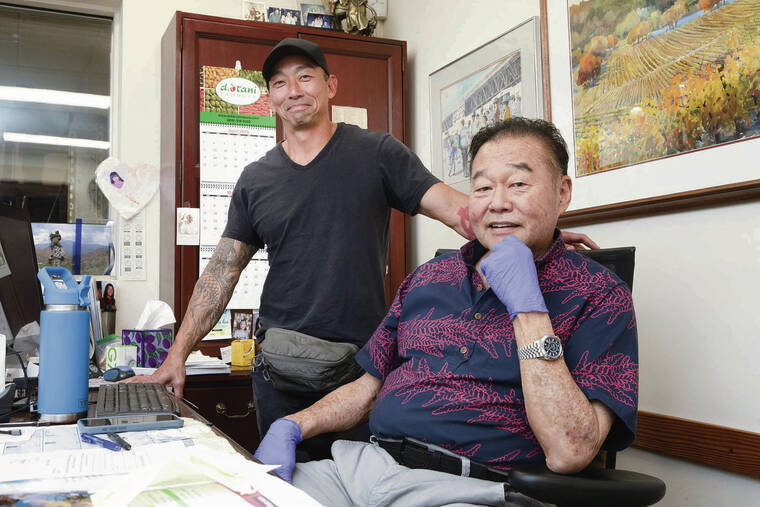
It’s National Donate Life Month and Dwight Otani, the CEO and owner of D. Otani Produce, wants people to know the importance of becoming an organ donor after receiving a kidney from his son in January.
For Mitchell Otani, a state firefighter, the decision was simple.
“It was an opportunity for me to do something that is within my capability,” he said.
He had no hesitation in getting screened to be a potential donor for his father, who was undergoing dialysis.
Hawaii has a high prevalence of factors that can lead to kidney failure that include type 2 diabetes, high blood pressure, alcohol consumption and unhealthy diets.
“There’s an absolute need for organ donations,” said Dr. Felix Lung-Yi Lee, a Queen’s Medical Center transplant surgeon and director of Queen’s kidney transplant program. “Without people willing to donate, our patients will suffer on dialysis and do poorly.”
Don’t miss out on what’s happening!
Stay in touch with breaking news, as it happens, conveniently in your email inbox. It’s FREE!
In his specialty, Lee said more than 300 people are on the waitlist for a kidney transplant, far exceeding the number of patients waiting for a combined kidney-pancreas transplant or liver transplant.
Kidney failure is known as “the silent killer” because there are no obvious symptoms and usually gets detected through blood work that measures whether a kidney is healthy or failing.
A Glomerular Filtration Rate (GFR) measure of 90% or higher indicates a kidney is functioning normally. Even a GFR rate that falls to 30% often won’t give a patient signs of kidney failure, Dr. Lee said.
Even when a GFR number falls below 20%, “they may just feel fatigued or weak with swelling in the legs or feet,” Lee said. “They’re bloated everywhere and basically have to start dialysis at the very end-stage of the disease.”
Preparing for surgery
Dwight Otani had no symptoms until his feet and hands began swelling and grew darker in color. He stopped drinking 15 months ago — his drinks of choice were wine and champagne.
When his GFR plummeted to 10, Dwight’s doctor at Queen’s became more urgent in recommending transplant surgery using a kidney donor, possibly from one of his four children, three of whom work with Dwight in their Kalihi headquarters and warehouse.
Mitchell, 43, was the healthiest.
“They’re looking at the possibility of diabetes in your future,” he said. “They look at high blood pressure and all of those important things that help your kidney function overall.”
His Queen’s health care team also wanted “to make sure that post surgery we’re going to be OK living your life with just one kidney,” he said.
Mitchell underwent six months of testing while preparing his wife and three children — ages 3 to 15 — of the potential downsides of undergoing major surgery.
“During the operation, anything can happen,” he said. “Those things are scary, you know. But I told them, ‘Papa needs help.’ I was telling them, ‘He’s done so much for us, his kids, and if this is the only way I can give back to him then this is what I’m going to do.’ … I was 100% physically prepared and 100% mentally prepared.”
Dwight Otani had begun dialysis treatment for kidney disease in August.
In late January, both Mitchell and Dwight were wheeled into surgery for the transplant.
Dwight, 70, now wears protective gloves and takes antibiotics to ward off infections, along with medications to prevent his body from rejecting Mitchell’s kidney.
He’s also had to eat healthier and can no longer enjoy bloody rare meat. While in his hospital bed at Queen’s, he called the chef at the Pacific Club on prime rib night and had him prepare a cut that was well done.
“I said, ‘Brother, you need to make me one prime rib. But it has to be cooked well done’ and he brought it well done,” Dwight said. “It was horrible. It was like eating beef jerky. And he gave me the end, so it was even worse. But now I’ve learned how to cook and cook it right and everybody’s on this journey — even the chefs.”
“My son has given me life again,” Dwight told the Honolulu Star-Advertiser following the transplant.
When he saw Mitchell days later for the first time after surgery, Dwight said his first words to his son were simple, but heart-felt:
“I said, ‘Thank you.’”
Saving strangers’ lives
It’s one thing to donate an organ to a family member or other loved one.
But Brandi Mikami — a 27-year-old, third-year medical student at the University of Hawaii’s John A. Burns School of Medicine — has undergone months of screening and testing to donate her bone marrow or stem cells to two different patients she’s never met.
Mikami was vacationing in New York in 2023 when she was asked to undergo further testing after she matched with “a very young girl with some sort of blood cancer” who apparently lived in the area.
After six months of phone calls, screening and testing, the girl’s family ultimately went with another donor, likely because of Mikami’s childhood history with Grave’s disease, an autoimmune disorder, she believes.
Mikami knows nothing about her other, more recent match, including where he or she lives.
But she’s willing to start the process over, including the possibility of traveling to the mainland again, if it means helping someone whose life she can possibly save, or at least make better.
“From a young age, I’ve always wanted to step in to help people,” Mikami said. “No one ever said, ‘You should help other people.’ If I saw a stranger fall down, something about me wants me to get more involved than I have to. That instinct has matured, especially as I’ve gone into the medical field and can see medical needs. I think my classmates feel the same way. It takes a specific type of person to become a medical student. The goal at the end of the day is to provide that help.”
In Hawaii, an estimated 80% of transplanted kidneys come from deceased donors, making living donors highly sought-after, Dr. Lee said.
Deceased donors often are elderly and may have died from the same sorts of conditions such as type 2 diabetes and high blood pressure that plagues Hawaii and can lead to kidney failure, Lee said. “There’s a reason they died,” he said.
Living donors can be more thoroughly screened for their health histories, lifestyles and compatibility with recipients to better ensure their organs will not be rejected, Lee said.
“We only choose the healthiest people,” he said. “Ideally they will be a living donor. There’s always a need for living donors.”
Ongoing need
Mitchell Otani stays in shape for his job as a state firefighter stationed at Daniel K. Inouye International Airport, eats healthy and doesn’t smoke or drink.
Healthy family members like him typically represent the best hope to match an organ donation with a family member while reducing the chances of the organ being rejected, Lee said.
But the ongoing need for donated organs in Hawaii — especially kidneys — means that complete strangers are also needed, he said.
Lee called donors like Mikami “the most altruistic people. I know many cases where people donated to a complete stranger they know nothing about.”
In one instance, Lee said, a restaurant customer learned of his server’s need for a kidney and agreed to be tested and ultimately had one of his own surgically removed.
As children, Lee said many people are raised “to be altruistic and change the world. This is a way for them to contribute.”
So he called April’s National Donate Life Month “a call to the public to volunteer as an organ donor or be willing to be tested.”
Mikami’s interest in health care began as a child while being treated for Grave’s disease, starting at age 12 or 13. “That shaped my life in pretty significant ways,” she said. “I always wanted to do the same thing for other people.”
Her interest in becoming a donor began when her UH anatomy and physiology professor — Dr. Jason Higa — offered extra credit for students who signed up for the national bone marrow registry.
“To be able to provide that help for someone I thought would be really rewarding,” Mikami said. “Initially, I didn’t know a whole lot about it. All I knew is they needed something to live.”
The process to donate bone marrow or stem cells can be painful, followed by a week or so of recovery, Mikami said.
“That’s a low cost to me to be able to prolong somebody’s life,” she said. “It’s painful but I always think it’s temporary and I’ll heal from it. It doesn’t feel odd. It doesn’t feel strange. I’m all in for it. If I can, I should. Why not?”
Higa told the Star-Advertiser in a text that, “When we first held a donor drive after class, I have to admit that I was disappointed to find out from the program that some students matched, but backed out at the last minute.
“However, knowing that Brandi matched multiple times and remained 100% committed to donating every time makes up a thousand times more for that, and it really shows her dedication to saving lives and helping the local community.”
BECOMING A DONOR
For more information on becoming an organ donor, contact legacyoflifehawaii.org; visit queens.donorscreen.org or call Queen’s Transplant Center Organ Donation at 808-691-8897.