
Chris Young’s Beyond Earth column explores the intersection of space technology and policy, providing thought-provoking commentary on the latest advancements and regulatory developments in the sector.
NASA’s Artemis II mission was a blazing success.
As the Artemis II crew flew back into Earth’s atmosphere, they soared faster than any astronaut crew in history, reaching speeds of roughly 25,000 mph (40,000 km/h). It was a record-breaking reentry—the fastest ever performed by a crew flying into Earth’s atmosphere.
The Artemis II crew, ironically, performed this daring feat as a safety measure. To mitigate safety concerns regarding the Orion capsule’s heat shield, NASA specifically chose a steeper reentry trajectory to shorten the time spent in the critical high-temperature range.
With the Artemis II crew now safely back on land, NASA will assess the data and look towards a future of lunar habitats and, eventually, Mars missions. However, one thing was clear even before the mission took flight: NASA needs to find an alternative to the Orion spacecraft’s heat shield.
The space agency arguably took a smart, calculated risk, though some experts vocally criticized the decision to fly. Taking a “hardware rich” approach, as NASA head Jared Isaacman recently put it, is a critical necessity.
Why was the Artemis II reentry so risky?
The head of NASA was fully aware that the final 100 or so miles of their journey to the Moon and back would be the most dangerous. Three days prior to the crew’s splashdown, NASA administrator Jared Isaacman stated that his blood pressure would remain high until the crew returned to Earth.
Speaking to the press, Isaacman said: “In terms of what keeps me up at night, my blood pressure will be elevated until they’re under parachutes in the water off the West Coast.”
“There’s no plan B there,” he continued. “That is the thermal protection system. The heat shield has to work.”
 Artemis II crew member Cristina Koch peering back at Earth from inside the Orion capsule. Source: NASA
The NASA chief was referring to the fact that the space agency decided to go ahead with Artemis II, despite the fact that the Orion spacecraft’s heat shield showed extensive cracking during the uncrewed Artemis I mission around the Moon.
Prior to launch, NASA conducted an extensive review of the heat shield. Following this investigation, the space agency expressed confidence in its operational workaround. Orion would reenter Earth’s atmosphere at a steeper angle to shorten its exposure to high temperatures that could cause cracking. This altered mission profile would “account for the shortcomings of the current heatshield” on Orion, Isaacman said.
NASA aims for ‘hardware rich’ future
Though Isaacman emphasized that the Artemis II team did the right analysis on the Orion heatshield, he has reiterated that the space agency must look for an alternative moving forward. “I have no doubt the team did the right analysis on this”, Isaacman said. “[But] it’s not the right way to do things long term, and we are fixing that.”
“That is not the perfect approach,” he continued. “If this was the 1960s again, we’d be printing off so many heatshields and so many capsules that if we don’t like something, we throw it out.”
Industry does that very well, Isaacman continued, adding that SpaceX did just that before he launched aboard a SpaceX Crew Dragon capsule for the Polaris Dawn mission. Before that mission took off, SpaceX’s Falcon 9 second stage had an issue on the stand. SpaceX moved the second stage aside, and the mission went ahead with a new one. SpaceX believes in being “hardware rich”, Isaacman said. NASA was the same way in the 60s, he added, and it is now aiming to regain that operational flexibility.
What is the Orion heatshield made of?
The Orion heatshield has a titanium base covered in 186 blocks of a heat-resistant material called Avcoat. Each of these blocks is 1.5 inches (3.8 centimeters) thick.
During the Artemis I reentry into Earth’s atmosphere, gases trapped within the heatshield expanded as they were subjected to extremely high temperatures. This led to cracking and loss of some char-covered Avcoat fragments. Overall, this reduced the effectiveness of the heat shield.
Following NASA’s announcement it would fly Artemis II with the same heatshield, Charlie Camarda, a former NASA astronaut and heat shield expert who flew on Space Shuttle mission STS-114 was highly critical of the decision. Camarda argued that NASA’s analysis tools were inadequate, the root cause wasn’t fully understood, and flying crew with the same flawed design was irresponsible, echoing patterns before past shuttle accidents.
Ultimately, NASA’s decision paid off, as the Artemis II crew returned safely home. Ongoing analysis of the Orion capsule used for Artemis II will shed light on any damage, as well as the true risk of the maneuver.
NASA’s history of high risk management
Before Orion returned the Artemis II astronauts home, NASA officials were sheepish when asked to quantify the risk faced by the crew.
At a press conference before the mission, John Honeycutt, chair of the Artemis 2 mission management team, touched on the lack of hard data regarding SLS and Orion.
“We’re being really careful not to really lay probabilistic numbers on the table for this mission, just given the small amount of data,” he said.
However, when pressed, Honeycutt cited a few figures. Human spaceflight programs that launch regularly could expect a failure rate of roughly 2%, or 1 in 50, on their second or third launch. The reason it’s hard to quantify the risk behind Artemis II is that the SLS rocket’s launch cadence would only be two launches in 3.5 years.
“That basically means we’re probably not 1 in 50 on the mission going exactly like we want to, but we’re probably not 1 in 2 like we were on the first flight,” Honeycutt said, referring to the historical launch success of rockets on their debut flights.
NASA has a long history of carrying out high-risk missions in the pursuit of furthering human spaceflight. The Artemis II mission bore a striking similarity to the Apollo 8 mission, for example. Apollo 8 was the first time humans flew beyond low Earth orbit.
Unlike Artemis II, the mission didn’t benefit from the improved computing, navigation, communications, and redundancies we have today. Early Apollo probabilistic assessments put loss-of-crew (LOC) chances around 1 in 10 for lunar missions. That is extremely high by modern standards, though Artemis II was likely a little too close for comfort, given Honeycutt’s comments.
NASA kickstarts new Artemis era
The Artemis II mission made history by flying farther than any humans before—they flew roughly 252,757 miles (406,773 km) from Earth, beating the previous record set by Apollo 13. The impressive milestone served as a hopeful counterpoint to the miserable political turmoil caused by the Trump administration’s recent escalation in the Middle East.
The Artemis program is now truly underway, with Isaacman having set the goal of launching at least one lunar mission a year from now on, moving forward.
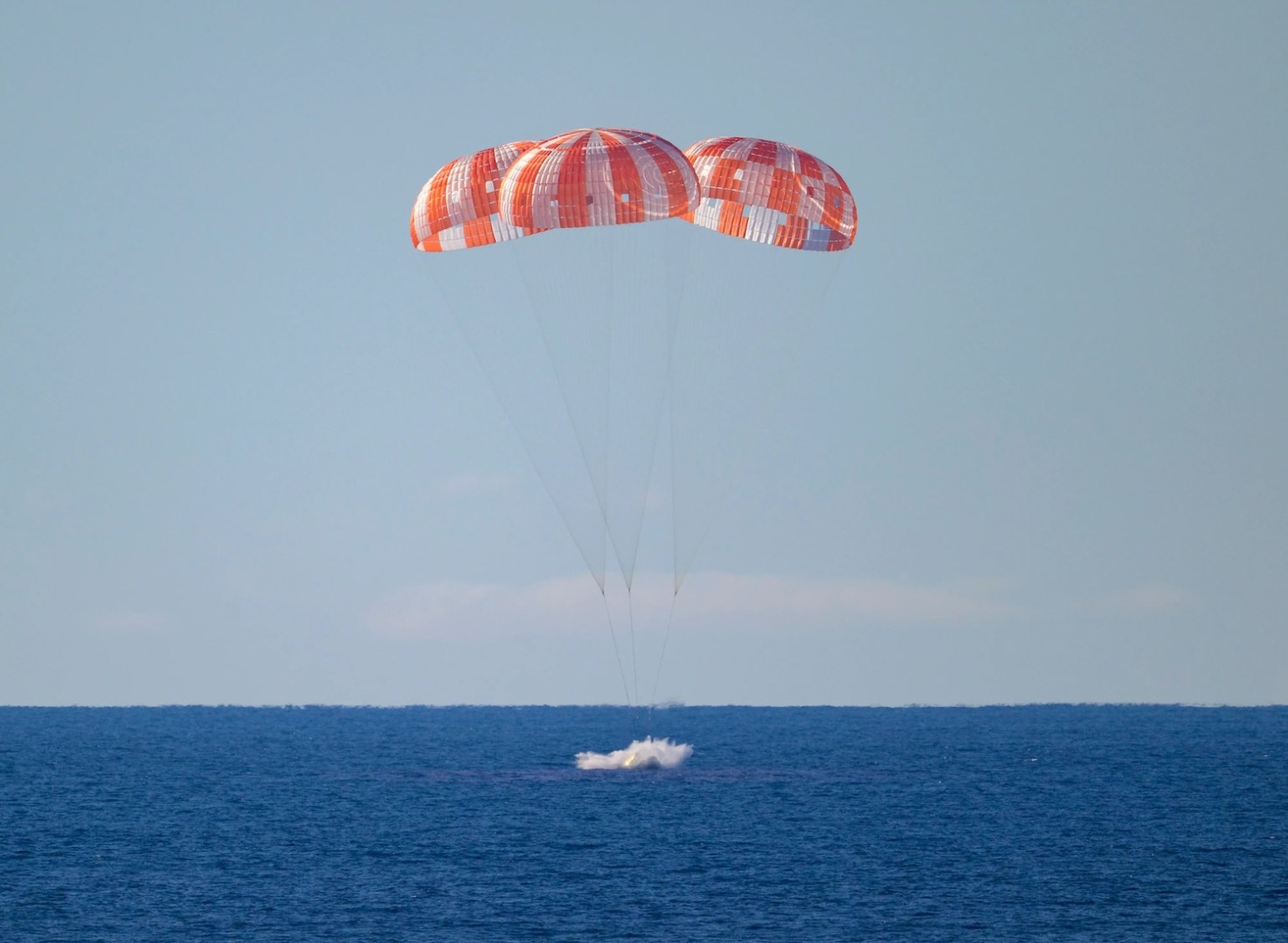 The Orion capsule splashing down after a successful mission. Source: NASA
Crucially, NASA aims to correct course and renew its culture of transparency. In an interview with IE last month, Jared Isaacman noted that NASA was entering a new era, following his outspoken criticism of previous NASA leadership.
“Human spaceflight demands that we learn from every lesson, not just the convenient ones,” Isaacman said to IE, referring to the space agency’s reclassification of the Starliner launch mishap. “Getting the record right strengthens the culture of accountability that keeps our crews safe.”
Some will still argue Artemis II was irresponsible, while others will laud NASA for its smart risk management. Either way, if Isaacman’s recent track record of delivering on his word is anything to go by, NASA will release a full no-holds-barred report on the Orion capsule’s performance in the coming months. In the same time period, it could also make important strides towards regaining the operational flexibility it once had during the Apollo era.