

What This Story Is AboutA environmental group has found that a type of air pollution in Nashville is higher than federal standards permit.Why It MattersExcess exposure to fine particles is linked to “serious and sometimes deadly illnesses,” and the EPA considers the kind over the standard in Davidson County “one of the most dangerous forms of air pollution.”What Happens NextThe groups also filed a motion asking the court to force the EPA to take action within 150 days, including by notifying states of any locales that are recommended “nonattainment,” or determined to be not meeting EPA air quality standards. For Context“EPA’s failure to implement the standard by the legal deadline puts communities at greater risk of breathing in more deadly pollution, and the stakes are particularly high for Southern communities,” said the Southern Environmental Law Center.
NASHVILLE, Tenn. (WSMV) – A collection of environmental, health and public advocacy groups has filed a lawsuit alleging the U.S. Environmental Protection Agency has failed to enforce its own air quality standards, including in Nashville.
A Tuesday press release from the Southern Environmental Law Center (SELC) says the suit, filed in U.S. District Court for the Northern District of California, specifically accuses the EPA of failing to implement heightened standards on particulate matter – or soot – pollution, under Pres. Trump’s leadership.
SELC said Tuesday that recent EPA data shows many Southern cities, including Nashville, Atlanta, Macon, Charlotte and Birmingham, are allegedly violating standards that the EPA strengthened in 2024. The group warned that levels of fine inhalable particles are in excess in Nashville. WSMV4 Investigates found that the kind of particles exceeding EPA limits are tied to serious heart and lung issues, including premature death for some people with preexisting conditions.
“The EPA’s refusal to take even basic steps to drive compliance with the 2024 soot standard leaves one of the most dangerous forms of air pollution largely unchecked, putting the health of Americans at risk. Doctors and scientists who treat patients and study air pollution have made overwhelmingly clear that soot pollution kills and sickens people. Delaying compliance and enforcement of the standard is a choice the Trump administration is making to allow preventable health harms to worsen every day. Over and over again, this administration shows what its priority is – letting polluters off the hook. We are determined to ensure that the Trump EPA complies with the law and carries out these life-saving protections against soot pollution.”
When reached by WSMV4, the EPA declined to comment.
See the full lawsuit below:
The coalition, which represents groups including CleanAIRE NC, Georgia Interfaith Power & Light, Clean Air Task Force and Earthjustice, asked the court in the lawsuit to force the EPA to take action, and in a separate filing they requested that action take place within 150 days, saying such measures are important to follow the Clean Air Act and “to protect public health.”
They want the court to require the EPA to notify states of any regions that are recommended “nonattainment,” or determined to not meet EPA air quality standards. The litigation cited a Feb. 7 deadline that was passed without any EPA designation announcements. The federal agency also did not issue any memos by Feb. 7 to notify local governments of plans to announce designations.
“EPA’s delay in promulgating designations means that the people living, working, and enjoying outdoor activities in these areas are deprived of Clean Air Act protections specifically designed to reduce particulate matter pollution and protect their health,” a court filing says.
The group also filed a separate motion asking for government intervention.
“The coalition also filed a motion for summary judgment requesting a court-ordered deadline for EPA to carry out its overdue legal requirement to designate areas that are violating the standard after missing the Clean Air Act’s February deadline,” the press release said.
See the full motion below:
Group alleges Nashville has ‘presumptively unhealthy air quality’
The environmental group flagged concerns with the most recent EPA data examining Nashville’s three-year average of PM2.5, which are defined by the EPA as “fine inhalable particles, with diameters that are generally 2.5 micrometers and smaller.”
These particles are not visible to the naked eye. The EPA says the diameter of a single human hair is about 70 micrometers on average, meaning it is 30 times larger than the absolute biggest fine particle in this category.
When looking at Davidson County’s so-called “design value” between 2022 and 2024, or its three-year average of PM2.5 concentrations during that time period, SELC says the capital county exceeds the 2024 standard max of 9.0, which “reflects presumptively unhealthy air quality.”
Below is a chart provided by SELC showing that figure for many Tennessee regions, based on EPA data.
TN County2022-2024
Design Value (µg/m3)Blount7.2Davidson9.3Dyer7.1Hamilton8.0Knox8.6Lawrence7.0Loudon6.3Madison7.6Maury6.9McMinn7.4Montgomery6.7Putnam6.7Roane7.1Shelby8.9Sullivan6.3Sumner7.5
SELC noted that Shelby and Knox counties are also teetering on the highest end of the spectrum allowed by the EPA’s standards. The activist organization also noted “no scientific study has identified a concentration below which there are no health effects — so while a design value above 9.0 means the air is presumptively unhealthy, a value below 9.0 does not mean it is healthy.”
EPA data obtained by WSMV4 also tells a story of higher-than-ideal levels of fine inhalable particles in and around Nashville.
Below is a graphic from the federal agency showing daily PM2.5 levels near Nashville, Murfreesboro and Franklin. The dark blue line shows 2025 data, the gray line shows the region’s five-year average, and the light blue shows the 24-year highs and lows.
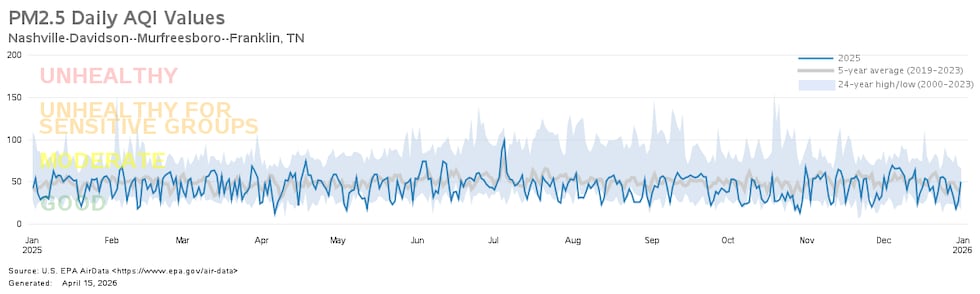 EPA data obtained by WSMV4 also tells a story of higher-than-ideal levels of fine inhalable particles in and around Nashville.(U.S. Environmental Protection Agency)
The data shows a trend of PM2.5 levels regularly entering the moderate end of the spectrum and occasionally reaching all the way into a range deemed “unhealthy for sensitive groups.”
But Nashville is not alone.
“Particle pollution can occur year-round and presents air quality problems at concentrations found in many major cities throughout the United States,” the EPA website says.
It’s most commonly found in high concentrations:
Near busy roads, in urban areas (especially during rush hour), and in industrial areasWhen there is smoke in the air from wood stoves, fireplaces, campfires, or wildfiresWhen the weather is calm, allowing air pollution to build up — for example, hot humid days with stagnant air have much higher particle concentrations than days with air partially “scrubbed” by rain or snow
Fine particles are so small that they can even penetrate homes and buildings, the EPA notes, saying “high outdoor particle pollution levels can elevate indoor particle pollution concentrations.”
 Exposure to excess particles linked to ‘serious’ heart, lung ailments
“Particle or soot pollution is one of the most dangerous forms of air pollution, and an extensive body of science links it to a range of serious and sometimes deadly illnesses,” the EPA website says when introducing the 2024 strengthened standards.
The EPA says that particulate matter can cause “serious health problems” when inhaled, and the kind reportedly found in Nashville is most dangerous.
“Some particles less than 10 micrometers in diameter can get deep into your lungs and some may even get into your bloodstream. Of these, particles less than 2.5 micrometers in diameter, also known as fine particles or PM2.5, pose the greatest risk to health,” the EPA website says.
Breathing in these particles can pose a risk to a person’s lungs and heart, per the federal agency. The EPA says many scientific studies have shown exposure is linked to a myriad of health issues, including:
premature death in people with heart or lung diseasenonfatal heart attacksirregular heartbeataggravated asthmadecreased lung functionincreased respiratory symptoms, such as irritation of the airways, coughing or difficulty breathing
Fine particles can also have negative effects on the environment, which can subsequently cause dangerous conditions for wildlife and even people.
The EPA reports that wind can carry the particles long distances, where they will ultimately settle on the ground or water. Depending on their chemical composition, the effects of this settling may include:
making lakes and streams acidicchanging the nutrient balance in coastal waters and large river basinsdepleting the nutrients in the soildamaging sensitive forests and farm cropsaffecting the diversity of ecosystemscontributing to acid rain effectsVulnerable, minority and low socioeconomic populations most likely to feel impacts
Both the SELC and EPA say that this pollution is most likely to affect historically marginalized communities or vulnerable populations.
“People with heart or lung diseases, children, older adults, minority populations, and low socioeconomic status populations are the most likely to be affected by particle pollution exposure, either because they are more sensitive or may have higher exposures,” the EPA website says.
The SELC condemned the EPA’s alleged inaction on enforcing its air quality standards, noting that “many of the hardest-hit neighborhoods are communities of color and low-income communities located near industrial facilities.”
“EPA continues to turn its back on communities who should be able to trust that a federal agency will fulfill its responsibilities and comply with legal requirements intended to make our air safe to breathe,” said SELC Senior Attorney Caroline Cress in a written statement. “As the Trump administration inflicts more harm on local communities through delay and inaction on deadly soot pollution, we are asking a federal court to hold EPA accountable to implement its own strengthened standard that will save thousands of lives.”
 (MGN)What protective action is the EPA taking?
When reached by WSMV4 with questions about the possible health impacts on Middle Tennesseans, steps the EPA has taken to enforce its regulations and a response to the litigations and accusations listed therein, an EPA spokesperson sent an email with the following comment:
“In keeping with a longstanding practice, EPA does not comment on current or pending litigation.”
The Clean Air Act requires the EPA to set National Ambient Air Quality Standards (NAAQS) for six “criteria pollutants,” including particle pollution.
“EPA works with partners at state, local, and tribal air quality agencies to meet these standards,” the federal website says.
What can you do to stay healthy?
The EPA advises people to monitor their local Air Quality Index on a daily basis, which can be done by clicking here.
“Every day the Air Quality Index (AQI) tells you how clean or polluted your outdoor air is, along with associated health effects that may be of concern,” the EPA says. “The AQI translates air quality data into numbers and colors that help people understand when to take action to protect their health.”
You can also sign up for AQI notifications by clicking here.
The Air Quality Flag Program also works to notify communities of harmful conditions.
Copyright 2025 WSMV. All rights reserved.