
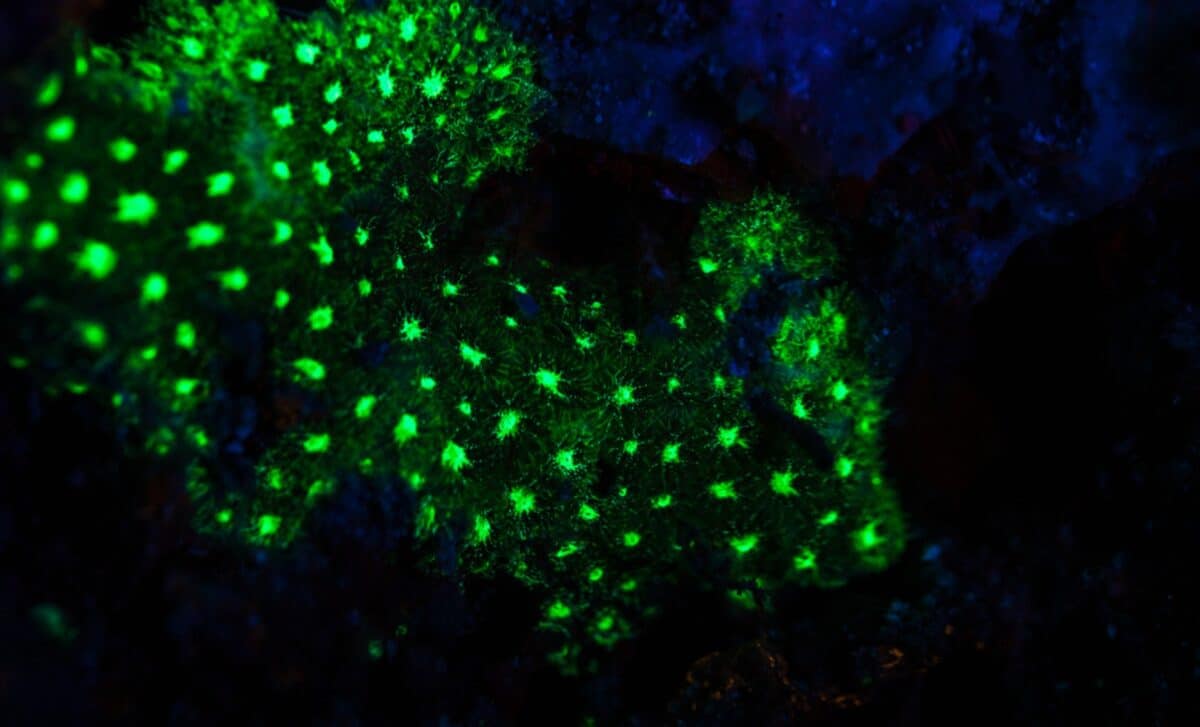
A remotely operated vehicle exploring a dark limestone cave 385 meters beneath the ocean surface near a remote Japanese island captured a flash of brilliant green light when its mechanical arm brushed against an unfamiliar coral colony. That brief flicker has led scientists to formally describe a new species of bioluminescent coral, Corallizoanthus aureus, whose light appears only when touched and which may use its glow as a biological alarm system.
The discovery occurred in May 2024 during a dive conducted by the Japan Agency for Marine-Earth Science and Technology, known as JAMSTEC. The exploration targeted the submerged karst caves surrounding Minamidaito Island, a small landmass located approximately 360 kilometers east of Okinawa in the Pacific Ocean. The steep limestone cliffs that ring the island extend underwater, creating a network of inaccessible pockets and tunnels that have remained largely unexplored due to the difficulty of traditional sampling methods.
The research team deployed a remotely operated vehicle to navigate the treacherous vertical terrain. At a depth of 385 meters, the vehicle encountered colonies of precious corals belonging to the genus Pleurocorallium. Attached to these corals were clusters of a small, bright yellow organism that had never been scientifically documented. When the vehicle’s manipulator arm made contact with the polyps, they responded not with a constant glow but with a distinct blinking green light. The rest of the connecting tissue between polyps remained dark, confining the bioluminescence strictly to the living tentacles.
Corallizoanthus aureus Morphology and Classification
The newly described species belongs to the order Zoantharia, a group of cnidarians related to sea anemones and stony corals. Corallizoanthus aureus possesses between 24 and 26 tentacles, a morphological trait that helps distinguish it from its closest known relative, Corallizoanthus tsukaharai. The specific epithet aureus refers to the organism’s vivid yellow coloration.
The species exhibits a specialized lifestyle as an epibiont, meaning it lives attached exclusively to other organisms. In this case, researchers found Corallizoanthus aureus only on corals of the genus Pleurocorallium. Its marginal musculature, the muscle structure surrounding the oral disc, differs from that of closely related species, providing additional anatomical evidence for its classification as a distinct species.
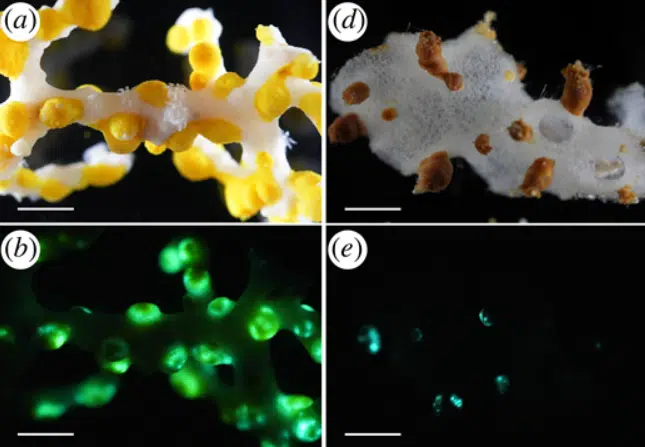 Photograph showing the new species, Corallizoanthus aureus sp. nov. (a–c) and Churabana kuroshioae (d–f). Image credit: Hiroki Kise et al. Royal Society Open Science
The study, published in the journal Royal Society Open Science, documented that the bioluminescent peak occurs at approximately 515 nanometers, which falls within the green portion of the visible spectrum. Laboratory analysis aboard the JAMSTEC research vessel and subsequent in-situ observations using light-sensitive cameras confirmed that the light emission is not spontaneous. The coral requires mechanical or chemical stimulation to trigger its flash response.
Bioluminescence Mechanism and Absence of Bacterial Symbionts
Researchers investigating the source of the green light ruled out several common explanations for marine bioluminescence. The coral showed no fluorescence under ultraviolet light, eliminating the possibility that the glow resulted from fluorescent proteins re-emitting absorbed light. Examination of the tissue revealed no evidence of symbiotic bioluminescent bacteria living within the coral.
These findings point toward an intrinsic biochemical pathway. Scientists suspect that Corallizoanthus aureus produces its light using a luciferin compound, most likely coelenterazine, which is widely distributed among bioluminescent marine organisms including jellyfish, copepods, and certain deep-sea fish.
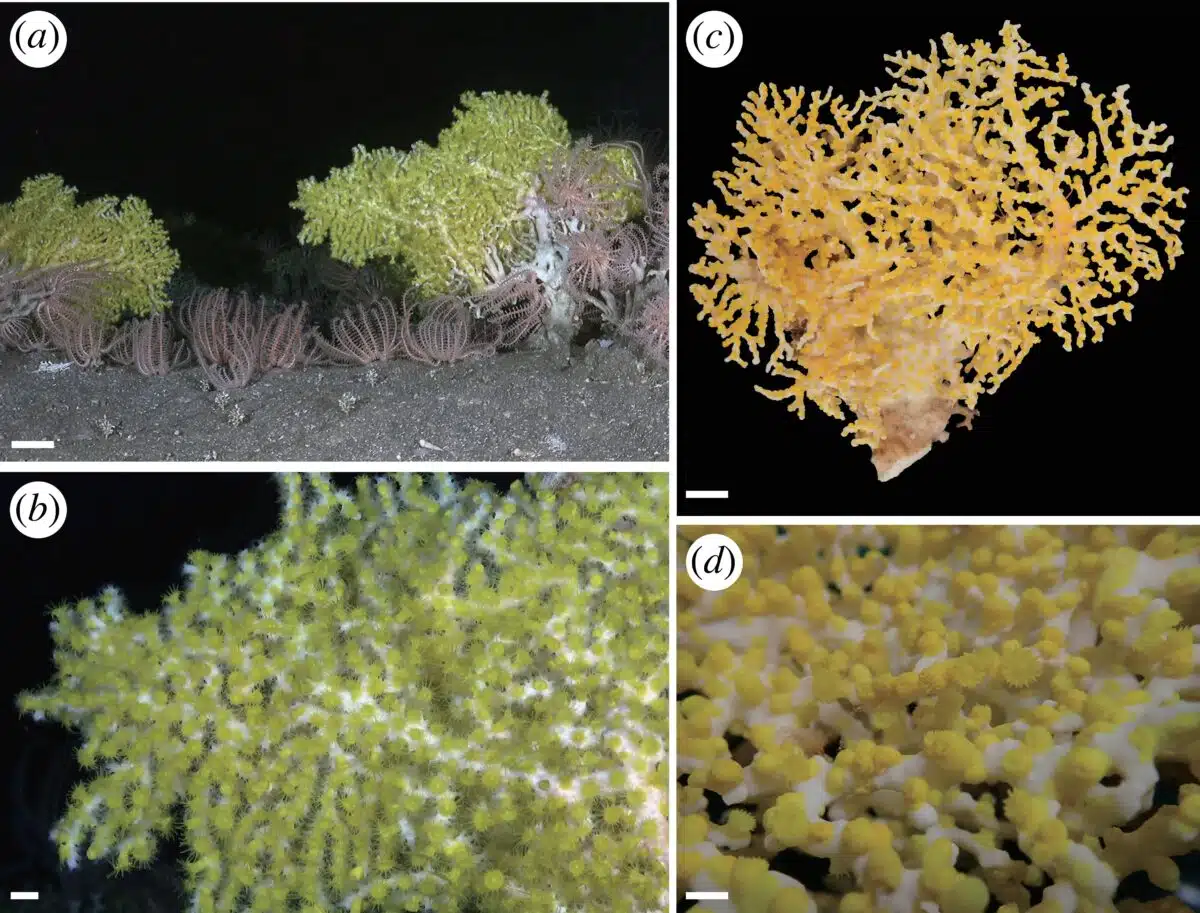 Images of external morphology of Corallizoanthus aureus sp. nov. In situ image (a), close-up in situ polyps (b), relaxed specimen (c) and close-up relaxed specimen (d). Image credit: Hiroki Kise et al. Royal Society Open Science
In a typical coelenterazine-based system, the molecule reacts with oxygen in the presence of a luciferase enzyme to produce light. The precise trigger mechanism that links physical contact to the activation of this chemical pathway in Corallizoanthus aureus remains under investigation.
The localized nature of the light emission, appearing only in the polyp tentacles rather than the connecting stolon tissue, suggests that the light-producing cells or organelles are concentrated in specific anatomical regions. This spatial restriction may reflect an evolutionary optimization for the coral’s presumed defensive strategy.
The Burglar Alarm Hypothesis and Ecological Function
The observation that Corallizoanthus aureus only illuminates upon contact aligns with a long-standing theory in marine biology known as the burglar alarm hypothesis. First articulated by researcher Burkenroad in the 1940s, the hypothesis proposes that small prey organisms can use bioluminescence to summon larger predators when attacked.
In this scenario, a small predator attempting to consume the coral polyps would trigger the green flash. The sudden light display could attract secondary predators such as larger fish or crustaceans to the location. These newcomers would then prey upon or drive away the initial attacker, providing an indirect defense for the coral. While the hypothesis offers a compelling explanation for the observed behavior, direct field observations of this predator chain reaction occurring in the deep sea cave environment are still needed.
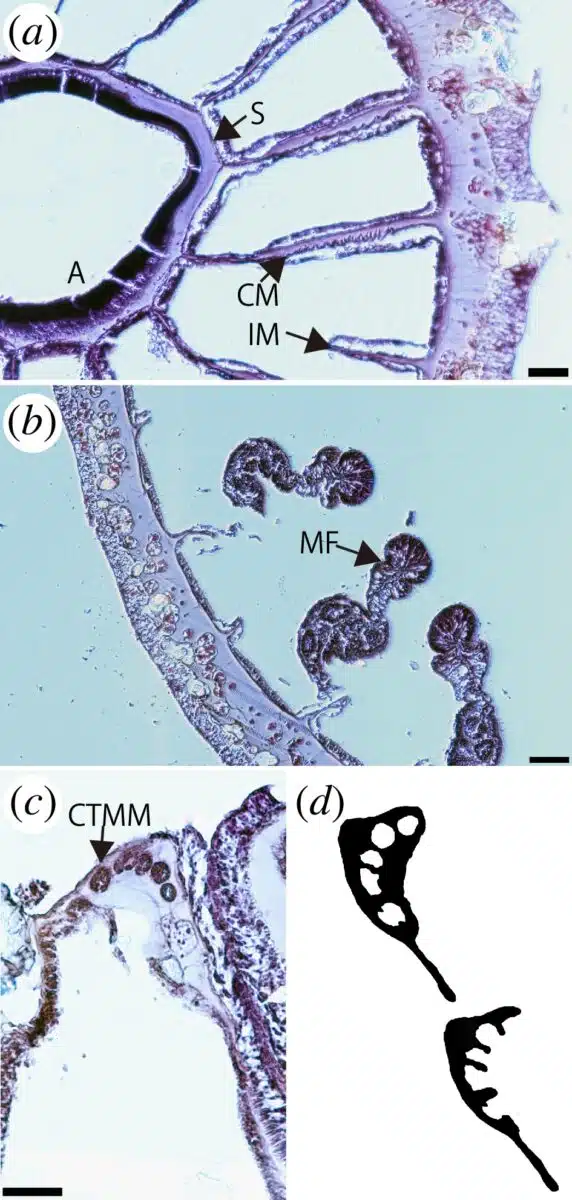 Images of internal morphology of Corallizoanthus aureus sp. nov. Transverse section at the level of the actinopharynx (a) and mesenterial filaments (b), close-up image of cyclically transitional marginal musculature (c), and illustration of cyclically transitional marginal musculature (d). Image credit: Hiroki Kise et al. Royal Society Open Science
The findings represent the first documented case of bioluminescence observed within a deep-sea cave ecosystem. Previous reports of glowing marine life have largely come from open ocean environments, pelagic zones, or shallow reef systems. The cave setting introduces unique environmental conditions including limited water circulation, reduced food availability, and permanent darkness, which may have shaped the evolution of this particular defensive adaptation.
Deep Sea Cave Exploration Expands Known Biodiversity
The Minamidaito Island caves exemplify a broader category of underexplored marine habitats that scientists believe harbor substantial undiscovered biodiversity. Submerged karst formations, created by the dissolution of soluble rocks like limestone, produce complex three-dimensional mazes of chambers and passages that are difficult to access using conventional submersibles or diving equipment.
The research team’s use of a maneuverable remotely operated vehicle allowed them to examine vertical cliff faces and narrow cave entrances that would otherwise remain beyond reach. The discovery of Corallizoanthus aureus demonstrates the value of deploying specialized exploration technologies in geologically complex underwater environments.
The study’s authors suggest that bioluminescence should be incorporated more systematically into the taxonomic descriptions of new species. The presence of a light-producing capability can serve as both an ecological marker and a diagnostic characteristic for identification purposes. As exploration of deep-sea caves and other cryptic habitats continues, researchers anticipate that additional bioluminescent species will come to light.