
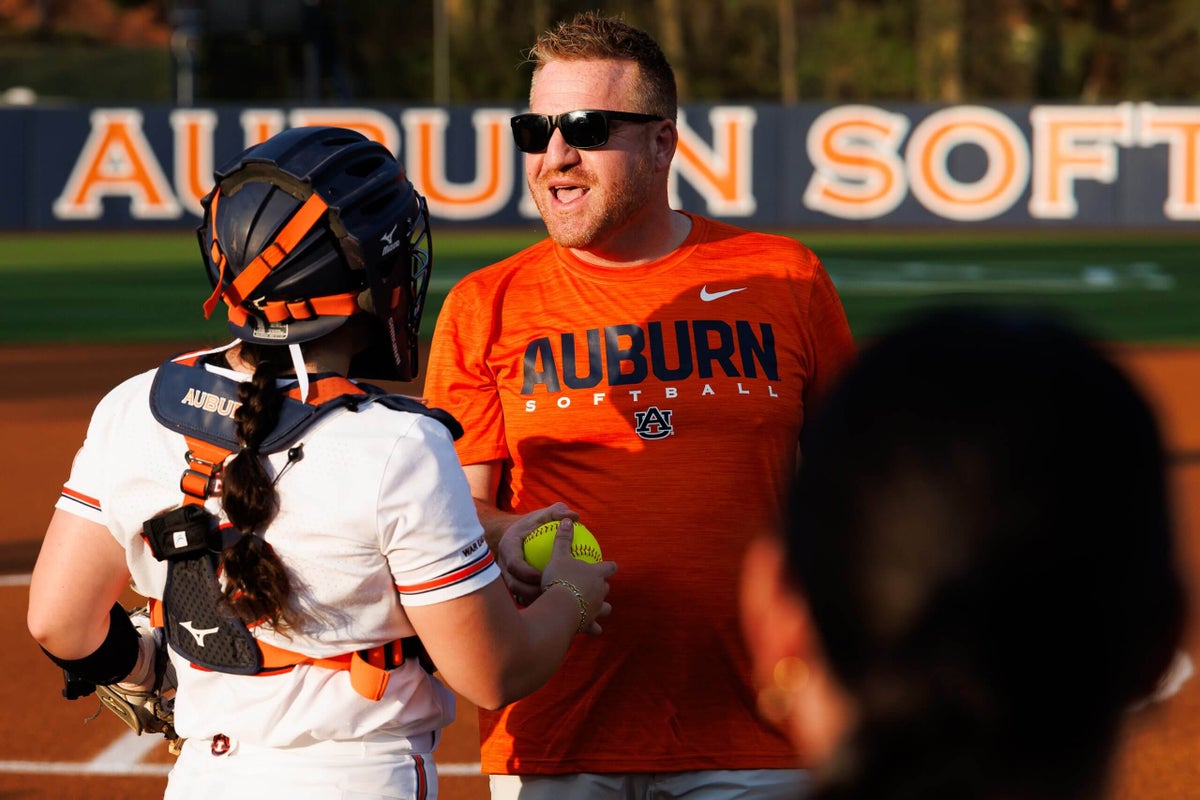
AUBURN, Ala. — The life of Alex Golesh, the very American and very deep South life of Alex Golesh, took him to the pitching mound one recent day. The ceremonial duties of the first pitch at an Auburn softball game. The crowd cheered. Golesh smiled, waved and walked off the mound, soaking in another hearty welcome to Auburn’s new head football coach.
Then he heard it. It took a few beats for his brain to catch up to what he was hearing.
Ya A sobiralsya zaglyanut’ k vam v ofis. No ne khotel pokazat’sya nevezhlivym.
It’s rare these days, even with family, for Golesh to hear his native Russian tongue. So he stared silently at the source of the words, an Auburn swimmer who was telling Golesh — in Russian — that she was excited to meet him, had wanted to stop by his office but thought it would be rude.
Golesh’s brain caught up. He switched from English to Russian. He was once again, for a moment, the Muscovite who had never heard of American football, comparing notes with a young woman from the far reaches of their homeland.
“Are you really from Siberia?” Golesh asked, in Russian. “I don’t think I’ve ever met anybody from Siberia. How do you like Auburn?”
“It’s really small,” she answered.
“You’re from Siberia!”
“The town I’m from has a million people.”
After a bit more small talk, they parted, and Golesh returned to his very American life. One that’s been about hope, hard work, and now riches, fame and pressure.
The Auburn football program, winner of the 2010 national championship, proud and tradition-laden, has had five straight losing seasons. It is desperate to return to national relevancy. And it has entrusted its fate to a Russian immigrant who didn’t play college football, and had never stepped foot on Auburn’s campus until a few months ago.
Auburn football and Golesh finding each other is as unlikely a story as there can be.
The Golesh family — Vladimir, Bella and their sons Eugene, 10, and Aleksay, 7 — left Moscow in September 1991, amid the dissolution of the Soviet Union. They left behind a middle-class lifestyle for New York City, with no jobs and no ability to speak English. Vladimir took a job driving a truck, Bella cleaned houses. The boys joined schools that included some other Russian immigrants, and took English as a Second Language classes.
Aleksay, soon shortening his name to Americanize it, also discovered a purely American sport.
The other kids at P.S. 48 would play football with a Nerf ball. Alex was an aggressive kid, and loved this new sport where you could tackle people.
“I remember the only thing I never asked for, we didn’t have any money at all, but I’d always ask for a Nerf ball, like, every Christmas, every birthday,” Golesh said. “I wanted a Nerf ball because you all show up, and whoever had the coolest Nerf ball, that’s who you’re playing with. Those are the first memories I have.”
His parents sent him to a summer day camp, and one of the sessions was football, taught by a coach at the U.S. Merchant Marine Academy. The coach took to Golesh and invited him to be a ball boy for the team, so for a couple of years, Golesh’s father drove him to games and practices.
The family eventually moved to Dublin, Ohio, where Alex was a letterwinner, but not a star, for the high school football team. He enrolled at Ohio State, a regular student at the football powerhouse, and after coaching at a local high school — while only a sophomore — he hooked on to Jim Tressel’s program as a student assistant. From there, it was a slow rise up the coaching ladder as an offensive assistant, with jobs at Northern Illinois, Oklahoma State, Toledo, Illinois, Iowa State, UCF and Tennessee.
His now very American career journey landed him as the head coach at South Florida in 2023, taking over a program that was 1-11. His new players knew nothing about him, just that he had been the play caller at Tennessee. He had never been a head coach, hadn’t been a college player.
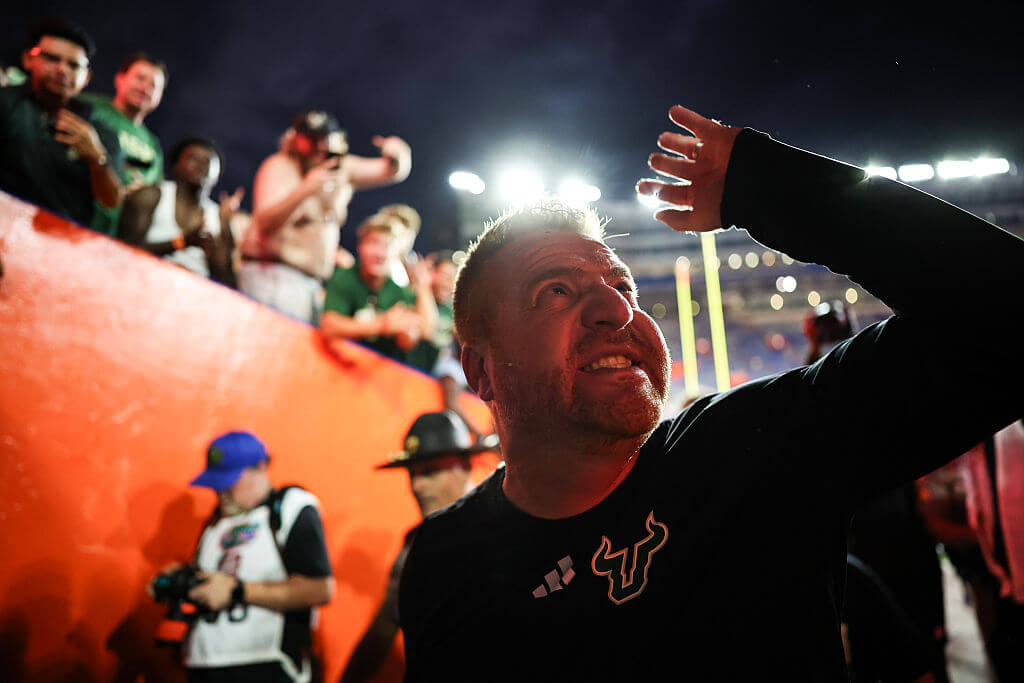
Alex Golesh celebrates after leading USF over Florida last fall. (James Gilbert / Getty Images)
“He came in and was like, you know, you guys have no reason to trust me. You have no reason to believe in me,” then-South Florida center Cole Best recalled. “He was very real off the bat. Said, I haven’t done anything to earn your trust. But all I’m asking of you is some blind faith. And that really stuck with me.”
Golesh guided the Bulls to three straight winning seasons, including an upset of Florida that put him firmly on the radar for a big-time coaching job.
But one already had its eye on Golesh.
Auburn athletic director John Cohen looked at Golesh in 2022, impressed by what he had done guiding Tennessee’s offense, and his ability to relate to players in different parts of the country. But Cohen wanted head coaching experience so he hired Hugh Freeze. Instead of the offensive mastermind from his Ole Miss and Liberty days, Auburn got a Freeze who couldn’t score many points and made headlines for golfing a lot.
This time Cohen’s search landed on Golesh. He retained defensive coordinator D.J. Durkin, whose unit was the strength of the team. And then Golesh followed the model Curt Cignetti popularized when he went from James Madison to Indiana: He brought many of his players from South Florida. Bell, quarterback Byrum Brown and 11 others, the fourth-most among power-conference schools this cycle. Golesh also brought his strength staff.
“It was a bit different at first. You’re coming in and see the same faces, just everyone’s in different colors,” Brown said.
That could create tension in the building, as Golesh knew, so he made sure the players who came with him were capable of playing at the SEC level.
“I knew coming here, if we can have guys in the locker room help shift that mindset and if nothing else, co-sign what was going on from a message standpoint, from the staff, you can accelerate the process,” Golesh said. “But the only way that was ever going to work, was if they were actually good players.”
It also helped that Auburn, after five losing seasons, is at about the same desperation level Indiana was at when Cignetti arrived. That’s why it hired Freeze, despite his baggage. And while the hire of Golesh is similar to Bryan Harsin — an outsider, Group of 6 head coach who flamed out at Auburn in just two seasons — what drew Cohen to Golesh was more strategic.
Hiring Golesh, along with his quarterback, center and other offensive pieces, gives Auburn a chance to win right away, and perhaps take advantage of a window when arch-rival Alabama is slipping.
“I know things don’t happen overnight, and you have to build your own culture. But I like where we are, and I feel like Alex is a great fit here,” Cohen said.
Golesh also infused an energy that was much needed, along with a level of detail.
“There’s way more structure now,” said Rayshawn Pleasant, a senior cornerback and kick returner. “We actually have a standard that everybody’s after. It’s not a choice that you want to do it. It’s something that you have to do. And I feel like that’s in this day and age of the football, I feel like that’s the most important thing for success.
“Like we just saw at Indiana: They have like the 100th-some talent roster rank on paper. But they end up winning the national championship. It’s because it’s about the stuff that’s off the field.”
Golesh has plastered around the building his favorite phrase: “Be who you say you are.” If you say you’re a great athlete, be that. If you say you’re a hard worker, be that. And so on. Golesh has been at places where too many motivational phrases are thrown at players. (“S— on the wall,” he called it.) So Golesh tries to keep it simple with just one clear, concise motto.
“And we laid it out and actually define what it is. And now is actually on the wall,” Golesh said, then smiled as he added: “S— on the wall.”
None of this, of course, ensures that Auburn will return to glory, that in Golesh it has the next Cignetti. But one optimistic person is Pleasant, the defensive back, who himself transferred from Tulane to Auburn before last season. After playing one season in the SEC, Pleasant thinks there’s little to no difference between the G6 and power-conference in offensive skill positions and defensive skill positions.
“The only difference is the inside, in the trenches. That is the only thing that’s different,” Pleasant said. “But I feel like us already having people here in the trenches and them being and getting guys out the portal, I feel like we was doing the same thing as far as Cignetti.”
Cignetti, of course, won at multiple stops before Indiana. Golesh went 23-16 at South Florida. So time will tell if Golesh is something special as a coach.
As a story, though, it’s certain.
Golesh has no trace of a Russian accent, because you can learn a language before a certain point, usually around puberty, and sound like a native. His family became U.S. citizens when he was around 11, and he hasn’t been back to Russia. His brother became successful in the business world. Alex Golesh signed a contract with Auburn that guarantees him at least $44.25 million over the next six years.
Pretty good for a kid from Moscow.
“The more that like we learn about him,” Bell said, “The more cool that his story gets.”