
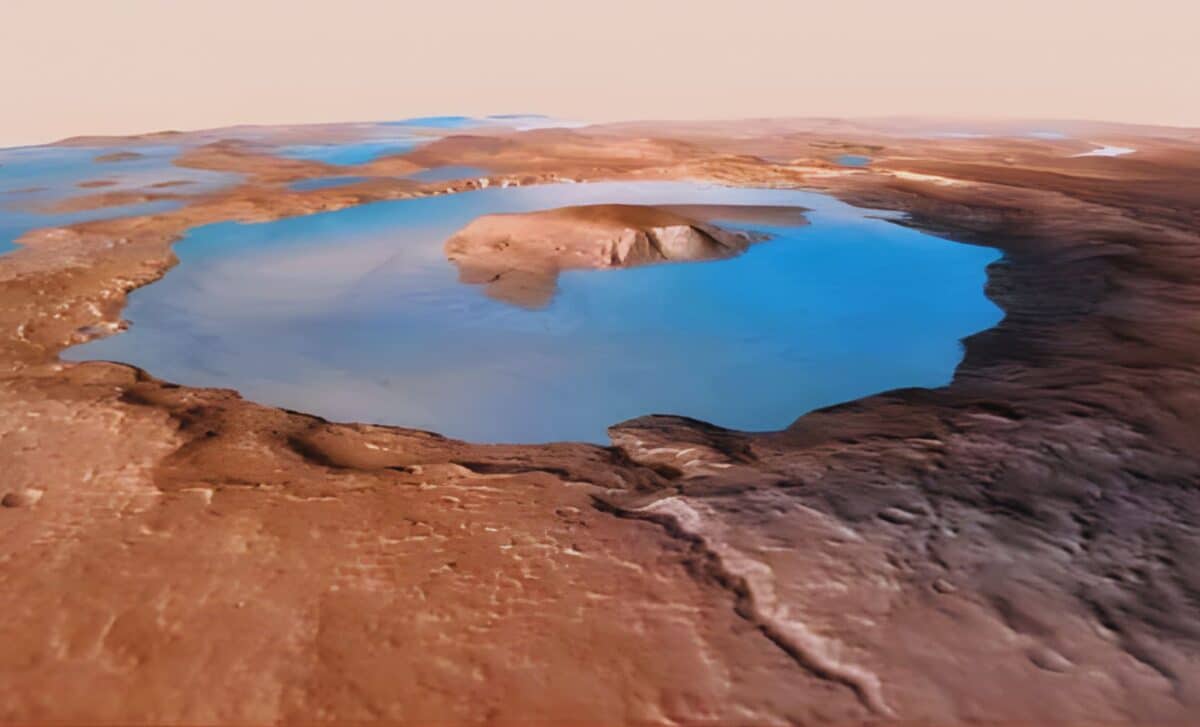
New research has revealed a feature on Mars that could confirm the planet once had an ocean. Scientists have identified what they believe is Mars’ version of a continental shelf, a stable geological feature that points to a large, long-lasting ocean.
Mars’ northern hemisphere has long been thought to be a likely spot for an ancient ocean, mainly because it’s lower in elevation and has fewer craters than the southern hemisphere.
But proving the existence of a shoreline has been tricky, as previous evidence didn’t match up and was hard to interpret. Instead of focusing on shifting shorelines, scientists decided to look at a more stable feature: the coastal shelf.
What’s Happening to Our Shorelines?
Shorelines have often been used as signs of ancient oceans, but they’re not always reliable. Dr. Abdallah Zaki, now at the University of Texas at Austin, explained that shorelines change over time due to things like geological activity and tidal movements.
“If people really want to search for oceans, they shouldn’t look for shorelines because they are not really good indicators. They move really fast, and that’s why they’re not even indicators of [ancient] lakes on Earth,” he said.
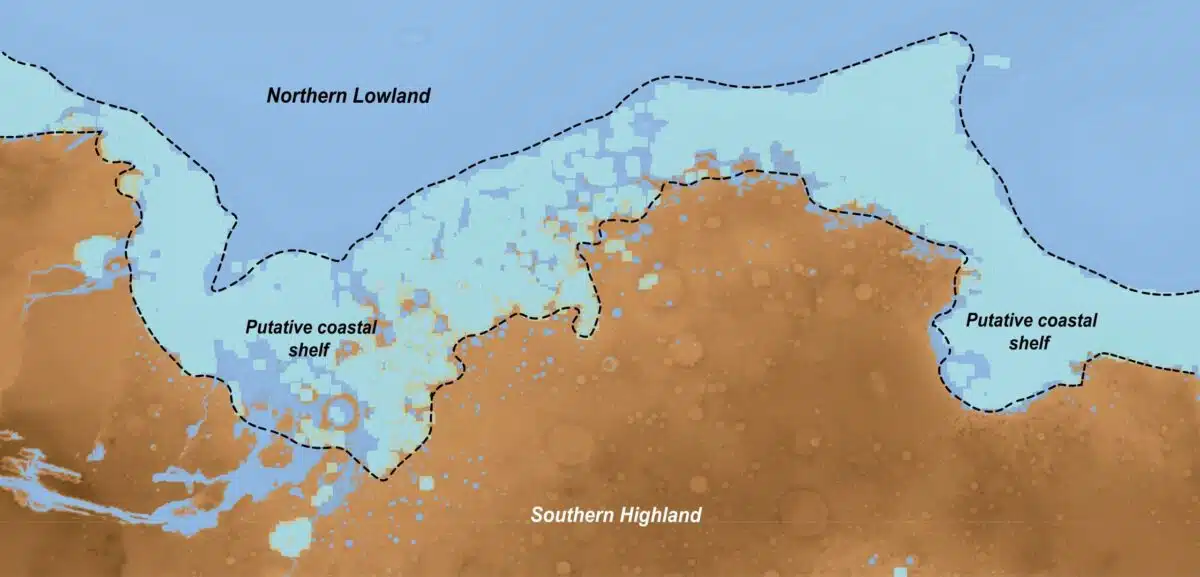 This map shows the possible location of an ancient coastal shelf on Mars. Credit: Caltech/A. Zaki
Because of this, they don’t always reflect ancient bodies of water accurately. On Earth, the continental shelf, an area of the seabed that’s shallow and stable, has been a much more reliable indicator of long-lasting oceans. Dr. Zaki, who used to work at Caltech, along with his supervisor Professor Michael Lamb, applied this idea to Mars.
“If Mars did have an ocean, it dried up a long time ago — possibly several billion years ago, more than half of the age of the planet itself,” Lamb explained in a university statement. “There is hardly anything on Earth that is that old; anything on Mars from that time has been eroded by billions of years of wind blowing, volcanoes erupting, and other disturbances removing subtle features. We wanted to find a better topographic feature than shorelines that could be evidence for an ocean.”
The Red Planet’s Mysterious Shoreline
By analyzing Mars’ topography, the researchers found a region in the northern hemisphere that looked similar to Earth’s continental shelf. This area has gentle slopes and low curvature, suggesting that an ocean might have existed there in the distant past.
“Within the zone that has low values of slopes and curvature, we found evidence of coastal deposits, deltas, and depositional rivers. This is common. You see, actually, the continental shelf [on Earth] has all these: it has deltas, it has coastal deposits, and it has some flowing deposits bloomed from the rivers globally.”
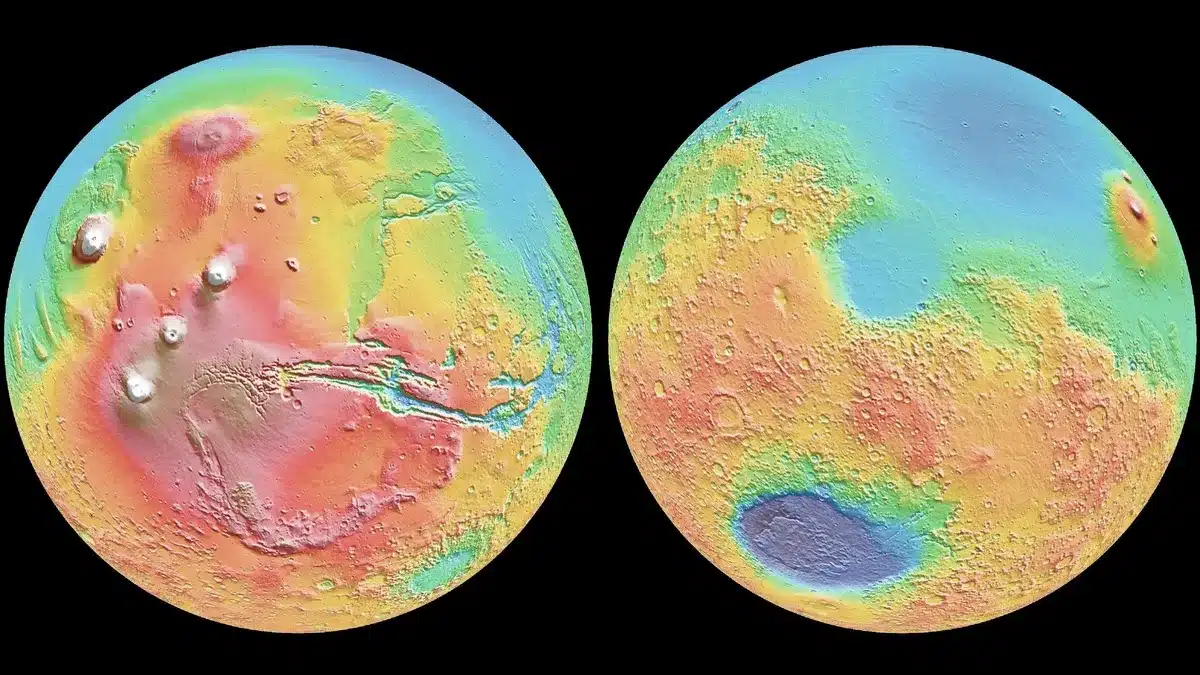 This topographic map of Mars shows its varying elevations, with red areas representing higher elevations and blue indicating lower regions. Credit: NASA/JPL
Unlike Earth, the Red Planet does not have tectonic plates, meaning its surface doesn’t shift in the same way. This makes the newly discovered shelf on the Red Planet particularly stable, and it’s likely that it hasn’t changed much over time. The presence of this shelf suggests that Mars could have had an ocean that lasted for millions of years, long enough to potentially support life.
Could Mars Be Our Next Home?
The study, published in Nature, focused on stable features like the coastal shelf as a better way to search for signs of ancient life on Mars. This new method could help scientists more accurately identify past water bodies and, potentially, find places where life might have existed.
“It’s a strong additional piece of evidence supporting a northern ocean on Mars,” Zaki stated, “but there’s plenty of follow-up work to be done for rovers to examine deposits and for further analysis of satellite data.”
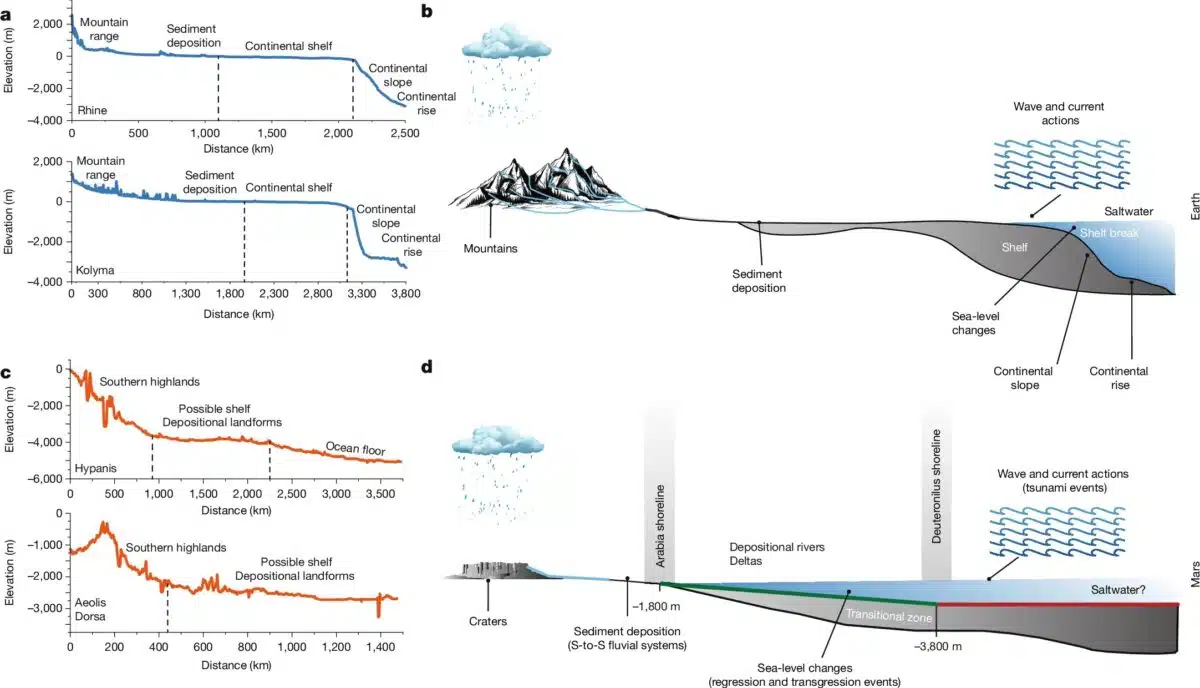 This image compares the topography of Earth’s continental shelf (top) with potential Martian coastal features (bottom). Credit: Nature
This coastal shelf could be a prime spot for future missions hoping to uncover Mars’ past, and find out if life ever existed there.