
Deep beneath Tuscany, Italy, scientists have uncovered a massive magma reservoir that has been lying dormant without anyone noticing. This discovery reveals an enormous magmatic system hiding beneath the region, comparable in size to those found beneath supervolcanoes like Yellowstone. Led by the University of Geneva and several Italian institutions, the study relied on data collected from a network of seismometers that mapped the subsurface of Tuscany.
A Geothermally Active Region Full of Surprises
Tuscany has long been known for its geothermal activity, with hot springs and thermal phenomena that attract researchers. But what scientists discovered beneath the region was far beyond what they expected. According to Matteo Lupi, the lead researcher of the study, the size of the magma reservoir was a complete surprise.
“We knew that this region, which extends from north to south across Tuscany, is geothermally active, but we did not realize it contained such a large volume of magma, comparable to that of supervolcanic systems such as Yellowstone,” as mentioned in the release.
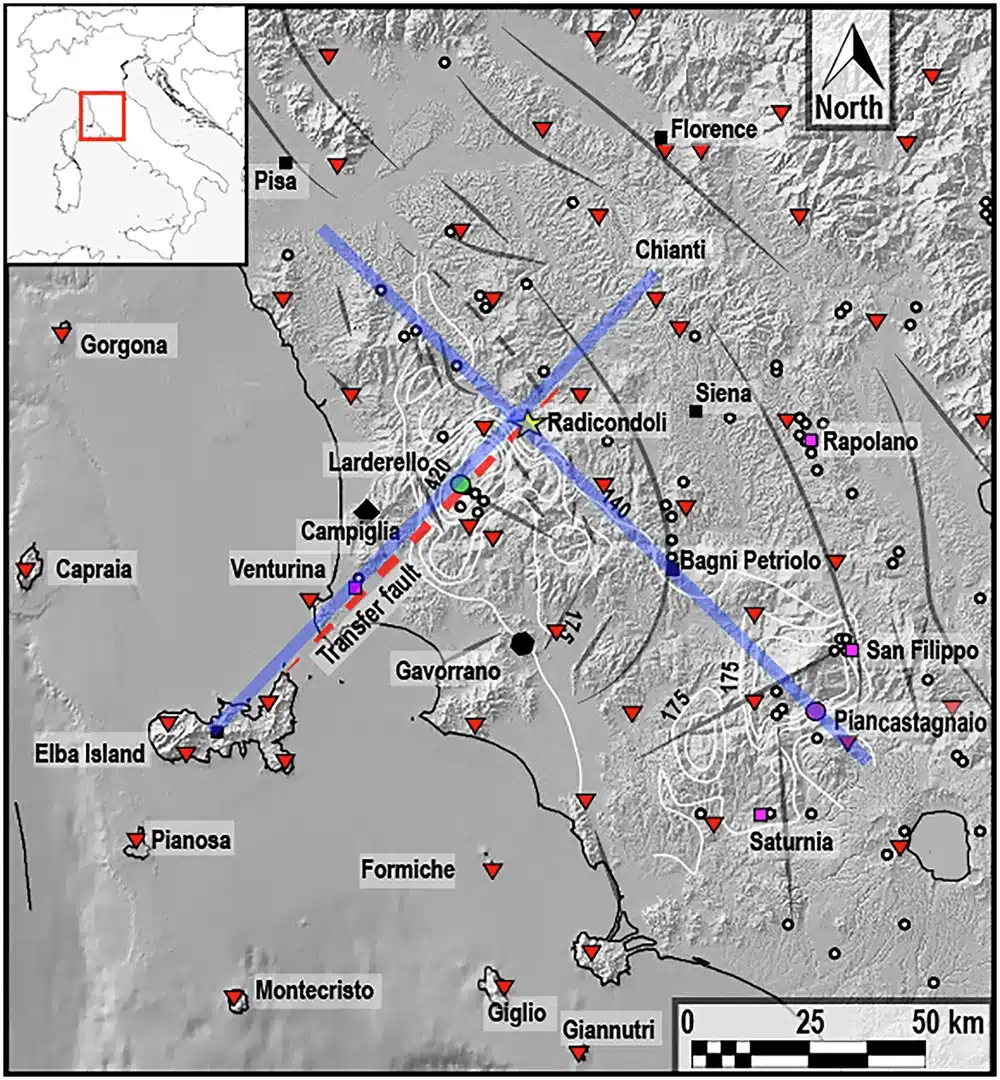 Map of Tuscany showing geothermal sites and fault lines, including the Transfer Fault. Credit: Communications earth & environment
But unlike these volcanoes, there are no visible signs of explosive activity. This geological silence is particularly striking given the enormous amount of magma hiding underground.
How Seismometers Uncovered a Hidden Secret
As mentioned in the the study published in Communications Earth & Environment, to uncover this hidden reservoir, the team used seismometers; devices that send waves through the Earth to create detailed maps of its subsurface. This technology allowed them to “see” beneath the surface and model the Earth’s crust up to a depth of 15 kilometers. The resulting data revealed a vast magma network buried deep within the region.
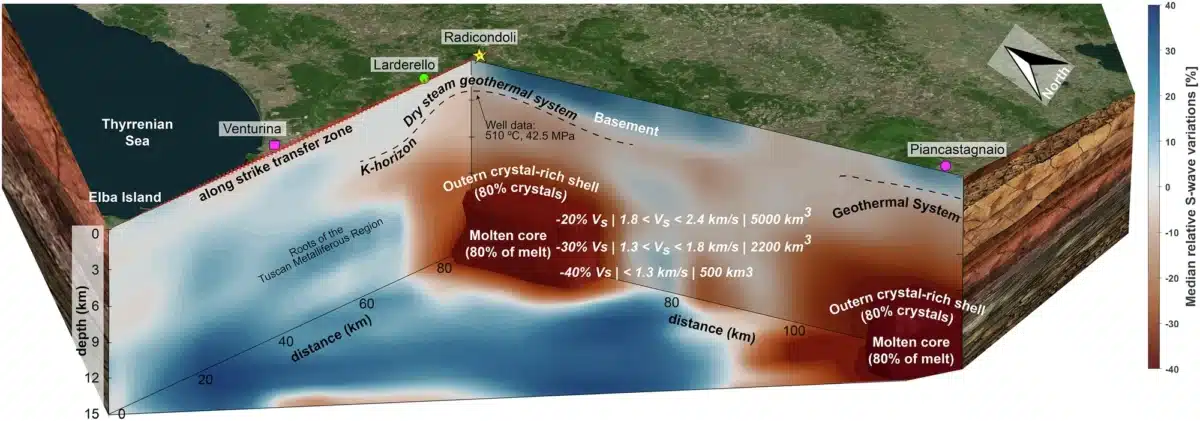 A simplified conceptual model representing the Tuscan Magmatic Province. Credit: Communications Earth & Environment
This technology, which allows for quick and low-cost exploration of the Earth’s interior, could have applications far beyond volcanology. The same methods could be used to locate geothermal reservoirs or even deposits of lithium and rare earth elements.
“These results are important both for fundamental research and for practical applications, such as locating geothermal reservoirs or deposits rich in lithium and rare earth elements, which are used, for example, in electric vehicle batteries.”
Why Hasn’t This Magma Erupted?
Perhaps the most intriguing aspect of this discovery is the fact that such a large volume of magma hasn’t resulted in any eruptions. Why has this magma remained dormant for so long? As explained by the study’s authors, this is a mystery that remains unsolved.
“The reason why this large amount of melt never gave rise to eruptions is enigmatic and debated,” they said.
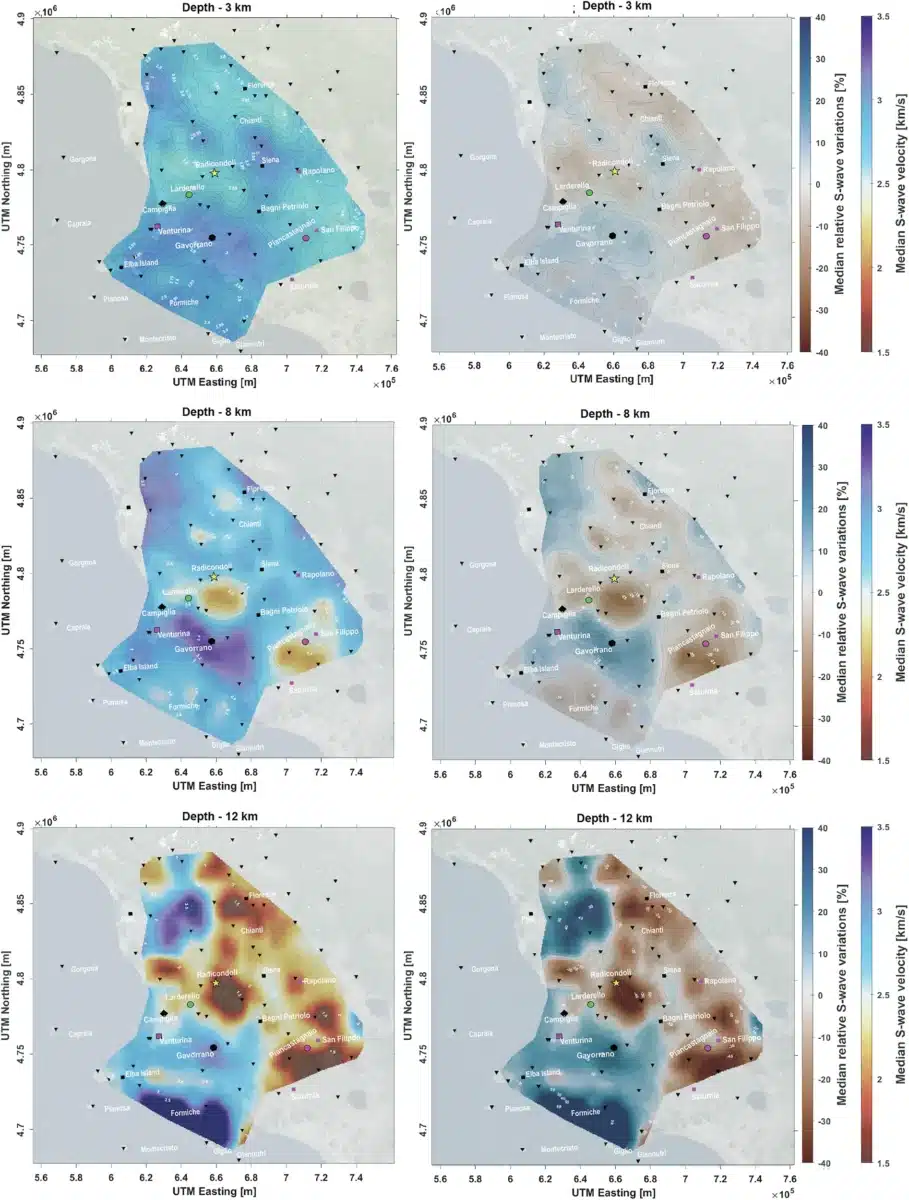 Seismic wave velocity variations at depths of 3 km, 8 km, and 12 km beneath Tuscany. Credit: Communications earth & environment
Research like this, which helps explain why some magma reservoirs remain inactive while others lead to violent eruptions, could assist scientists in better predicting volcanic activity around the world. The authors concluded by saying:
“Such partial melts may help understand the long-term evolutionary processes taking place at volcanic systems that featured super-eruptions and in regional-scale high-enthalpy systems that have not (yet?) erupted.”