
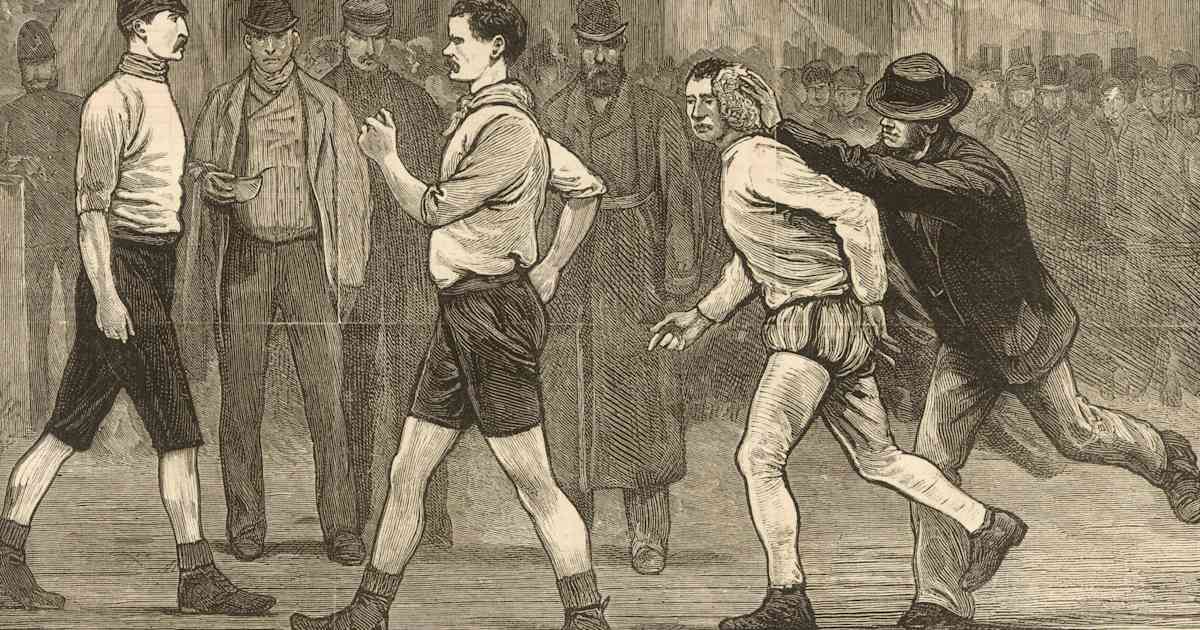
Pedestrianism’s Golden Age as the People’s Sport
The crowds reflected the sport’s wide appeal. Factory workers, clerks and dockhands rubbed shoulders with society gentlemen and gamblers. Women became involved, both as enthusiastic spectators and as competitors. “The pedestrian mania has proved that women can walk,” boasted the Philadelphia Chronicle in 1879. “Married men will remember this when their wives ask them to carry their babies.”
Weston’s own success inspired a wave of challengers, many of whom became celebrities in their own right. “The first great race was between Weston and an Irish immigrant named Daniel O’Leary,” says Algeo.
In 1874, O’Leary stunned crowds by beating Weston in a six-day contest. Other competitors soon joined the circuit, such as Charles Rowell of England, known for his steady pace and iron discipline, and Frank Hart, a Black athlete from Boston. In 1880, Hart walked 565 miles in six days, a performance that won him not just prize money but nationwide acclaim.
The sport reached its height in the 1870s and 1880s with the creation of the Astley Belt races. Sir John Astley, a British sports promoter known as the “Sporting Colonel,” sponsored a series of international competitions to crown the world’s best pedestrian. The Astley Belt races brought together top competitors from around the world. They were held first in London’s Agricultural Hall and later in New York City’s Madison Square Garden.
Pedestrianism Popularity Fades
“Betting elevated the drama and stakes,” says Fleeman. “Spectators bet on everything, not just who would win, but who might drop out, who would collapse, even who might vomit first. Athletes often wagered on themselves.” But with that excitement came volatility. Scandals over race-fixing, heavy drinking among competitors and unruly crowds began to tarnish pedestrianism’s reputation. What once thrilled audiences now felt repetitive, as walkers circled indoor tracks for days on end.
By the late 1880s, the sport’s popularity was waning. Faster, flashier entertainments emerged, bicycles captured the imagination and newly organized team sports like baseball and football offered clearer winners and livelier action. The rise of the Olympic movement, with its emphasis on purity and prestige over prize money, also challenged pedestrianism’s seedy reputation. Even so, race walking has been part of the Summer Olympics since 1904.
And while the sport itself has largely faded, its legacy lingers. In many ways, pedestrianism walked so modern sports like the ultramarathon could run.