
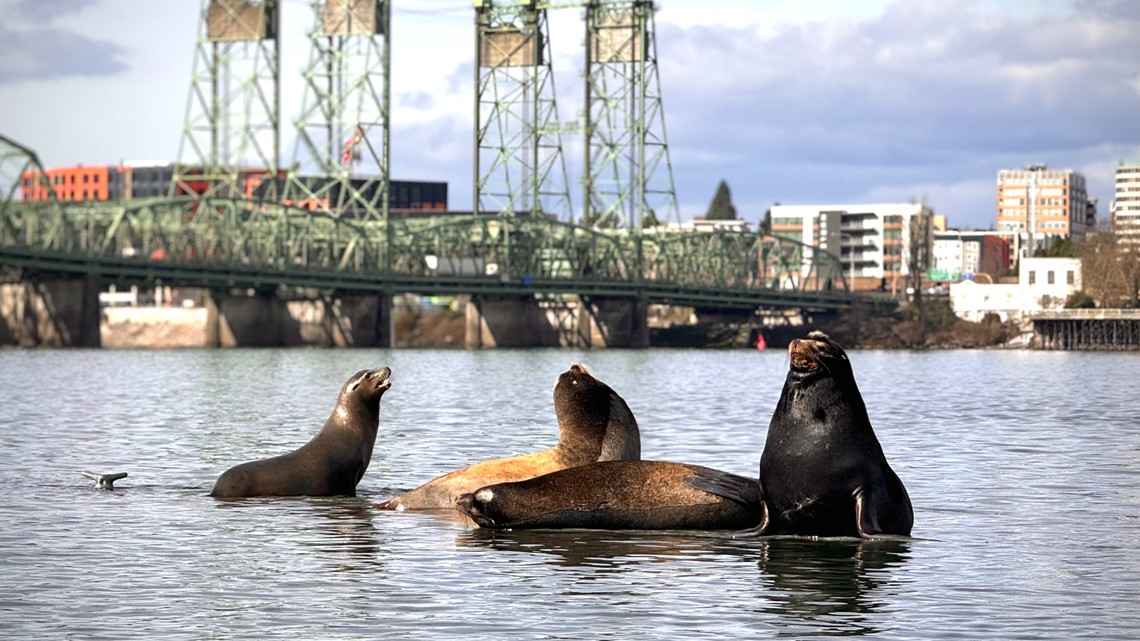
Sea lions benefit from federal protections, but their relentless snacking on the Columbia’s precarious salmon population has increasingly made for exceptions.
VANCOUVER, Wash. — Congresswoman Marie Gluesenkamp Perez of Washington’s 3rd District is pushing the Trump administration for an expansion of sea lion culling along the Columbia River, citing the predators’ voracious appetite for endangered salmon and steelhead.
Gluesenkamp Perez said she recently wrote to U.S. Secretary of Commerce Howard Lutnick, the Trump cabinet official in charge of the National Oceanic and Atmospheric Administration (NOAA) and its fish management activities, to ask for more federal action on sea lion removals.

This story continues below.
“Sea lions have eaten four times as many salmon as our fishermen and Tribes have harvested in the Columbia River in a year. During the 2025 spring season, nearly one-fourth of fish at Bonneville Dam show wounds from sea lion bites,” Gluesenkamp Perez wrote in her letter. “We need NOAA, in close partnership with states and Tribes, to examine what strategies yield the best results for pinniped removals — including direct, lethal removal.”
Sea lions are federally protected under the Marine Mammal Protection Act — making it illegal to harass, hunt or kill any marine mammals. There are some exceptions in place that allow state and Tribal authorities to remove the predatory pinnipeds, sometimes by killing them.
READ MORE: Battle over endangered fish has led Oregon to cull sea lions
Over decades, Steller and California sea lions have moved up the Columbia and its tributaries to feed on fish, including the 13 threatened and endangered runs which are themselves protected under the Endangered Species Act. The sea lions have come to expect that fish heading upriver to spawn will gather at dams, falls and other pinch points, making them easy prey.
That increasingly puts the sea lions in direct competition with the anglers of Oregon and Washington, as well as the region’s Tribes, and takes a toll on flagging population numbers.
In her letter, Gluesenkamp Perez argues that the conditions on killing sea lions are too onerous and costly, because they require that wildlife managers “capture these Toyota Corolla-sized creatures in traps, remove them from the river, chemically euthanize them with darts with a licensed veterinarian present, then transport the carcasses to a tertiary location for disposal and autopsy.”
Gluesenkamp Perez said she successfully included language in the 2026 Commerce, Science and Justice spending bill directing NOAA to study “what strategies yield the best results for pinniped removals — including direct, lethal removal.”
RELATED: Angling for predatory fish on the Columbia River earns some fishers a decent living
“I urge your assistance with the Department to complete this assessment,” the congresswoman wrote to Lutnick. “While this work is critical, our fish and fishermen need more urgent solutions.”
In the meantime, the congresswoman said she wants to see the allowable area of removals extended downriver from River Mile 112 on the Columbia — just east of Camas — to River Mile 66, near Longview. The far upriver edge of the removal area is McNary Dam, just past Umatilla.
“By River Mile 66, at the Cowlitz River where the Lewis and Clark Bridge crosses, the water is no longer salty enough to replicate traditional sea lion habitat,” Gluesenkamp Perez said. “These species don’t naturally live in water this fresh, and therefore we should be able to begin removals at this point.”
According to numbers tracked by the Oregon Department of Fish & Wildlife up to December of last year, there have been 505 lethal sea lion removals since they began in 2008. After just six removals throughout 2020, numbers ranged over subsequent years from 26 in 2022 up to a high of 67 in 2021.