
More Information
To watch the complete forum video, visit Walla Walla County Democrats on YouTube.
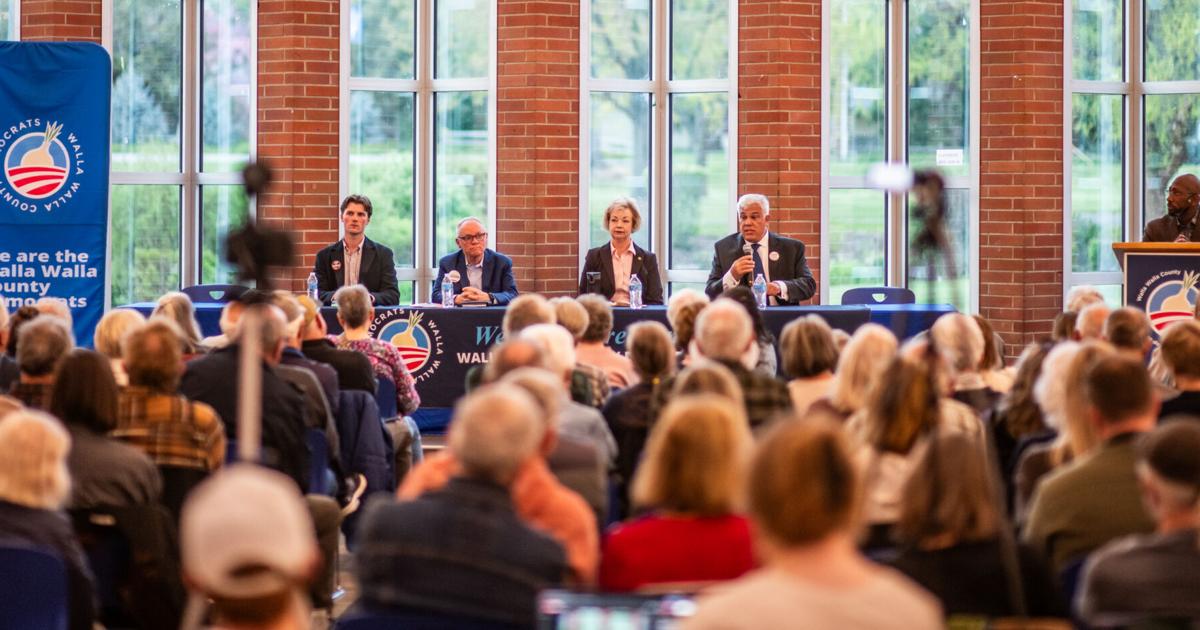
Four Democratic congressional candidates emphasized the need to restore Medicaid funding to protect rural health care during a public forum Wednesday, April 15.
The participating candidates were Carmela Conroy of Spokane, Kevin Fagan of Spokane, Bajun Mavalwalla of Valley, and Walla Walla’s David Womack. They are four of several candidates across the political spectrum who will challenge freshman U.S. Rep. Michael Baumgartner for his seat in 2026.
The forum was hosted by the Walla Walla County Democrats at the Walla Walla High School Commons. It was moderated by community organizer and educator Rodney Outlaw.
The event began with all the candidates introducing themselves, followed by a lightning round in which they gave “yes” or “no” answers to questions regarding the federal minimum wage, military support to Israel, student loan forgiveness and impeaching the president. After that, each candidate had two minutes to answer the questions raised by the moderator and voters.
There were 150 attendees at the venue, and 267 joined the livestream.
At the end of the forum, attendees could write down which candidate they thought was the best and why. The Democratic Party will announce the results at a later date.

An anonymous straw poll available to forum participants and those watching online to share their feedback on the candidates after the session.
Kezia Setyawan,
Walla Walla Union-Bulletin
Here are key highlights from the town hall:
Affordable housing
Fagan said that, if elected, he would ban private equity firms from owning single-family homes and direct significant amounts of federal funding toward affordable housing.
Womack said the primary issues contributing to the housing crisis are materials, labor and permitting, and that the federal government can influence all three. Some solutions include removing tariffs on building materials and working with cities to incentivize them to streamline permitting.
“I would love to see a full-on, all-government approach to solving our housing crisis,” he said. “I believe we could build 10 million new homes in 10 years if we put our minds to it.”
Conroy said she would work to revert tariff rates to what they were on Dec. 31, 2025.
“That would knock prices down immediately,” she said.
Another solution, she said, is eliminating red tape related to diversity, equity and inclusion so developers are no longer losing federal funding because they include accessibility language for wheelchair users in their documents.
Mavalwalla said young people are graduating from college with decades of debt, and by the time they begin to recover, they take on another 30 years of debt through homeownership.
He said it is important to make housing more affordable for young people and to regulate corporate ownership of housing nationwide.
Immigration and ICE
When asked what a realistic and humane approach to immigration looks like, Womack said it starts with enforcement at the border rather than in neighborhoods, schools, hospitals and churches.
“We can have secure borders and humane treatment,” he said. “It will take a complete cultural reworking of Border Patrol and abolishing ICE.”
He said the process of acquiring legal status also needs to be more affordable, especially for asylum seekers and refugees. In addition, those brought to the U.S. as children and undocumented individuals who contribute to society and pay taxes should have a streamlined pathway to citizenship.
Conroy said not only Immigration and Customs Enforcement but also the Department of Homeland Security needs to be abolished, since it has “become a many-headed monster — we have to decapitate it, dismember its parts and send law enforcement officers back into nonpolitical border security duties.”
Democratic candidates unanimously answer “yes” to abolishing ICE.
Kezia Setyawan,
Walla Walla Union-Bulletin
Mavalwalla said immigrants bring skills and talents at every level of society.
“It’s not just people who come here and tend our vineyards and orchards and pick our crops,” he said. “These are scientists, specialists, artists who come and enrich our entire society.”
To maintain secure borders, he said, ICE’s core responsibilities should be transferred to other federal agencies, current agents dismissed, and a new agency rebuilt from the ground up.
Fagan said the first step is abolishing ICE and launching an investigation into its leadership and any agents involved in misconduct.
He said reports of poor treatment at detention centers likely do not capture the full extent of the issue, and therefore there is a great need for comprehensive immigration reform.
“A lot of us in this room, unless you are Native, are immigrants,” he said. “Our families came here seeking a better future, and that idea for America should be what we strive for today.”
Rural and VA health care
Conroy said that in conversations with leadership at VA facilities and critical access hospitals in the 5th Congressional District, officials warned “they will be strangled to death in five to seven years” without restored Medicaid funding. She added that Trump’s tax bill will also reduce the quality of care at VA hospitals.
According to the Center on Budget and Policy Priorities, a research and policy institute, the Trump administration slashed the federal civilian workforce, including 28,000 VA employees. Those losses included more than 2,700 nurses, more than 1,000 medical officers and more than 1,000 psychologists.
“We have got to maintain funding and access to care at VA hospitals, restore Medicaid and, ideally, eventually get Medicare for all,” she said.
She also said Medicare Advantage plans should be eliminated “because that is also robbing our hospital blind.” These plans are offered by private companies as an alternative to traditional Medicare.
Mavalwalla said the largest employer in Dayton is the Columbia County Health System.
“That community will go broke without it,” he said.
He said health care should be viewed as a broader economic issue. So, he supports Medicare for all, a single-payer system — where a single public agency finances healthcare for all residents — and the restoration of the Affordable Care Act subsidies.
Many Walla Walla residents are paying higher health insurance premiums after the expiration of enhanced federal subsidies, resulting in about 90 people dropping coverage since January.
Fagan said rural hospitals are already struggling and that Medicaid cuts in H.R. 1, previously known as the One Big Beautiful Bill Act, have worsened the problem.
“The overall health care problem is one that will truly gut our communities and take the heart out, take the employment and tax base out of those communities,” he said.
Medicaid cuts, he said, should be reversed and more young people should be trained in health care professions to address staffing shortages in rural areas.
According to previous Union-Bulletin reporting, work requirements imposed by the current administration could strip Medicaid access from some of the most vulnerable populations, including formerly incarcerated individuals, people experiencing homelessness, those recovering from substance use disorder, and undocumented farmworkers.
Womack echoed other candidates’ views that Medicaid needs to be restored, particularly in the 5th District, where many residents, including children, rely on the program. He added that more people will lose health insurance following the expiration of ACA subsidies.
“Those are the short-term fixes that we can implement to restore what was taken away,” he said. “After that, the government needs to work toward universal health care.”
Find voter resources and full coverage of the Nov. 8 election at the UB Election Center.