
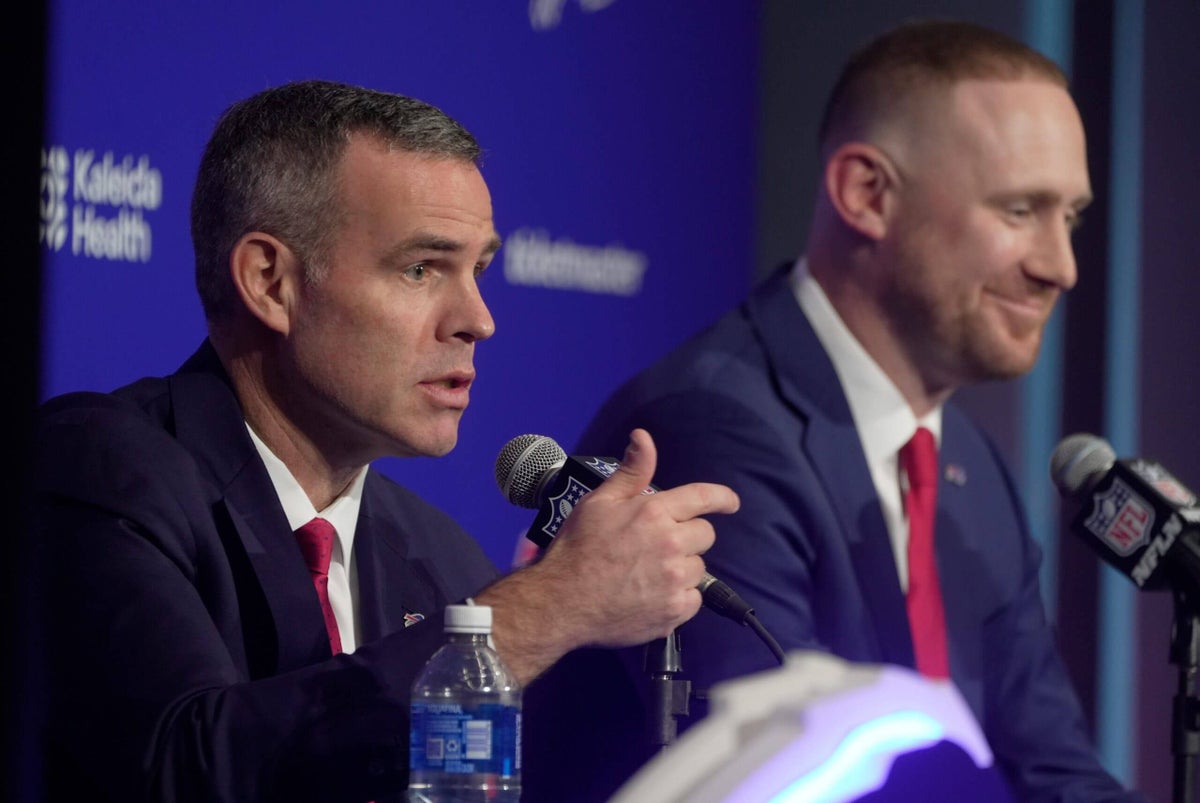
The 2026 NFL Draft is less than one week away. The Buffalo Bills are slated to pick No. 26, with a long wait ahead of their next pick at No. 91. With plenty of intrigue about their selection, it’s time for a draft week staple.
The Draft Files: An annual exercise of trying to channel what Bills general manager Brandon Beane is thinking by unpacking my notebook and entire draft brain to analyze the team’s potential strategy. It combines what they have said, the team’s actions, positional values, recent trends, roster and cap structuring and an excessive amount of time by yours truly to consider every possible scenario.
As usual, we’ve got a lot to cover about their top pick, so let’s get to it.
1. Getting a feel for Bills’ roster, early-round strategy
The environment is much different in 2026 than in 2025. The Bills mostly kept their roster together, adding a few key players in 2025. This offseason, the turnover has been quite extreme, specifically on the defensive side of the ball.
Not only have the Bills changed coaches and defensive schemes, but they’ve also had several high-profile contract expirations among starting and key rotational defenders. There are 11 defenders who, at some point in 2025, played a sizable role and are no longer under contract with the Bills in 2026. Nine expiring contracts, one traded (Taron Johnson) and one cut (Taylor Rapp).
Notable 2025 Bills defenders not on 2026 roster
The Bills have added only four players to replace them: edge rusher Bradley Chubb, nickel Dee Alford, safety C.J. Gardner-Johnson and safety Geno Stone. They also re-signed safety Damar Hamlin as depth. Still, not only is depth lacking, but they have a couple of starting lineup questions. On the flip side, the offense has seen next to no significant turnover outside of losing left guard David Edwards, and it has multiple options to replace him. They also added DJ Moore in what they deemed to be a big trade.
Considering the Bills spent their first five draft selections on defense in 2025, it would have made sense to swing back to the offensive side in 2026. However, given the turnover, change in scheme and roster, required plan at some positions, it appears they are leaning toward a second-straight defensive-heavy draft class.
2. Breaking down most realistic Day 1 needs
As is the case every year, not every need is the same. Based on the structure of their roster, the future cap sheet, and positional values, we can infer their draft positional preferences. It comes down to four positions.
Wide receiver — The Bills added Moore and have Khalil Shakir, but the third starter in 11 personnel has yet to be determined. Due to Tyrell Shavers’ torn ACL rehab likely pushing into the regular season, the Bills also have only four receivers locked in for the 53-man roster to begin the year, with the fifth spot open.
Edge rusher/outside linebacker — Beane revealed to The Athletic that Greg Rousseau will be an outside linebacker in defensive coordinator Jim Leonhard’s new scheme, which has Rousseau and Chubb as starters. However, Chubb turns 30 this summer, and it’s only a two-year commitment based on guaranteed salary. Michael Hoecht is still rehabbing a late-October torn Achilles, which calls his effectiveness into question. The rest of the depth is lacking. Overall, they lack a true explosive edge-rushing option.
Interior defensive line — Whether at nose tackle or defensive end, or a combination of the two, the Bills are one starter or rotational player shy of being where they likely want to be. We know Deone Walker and Ed Oliver will start. T.J. Sanders, a 2025 second-round pick, will be in the starting conversation, but they could, at the very least, use some competition.
Inside linebacker — The change in defensive scheme likely impacts this group the most. The Bills generally looked for lighter off-ball linebackers with the last defensive scheme, and now, they need to get a bit bigger. The Bills also lack depth and a potential starting option to pair with Terrel Bernard in 2026. Inside linebacker is a clear need in this draft.
Two positions not listed here: guard and safety. They could certainly use a top-tier guard or an offensive tackle who has guard versatility in the short term. However, having left tackle Dion Dawkins under contract for two more seasons and having five different players on the roster who could win the left guard spot (Alec Anderson, Austin Corbett, Tylan Grable, Sedrick Van Pran-Granger or Lloyd Cushenberry), the Bills are likely feeling pretty good about one of those options emerging. At safety, the Bills have Cole Bishop and signed Gardner-Johnson, likely to start in 2026. They also brought in Stone, Hamlin and still have Jordan Hancock and Sam Franklin, so they have extensive depth that other positions lack. Plus, safety and guard generally go against the next piece of the puzzle.
3. Important Beane maxim to consider for their top pick
When I sat down with Beane ahead of the draft, one of my questions was about the overall value of selecting a nose tackle, as some have wanted them to do based on their roster structure. Contained in his answer was an interesting nugget that helps explain his draft strategy. In context, it’s an answer about one position, but extrapolating creates a window.
“Listen, when you value your board, you also have to think about what would you pay in free agency for this.”
When you look back at Beane’s drafting history since 2018 — his first with the Bills — it mostly checks out with the team investing in premium positions and players with their top selection in the first or early second round.
Bills Top 40 pick history under GM Brandon Beane
Quarterback is self-explanatory. Tremaine Edmunds was a potential top 10 selection during his draft process, and the Bills got him at No. 16, making him a premium player. Given his size and speed combination, the Bears signed him in 2023 to an $18 million per year deal that would still rank third for off-ball linebackers in 2026. After that, it was Oliver, a pass-rushing defensive tackle, whom teams will pay a premium for on the open market. They drafted Ford to be an offensive tackle, not a guard. Rousseau is a pass-rushing defensive end, one of the highest-paid positions in the league. There were two tries at cornerback with Elam and Hairston, which, as we saw in free agency this year, do very well on the open market. Cornerback ranks only behind offensive tackle, wide receiver and edge rusher for players who make at least $15 million per season. Keon Coleman was their top pick in 2024, and wide receivers have more players making at least $20 million annually than any other position in the NFL.
The lone exception to the rule here is when the team took tight end Dalton Kincaid with their top pick in 2023, but their idea at the time was to get a high-snap-count big receiver who could become a difference-maker. It hasn’t worked out that way due to injuries, but that was at least their intent when they thought they had another potential Edmunds situation on their hands.
There are exceptions, or as Beane put it, a “unicorn” type of player that is so dominant in one thing, or coveted by others, that it raises their stock, giving some credence to why they opted for Kincaid. However, given their draft history, they have mostly targeted the premium positions where they can get the most bang for their buck on rookie deals. The more a player can do, the higher their consideration will be, just the same as in free agency. If you follow the money, that’s a good place to start to see how the Bills are stacking their board.
4. How best to apply it to Bills’ top needs to find some holes
It’s time to reintroduce the term I’ve used for Beane for several years after seeing how he operates: need meets value. While you’ll hear the term “best player available” associated with the draft, ‘need meets value’ has long been how Beane has operated with the vast majority of his early and mid-round picks.
Using the information we know about the Bills and how this draft class stacks up, it raises questions about some of the first-round options. It’s not to say either of these positions is out of the equation, but we’re looking to spot the higher-probability outcomes based on what we know.
Defensive line would likely merit some consideration because three-down interior defensive linemen have proven to be paid quite well on the open market, so it’s a premium position. However, the two things standing in its way are the defensive line draft class and the team’s recent investments in the position. There is at least one first-round name that carries that three-down potential in Keldric Faulk, but his combination of size, youth and potential usually goes much earlier than No. 26.
Past him, the interior defensive line group is lacking clear first-round options. There are some early down nose tackle types on the first-round fringe, but without a path to becoming trustworthy pass rushers, it’s doubtful that they will be selected. Some others carry too much overlap with recent investments like Oliver and Sanders. Furthermore, when Leonhard was with the Broncos last year, they used three defensive linemen on only 38 percent of their snaps, and since the Bills already have Oliver, Walker and Sanders, it might lessen the urgency to find one early.
Inside linebacker is a matter of positional value and the overall draft class. If you use the “follow the money” approach, off-ball linebackers are one of the least costly positions on the market. Only two inside linebackers are making at least $20 million per year, and only six make at least $15 million. For context, five positions have 20-plus players making at least $15 million per year.
Then comes this year’s draft class. If Sonny Styles were available, he would be the Edmunds case, but he’ll be long gone by No. 26. There is a relatively large gap between Styles and the next best inside linebacker, and the position could be flat enough to find a potential starter later in the draft. It will be tougher to find a potential starter at a premium position in the middle rounds.
5. Why it could be a year too soon for another early WR pick
Wide receiver certainly passes the “follow the money” test. It’s generally never a bad idea to invest in early-round wide receivers because, if they hit, teams are usually willing to trade legitimate assets, while also paying them a huge contract. However, a handful of things stand in the way. The Bills already made a massive draft investment in Moore, who cost them a second-round pick. While Moore is not technically a drafted player, when the Bills acquired Stefon Diggs, they viewed it as using a first-round pick on a receiver. The Bills view Moore as a potential No. 1 wide receiver who could have a big impact on their overall offensive environment.
He, along with their other three investments over the last two offseasons in Shakir, Keon Coleman and Joshua Palmer, likely has them feeling like their top four can compete immediately. Coleman is a lightning rod among fans for his inconsistency and multiple in-house punishments for tardiness. However, the Bills have made it abundantly clear — as most recently as this week to The Athletic — that they have a firm belief in Coleman. If they feel they have a potential No. 1, a dependable slot, a young player they believe in and a veteran they like as insurance for that young player, that can be enough to pass on an early-round receiver. It could be just a year too soon for that type of investment when looking at the entire picture.
On top of that, a few of the first-round receiver prospects have a skill set and role overlap with what the Bills have invested in. Shakir’s hold on the slot role stands in Makai Lemon’s way. Both Moore and Shakir are excellent short-yardage and run-after-catch players, which is one of Omar Cooper’s top skills. Denzel Boston is more of a contested catch type, and that is a clear duplication of what they like most about Coleman. Plus, with the way things are trending, five or six receivers could be gone by No. 26 anyway. The entire landscape is enough for me to reduce the probability of them selecting one in the first round, but I’ll stop short of ruling it out altogether, considering how dire it was at times in 2025.
6. Why edge rusher seems like a sweet spot at No. 26, and names to monitor
When it comes to need, the depth chart, potential first-year role, a lack of recent long-term investments and how much the position is valued leaguewide, edge rusher ticks every box for what Beane’s selection with his top pick.
There wouldn’t be an immediate pressure to start the edge rusher with both Rousseau and Chubb in-house, but the moment the draft pick deems himself worthy of more snaps, he could eat into Chubb’s playing time. In the interim, they would be a rotational rusher and sub-package player to fill the gaps of what the Bills’ edge rusher group lacks most: explosiveness.
The first and early second round is loaded with potential answers to put in the Bills’ outside linebacker rotation, underscoring how much the Bills’ positional need meets the value of both the players available and the pick. Some names to remember:
T.J. Parker, Clemson — This pairing isn’t getting too much buzz, but Parker has good enough explosiveness off the snap and has the arm length (33.125 inches) to beat offensive tackles that some other names may struggle with.
Malachi Lawrence, UCF — The more the draft process has continued, the more Lawrence’s name for the Bills has begun to make sense. He’s an excellent fit for Leonhard’s defense, has the explosiveness they crave from their outside linebackers and he doesn’t have arm length questions as others do (33.625 inches). Lawrence has an ascending skill set that could thrive in the Bills’ scheme.
Cashius Howell, Texas A&M — Howell has slowly moved down the board as the draft process has gone along due to size concerns (31-inch arm length), but he brings the speed and bend around the edge that no one else on the Bills roster possesses. He is definitely in the mix at No. 26 or in a trade-down scenario.
R Mason Thomas, Oklahoma — He might be more of a trade-back target, but he is explosive off the edge, has some bend to his game and while he has longer arms than Howell (31.75 inches), it’s still well below threshold. Another problem is that he’s 241 pounds — 12 pounds lighter than Howell — despite all the other positive attributes.
Akheem Mesidor, Miami (FL) — Mesidor is my least favorite fit of the five names here because he lacks explosiveness, his arm length is below threshold and he’s already 25 years old. He’s a high-floor player, but the Bills should already be swinging for much more, with two established starters on their team who play similarly to Mesidor.
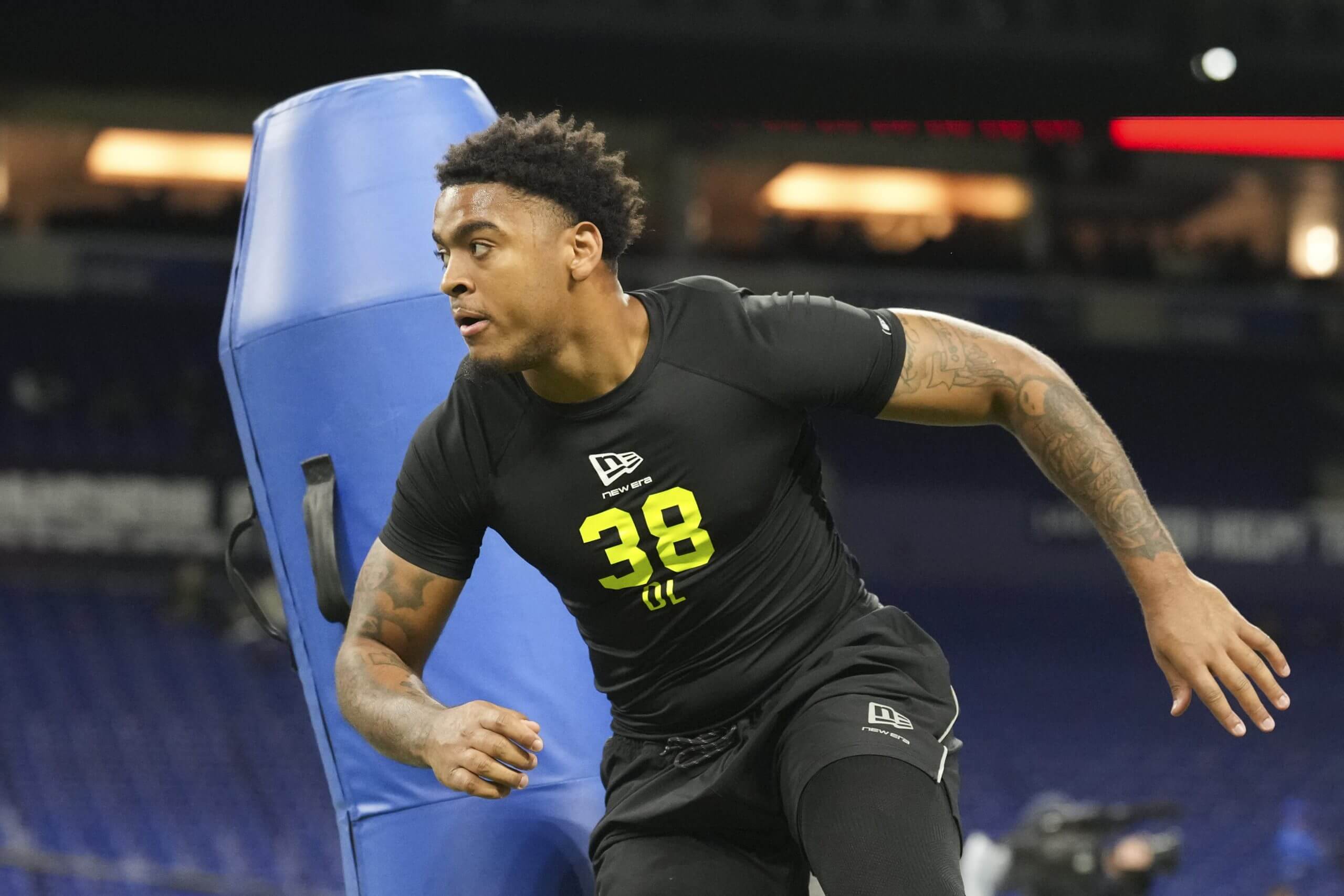
Keldric Faulk would likely be a hybrid player in the Bills’ defensive scheme. (Kirby Lee / Imagn Images)
7. Potential non-edge rusher curveballs at No. 26
Because the Bills are picking so late in the first, you never know what will happen. Here are some exceptions, if available.
WR KC Concepcion, Texas A&M — Like Jordyn Tyson, Concepcion is more of a complementary fit to the Bills receiver room than some other first-round receiver prospects who have starting potential. Concepcion would also take over the punt returner spot, adding some explosiveness. However, the closer we get, the less likely it seems either will be available at No. 26.
DL Keldric Faulk, Auburn — I didn’t list Faulk with the edge rushers because in the Bills’ scheme, he’d likely be more of a hybrid player who could spend most of his time at the defensive end position at either five-technique or 4i. Faulk’s pass-rush potential would make him a clear target for them to be a three-down player one day. It’s a great fit, but he might not be on the board at No. 26. If he is, don’t be stunned if he’s the guy, even over edge rushers.
NT Kayden McDonald, Ohio State — The lack of pass-rush ability here puts some skepticism in this pairing at No. 26, especially since nose tackles who aren’t great pass rushers aren’t as valuable leaguewide. Still, if they view him as a unicorn run defender, it puts him in the realm of possibilities.
S Dillon Thieneman, Oregon — Even though he plays a non-premium position, what makes him a potential target is his multiple position versatility. They love that in players, and he can make an immediate impact. Thieneman can play both safety spots, nickel and will give them a potential difference maker in the interim in dime personnel, a package the Broncos used plenty of in 2025. Then he’d be a potential long-term starting partner with Bishop at safety, while maintaining his versatility for other defensive looks. When it makes sense, they likely want to add multi-position players like this one for Leonhard’s scheme.
8. Trading down an optimal strategy. What could make it work?
Since the Bills lack a second-round pick, the only reasonable path for them to move off No. 26 is in a trade down. Considering this year’s draft class, team needs and where they’re picking, trading down is an optimal approach. If the Bills can add a pick or improve a pair of their current picks, it will go a long way to increase the likelihood they’ll come away with multiple contributors in this draft class.
However, saying to trade down is fine in theory, but teams need to have a plan and some luck. The usual candidate for teams trading into the late first round is a quarterback. That could certainly be the case for Alabama’s Ty Simpson, but the teams immediately behind the Bills (49ers at No. 27, Texans at No. 28 and Chiefs at No. 29) are no threat to take a quarterback. The real best friend of the Bills, if they want to trade down, appears to be the offensive line.
Not only is the need for possible starting offensive linemen rampant across the league, but you can make the case for all six teams picking after the Bills in the first round to select one. Plus, when you look at Dane Brugler’s rankings in The Beast this year, there is a noticeable dropoff from the first and fringe first-round offensive linemen to the next best ones. The dropoff is most prominent at offensive tackle.
It’s all about supply and demand, and for a premium position like the offensive line, don’t be surprised if several teams attempt to move up at this stage in the draft.
9. Which trade partners seem most realistic, and what are some potential returns?
We’ll keep this exclusively to teams who could use an offensive lineman this year and have the realistic draft ammo to pull it off. We used the Rich Hill Trade Value Chart, which utilizes recent trades to establish values for each pick.
Potential 2026 Bills trade yields with OL-needy teams
TeamPickBills giveBills get
No. 28
No. 26
Nos. 28, 141
No. 29
Nos. 26, 182
Nos. 29, 109
No. 34
Nos. 26, 91
Nos. 34, 65, 143
No. 36
Nos. 26, 91
Nos. 36, 67, 208
No. 36
Nos. 26, 220
Nos. 36, 102, 117
No. 38
Nos. 26, 220
Nos. 38, 69
No. 39
No. 26
Nos. 39, 70
No. 40
No. 26
Nos. 40, 74, 176
No. 53
No. 26
Nos. 53, 76, 85
No. 54
No. 26
Nos. 54, 68, 98
A few team-specific notes here.
Las Vegas (No. 36) — There are a couple of paths to find a Raiders deal, so I put both potential options on there.
Houston (Nos. 28 and 38) — The Texans could look to improve No. 38 to No. 26 with good draft capital, though if the Bills wanted a smaller move back, the Texans also have No. 28.
Cleveland (No. 39) — The Browns very easily could use one of their two first-round picks on an offensive lineman, but in the event they don’t, they have a lot of ammo to move up.
Chiefs (Nos. 29 and 40) — Like the Texans, the Chiefs also have an early second-round pick (No. 40) they could try to move rather than their top pick, giving the Bills more value in the trade. Trading with the Chiefs on draft day again would be, well, complicated in the eyes of fans, considering how poorly it was received in 2024.
Steelers (No. 53) and Eagles (No. 54) — Both teams have excellent draft capital and would yield the clear best return for the Bills, but it would be a massive drop and likely takes the Bills out of finding a potential premium position starter. Anytime Beane has traded down on draft night, it hasn’t been a particularly far drop, hoping to reduce variables above all else.
There are some other teams with offensive line needs, but they do not have the 2026 ammo to move up to No. 26.
10. Trade down player possibilities
Considering trading down would add many more variables, we’ll keep this group brief and focus mostly on positions rather than finite details about names. If they do trade down, I’ll have plenty to unpack the morning after the first round concludes in our mid-draft rendition of The Draft Files. Trading down does introduce the potential to go with a non-premium position, but the lean would still be toward those who would cost the most in free agency.
Any previously mentioned edge rushers still on the board — This could include Howell, Thomas and any others who fall out of the first round. Gabe Jacas of Illinois and Keyron Crawford from Auburn are scheme fits who could enter into this discussion.
Interior defensive linemen — Georgia’s Christen Miller and Texas Tech’s Lee Hunter both seem like players who could play a couple of spots along the defensive line. If McDonald winds up not going in the first round, the Bills could certainly make the case to pick him in the early second with additional draft resources at their disposal and less risk if his pass-rushing doesn’t work out. Clemson’s Peter Woods is more of a defensive end type in the Bills’ scheme, who may have some duplication with Sanders, but can’t be ruled out.
Inside linebackers — The Bills are looking to thread the needle with size, coverage abilities, blitzing skills and leadership for their next addition at inside linebacker. Jacob Rodriguez of Texas Tech and CJ Allen of Georgia become more palatable with an early-second round pick. Anthony Hill Jr. from Texas and Jake Golday of Cincinnati could have some inside and outside linebacker appeal to them, and they do like versatility. I wouldn’t rule out the Bills being much higher on Josiah Trotter of Missouri than some have him listed, considering how good a run defender and blitzer he was in college. I’ve got a full breakdown of who fits the Bills at ILB the best here.
11. Two paths — what, and who, seems most likely?
In analyzing the Bills’ situation and which players have a realistic chance of being there, I think the most impactful outcome is for the Bills to stick at No. 26 and land one of two things; either an explosive edge rusher who gives them an element to their game that they don’t have, or a three-down defensive lineman that they can move around formation, while even chipping in at edge rusher.
The names I keep coming back to are Lawrence, Parker, Howell, Thomas and Faulk. Of that quintet, and with the Bills usually breaking ties with size and length, Lawrence and Faulk are the ones who stand out the most. If they want to bend and forget the measurables, Howell makes sense. Parker would be a worthwhile pick, too.
There is a realistic chance that Howell or Thomas, given they are undersized, will be on the board in the early second round. So if there is a run on offensive linemen, I think a slight trade down into the 30s is firmly on the table for the Bills to take the best of what’s left on defense. Even if it’s for a non-premium position, they will still have recouped good draft capital to make the move. Adding an impact front-seven player would go a long way in 2026 and in the future.
And there you have it, my entire Bills draft brain heading into draft week. Coming up on Monday morning, my final Bills-only mock draft before it all gets started on Thursday, April 23.