
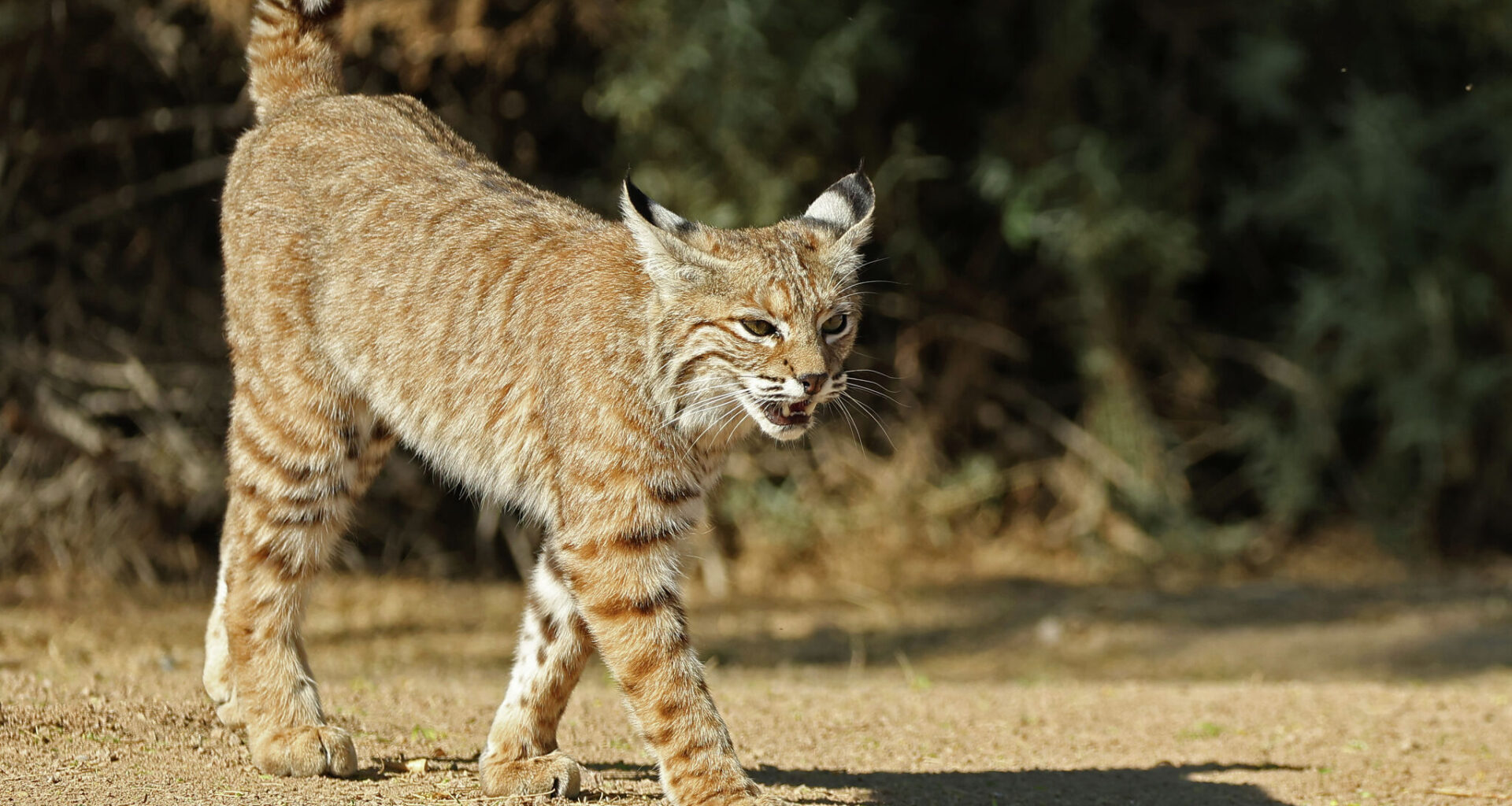
A bobcat is seen during the first round of the Ford Championship presented by Wild Horse Pass 2026 at Whirlwind Golf Club in Wild Horse Pass on March 26, 2026 in Phoenix, Arizona.
Sarah Stier/Getty Images
A bobcat is seen during the first round of the Ford Championship presented by Wild Horse Pass 2026 at Whirlwind Golf Club in Wild Horse Pass on March 26, 2026 in Phoenix, Arizona.
Sarah Stier/Getty Images
Connecticut’s bobcat population is growing this spring, continuing a decadeslong trend as the stout and spotted feline moves into ever more fields and forests across the state.

According to one of the state’s leading wildlife scientists, that expansion represents a conservation success story, after the animal nearly was hunted to extinction in the early 1970s.
Article continues below this ad
“It’s always great when we can see wildlife populations that have been very low rebound and recover,” Jenny Dickson, the wildlife division director at the state Department of Energy and Environmental Protection, said. “That’s what we strive for.”
Nowadays, bobcats are ubiquitous across Connecticut, with nearly 1,000 reported sightings so far in 2026, and more than 4,000 in each of the past four years. Dickson estimated the state’s bobcat population likely is between 4,000 and 5,000, with many never spotted because they appear during the twilight hours around dawn and dusk.
Perhaps even more relevant than the size of the bobcat population is their range. Bobcats already have been spotted in 146 of the state’s 169 municipalities this year, and many years are reported in every town and city in Connecticut.
Article continues below this ad
Make CT Insider a preferred source on Google to see more of our journalism when you search.
Add Preferred Source
While the highest concentration is in the towns to the north and northwest of Hartford — including West Hartford, Simsbury and Avon — bobcats are far more diffuse than the state’s bear or moose populations.
Stamford is among the top five in reported sightings, with 25, and the animal has been spotted in virtually every community along the shoreline.
Dickson said the population has grown and spread so much thanks to the bobcat’s adaptability and its ability to live in proximity to humans.
Article continues below this ad
A bobcat is seen during the first round of the Ford Championship presented by Wild Horse Pass 2026 at Whirlwind Golf Club in Wild Horse Pass on March 26, 2026 in Phoenix, Arizona.
Sarah Stier/Getty Images
That wasn’t always the case. While the bobcat is native to Connecticut, its population was curtailed severely by widespread deforestation and hunting in the mid-20th century. Between 1935 and 1971, the state had a bounty on the species, as they were viewed as a threat to agriculture.
It was the 1972 reclassification of bobcats as a protected furbearer and the concurrent end of the hunting and trapping of the animals that allowed for their recovery. The population has exploded since 2005, pouring out of the northwest hills of Litchfield County to occupy most of Connecticut.
And Dickson thinks they’re not done expanding.
Article continues below this ad
“I remember when it was very unusual to have bobcat sightings in the state,” Dickson said. “Now to have them be something that a lot more people can see in the wild is pretty amazing.”
Bobcats prefer forests or old fields that have become brushy habitats, she explained. The reforestation of the state amid declining farming, from 25% forest land in 1825 to 60% today, has allowed both bobcats and their preferred prey (rabbits, squirrels, voles, and other small mammals) to roam widely.
Mountain lions still not present in Connecticut, despite rumors
But even as bobcats become more common in Connecticut, Dickson says the state still does not have mountain lions, despite persistent rumors to the contrary.
Article continues below this ad
This photo provided by the U.S. National Park Service shows a mountain lion, newly dubbed P-79 with a new tracking collar, following its capture in a Simi Valley, Calif., neighborhood early Thursday, Dec. 12, 2019.
U.S. National Park Service / Contributed photo
Only one mountain lion has been recorded in the state’s history, in June 2011, when a 140-pound male was struck and killed by an SUV on the Wilbur Cross Parkway in Milford. Researchers later determined the mountain lion had traveled more than 1,500 miles from the Black Hills of South Dakota.
The felines are much larger than bobcats (weighing upward of 100 pounds as opposed to the mid-20s), and have long, curving tails as opposed to the short “bob” that christens the bobcat and is affixed to its rear.
Despite the lack of mountain lions, Dickson said the DEEP gets dozens of reports per year of their presence — often with a blurry or misidentified photo of a long-tailed cat — and has even been accused of keeping a secret population.
Article continues below this ad
“There are a lot of people who believe otherwise, but we don’t have (mountain lions),” Dickson said. “For us, that would be an exciting occurrence. That’s something that would be interesting to see happen.”
The reality of why the state lacks mountain lions is much less glamorous, according to the wildlife biologist: there is not enough open space for their habitats. And finding one would require some travel; the feline is not present in the United States east of Texas.