
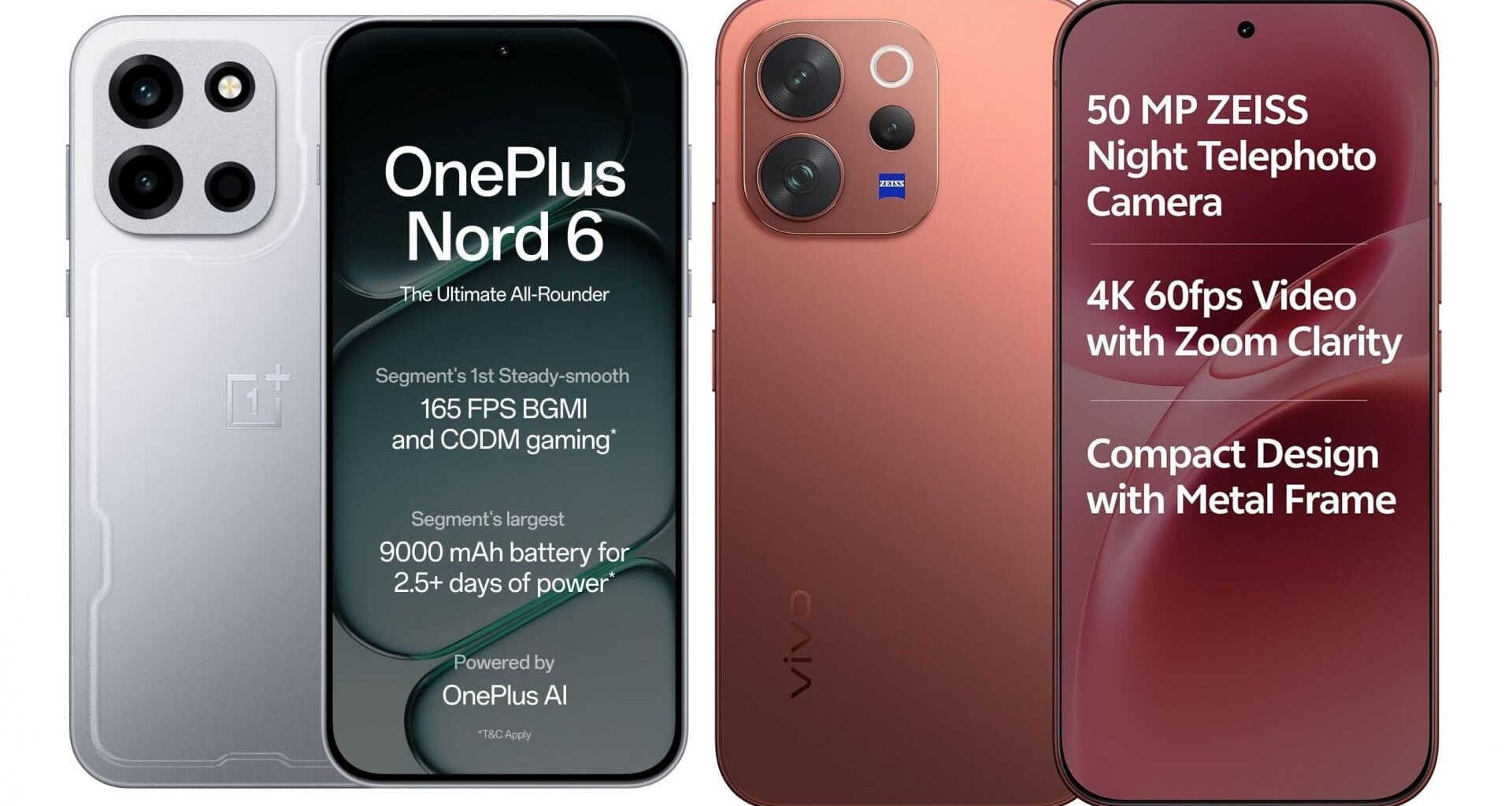

The newly launched OnePlus Nord 6 is generating a lot of buzz in the budget smartphone market thanks to its excellent value. The Vivo V70 is also an equally impressive value-for-money device, if not more so. In fact, it’s a fantastic phone for camera enthusiasts. The question is: Which smartphone delivers better camera performance, the OnePlus Nord 6 or the Vivo V70? Let’s compare the two phones and find out.
OnePlus Nord 6 vs Vivo V70: Detailed comparison
Specs comparison
Here are the specs of the OnePlus Nord 6 and Vivo V70:
SpecificationsOnePlus Nord 6Vivo V70Display6.78-inch OLED panel
1.5K resolution
165 Hz refresh rate
3840Hz PWM
1800 nits peak brightness6.59-inch AMOLED panel
1.5K resolution
120 Hz refresh rate
4320Hz PWM
5000 nits peak brightnessChipsetQualcomm Snapdragon 8s Gen 4Qualcomm Snapdragon 7 Gen 4Operating systemAndroid 16 with OxygenOS 16Android 16 with OriginOS 6Memory & storage8/12 GB RAM
256/512 GB internal UFS 4.1 storage8/12 GB RAM
256/512 GB internal UFS 4.1 storageCamera setup50+8 MP rear camera setup
32 MP selfie camera50+50+8 MP rear camera setup
50 MP selfie cameraBattery and charging9,000 mAh battery
80W wired fast charging
6,500 mAh battery
90W wired fast charging
Design, build quality, and display
OnePlus Nord 6 has a high refresh rate display (Image via OnePlus)
The OnePlus Nord 6 and Vivo V70 both feature aluminum frames, but differ in rear panels. The former has a plastic rear panel, while the latter has a plastic/glass rear panel, depending on the colors. The glass variant of the OnePlus phone will be more premium than the Vivo one.
However, the two phones have the same IP68/69K ratings for dust and water resistance. As for the display protection, the OnePlus Nord 6 has a OnePlus Crystal Guard, while the Vivo V70 features Schott Xensation Core glass. Neither of them is as popular or as widely tested as Gorilla Glass, so it remains to be seen how good they are.
Speaking of displays, the OnePlus Nord 6 and Vivo V70 have great AMOLED panels. However, the former has a higher refresh rate, while the latter has a higher PWM frequency and significantly higher brightness. Therefore, the OnePlus phone’s display is better for gamers, but Vivo’s display is better overall.
Moreover, the Vivo V70 is thinner and lighter than the OnePlus Nord 6, so the former will feel much better in the hand. Overall, the OnePlus phone has a slightly better build quality, but the Vivo phone has a better display and design.
Read more: 7 best flagship smartphones under ₹50,000
Performance and gaming
The Vivo V70 features the latest RAM and storage technologies (Image via Vivo)
The OnePlus Nord 6 features the Qualcomm Snapdragon 8s Gen 4, while the Vivo V70 has the Snapdragon 7 Gen 4. Here are the Geekbench 6 benchmarks of the two mobile chips:
BenchmarksQualcomm Snapdragon 8s Gen 4Qualcomm Snapdragon 7 Gen 4Geekbench 6 (CPU Single-core)20681244Geekbench 6 (CPU Multi-core CPU)63853506Compute Score (GPU)184986746
In Geekbench 6’s CPU benchmarks, the Qualcomm Snapdragon 8s Gen 4 chipset inside the Nord 6 delivers 65% higher single- and 82% higher multi-core scores than the Snapdragon 7 Gen 4. Therefore, the OnePlus phone will feel substantially smoother than the Vivo V70 in day-to-day use, and apps will launch quickly.
Moreover, the OnePlus Nord 6’s gaming performance is 174% higher than that of the Vivo V70. Therefore, if gaming is a priority, you should get the OnePlus phone.
Read more: The Xiaomi 18 Pro and Pro Max are tipped to sport dual 200MP cameras
Camera performance
The Vivo V70 is equipped with three cameras (Image via Vivo)
The OnePlus Nord 6 features a 50+8 MP dual rear camera setup, while the Vivo V70 includes a 50+50+8 MP triple rear camera setup. The Vivo phone’s main 50MP camera is better, as it has a larger sensor than the OnePlus phone’s and a wider aperture.
However, the ultrawide cameras of the OnePlus Nord 6 and Vivo V70 are quite similar and will capture similar quality ultrawide shots. However, the latter’s ultrawide shots are 115˚ wide, while the former’s is slightly narrower at 112˚. Therefore, there’s a small advantage to the Vivo phone, but that’s not all.
The Vivo V70 has another key advantage: a dedicated telephoto camera, which performs quite well. Its 3x zoomed shots look excellent, offering a good amount of detail, wider dynamic range, and lower noise levels. In contrast, the OnePlus phone lacks a telephoto camera.
The Vivo V70’s selfie camera is also superior to that of the OnePlus Nord 6, thanks to its larger sensor. This results in better facial details and more natural colors.
Read more: The Xiaomi 18 Pro and Pro Max are tipped to sport dual 200MP cameras
Battery, charging, and pricing
OnePlus Nord 6 includes a big battery (Image via OnePlus)
The OnePlus Nord 6 includes a large 9,000 mAh battery, while the Vivo V70 has a smaller 6,500 mAh battery. Therefore, expect the OnePlus phone to last three days on a single charge with light to moderate usage, while the Vivo phone will struggle to deliver two and a half days of battery life.
The OnePlus Nord 6 and Vivo V70 have similar charging speeds (80W vs 90W), but due to differences in battery capacities, the latter will charge significantly faster. Nonetheless, neither phone has wireless charging.
The OnePlus Nord 6 starts at 38,999 rupees, while the Vivo V70 begins at 45,999.
Which budget smartphone nails the camera?
The OnePlus Nord 6 and Vivo V70 are both great budget smartphones, but they are fundamentally different devices. The OnePlus phone is designed for gaming and excels at that. Its higher refresh rate display, significantly faster chipset, and longer battery life make it a better choice for gaming.
However, when it comes to the camera, the Vivo V70 beats the OnePlus phone in every single aspect. That’s not to say that the OnePlus 6 has a better camera, but the Vivo phone’s camera setup is significantly better. The Vivo V70 is also thinner and lighter, delivering a great in-hand experience. It has a better display and supports faster charging.
The Vivo V70 is not only a better smartphone overall, but it also features a much better camera setup. However, it is also more expensive.
Why did you not like this content?
Cancel
Submit
Was this article helpful?

Thank You for feedback
Edited by Suraj Bhowal