
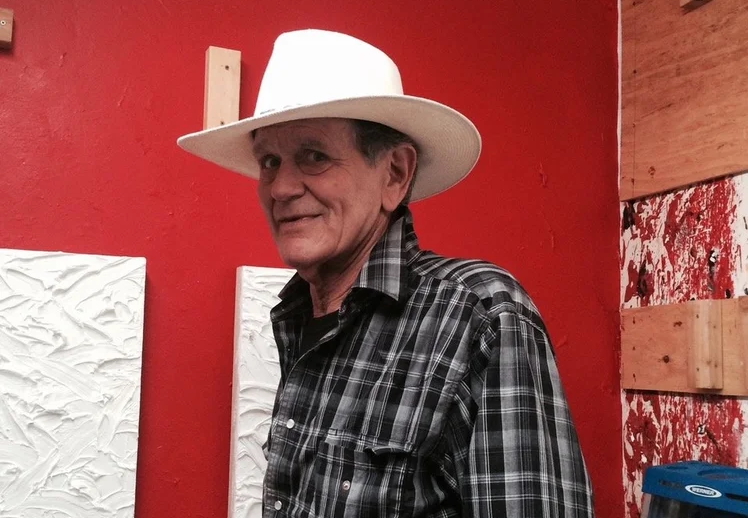
James Hayward, a San Francisco-born abstract painter whose heavily textured monochrome works made him a distinctive presence in California art for decades, has died at 82.
William Turner Gallery
James Hayward, a San Francisco-born abstract painter whose rugged, richly worked monochromes helped define a distinctly West Coast approach to contemporary painting, has died at 82.
His studio announced in an Instagram post Thursday, April 16, that Hayward “transitioned peacefully this morning.”
Though he never became a household name, Hayward was revered in California art circles as a painter’s painter: a fiercely independent artist whose thick, ridged surfaces and all-over fields of color pushed monochrome painting toward something more physical, sensual and unruly.
Article continues below this ad
Over decades, his work appeared in major museums including the Los Angeles County Museum of Art, the Museum of Contemporary Art in Los Angeles and the San Francisco Museum of Modern Art, while generations of younger artists encountered him as both a formidable presence and an influential teacher. William Turner Gallery said two of Hayward’s paintings are included in its current group exhibition, “Surface Tension.”
Born in San Francisco on Sept. 22, 1943, Hayward studied at San Diego State University, UCLA and the University of Washington, where he earned a Master of Fine Arts degree. He spent much of his life in Los Angeles and later lived and worked in Moorpark, where his ranch, dogs and cowboy persona became part of his legend.
San Francisco Chronicle Logo
Make us a Preferred Source to get more of our news when you search.
Add Preferred Source
That persona was not an act. In profiles over the years, Hayward emerged as part philosopher, part outlaw and part master craftsman: a lanky painter in a white hat, fond of tall tales, hard-won aesthetic convictions and long riffs about Titian, Pollock and the moral force of art.
“Art’s a first-hand experience,” he said in an undated interview with Flaunt. “Meaning, when you walk up to it and you look really close at it, you discover things you didn’t see from across the room.”
Article continues below this ad
Hayward first gained attention in the 1970s and 1980s. Early on, he made flatter so-called automatic paintings. Later, he became best known for dense monochrome abstractions built from repeated strokes of oil paint layered into peaks, furrows and shimmering surfaces. Roberts Projects gallery described those later works as paintings in which color, texture and structure fused into an “irreproducible distinct identity.”
To Hayward, painting was less about image than about mark-making, equality and presence.
“In my monochromes I try to avoid there ever being a special place,” he told Artillery in 2015. “There’s no chosen place. It’s totally proletariat, the marking. I want the corners to be as important as the center and I want every mark to be equal in terms of importance.”
That commitment made him difficult to neatly categorize. His work shared DNA with minimalism, process art and Abstract Expressionism, but never sat comfortably inside any of them.
Reviewing a 2011 exhibition in Artforum, critic Ben Carlson wrote that Hayward’s paintings showed an artist whose practice had “never veered from the ecstatic.” Mike Kelley, in a curatorial statement for a 2005 show, called him “one of the few truly important West Coast painters.”
Article continues below this ad
Hayward also taught at UCLA and ArtCenter College of Design, among other schools, and received major honors including a Guggenheim Fellowship, a National Endowment for the Arts Fellowship and a Pollock-Krasner Foundation Grant.
For all the swagger in his public persona, Hayward spoke of painting in almost civic terms. In the same Flaunt interview, he said he wanted to make “something that is shareable. That your fellow human beings can maybe look at and instead of seeing war and being ashamed of their species, they can look at it and go, ‘my people made that. I’m part of that.’”
That may be the clearest measure of his legacy. Hayward made paintings that insisted on being seen in person: slowly, closely, without distraction. In an age of images that flash by and disappear, he devoted his life to surfaces that asked viewers to stop, look again and stay awhile.
A cause of death was not disclosed.