
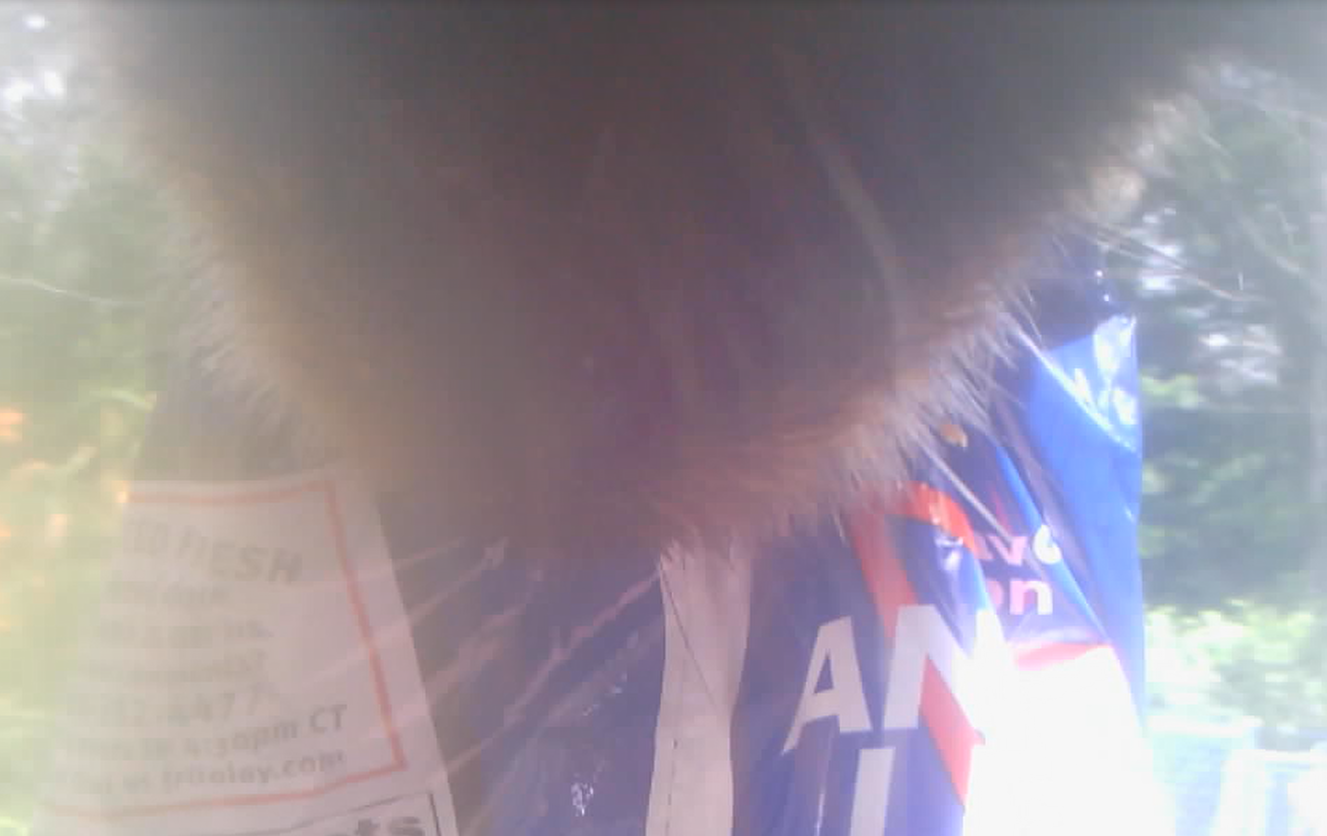
A bear is seen in a video screengrab taking a bag of Doritos. The state Department of Energy and Environmental Protection attached cameras to a handful of bears in the state to monitor their habits.
Courtesy of CT Department of Energy and Environmental Protection
Of the 32 black bears tracked by Jason Hawley and his team at the Connecticut state Department of Energy and Environmental Protection, his favorite was the bear known only as “250.”

250 was already collared when Hawley started at DEEP 22 years ago and, over the course of that time, the bear learned a bit about human behavior herself.
Article continues below this ad
“She used to just play games with us. Every year we have to go in and change the battery on their collar. She just knew I was coming,” he said. “I can remember one time I went after her in a snowstorm, because sometimes they lose their senses a little bit when it’s windy or it’s snowing, and next thing I know, she’s up on this ridge just looking down at me. I swear she was smiling.”
Biologists use collars to track bears, often entering dens when they believe the bear is hibernating and administering a sedative to make sure the animal remains asleep.
There are now about 1,100 black bears in Connecticut, with each female bear, or sow, birthing an average of 2.5 baby bears per year. As the state’s bear population grows, Hawley said it’s important to study the bears, both to help protect the bears and the people they are increasingly coming into contact with.
Article continues below this ad
Make CT Insider a preferred source on Google to see more of our journalism when you search.
Add Preferred Source
Usually, bear collars have GPS trackers installed so biologists can track the bears’ movements but Hawley, a supervising wildlife biologist for the state’s black bear program, and his team recently finished a pilot program that involved affixing a video camera to the bears’ collars.
The cameras, which captured 30-second bursts of footage every 15 minutes, offered the biologists more insight into the lives of bears and how they interact with the world around them.
“A GPS collar can only tell you so much, right? Because it’s just a point on a map. It shows us how a bear moves through the landscape. We’re getting a location every 30 minutes,” Hawley said.
Article continues below this ad
A bear is seen in a video screengrab walking in the woods and spotting another bear. The state Department of Energy and Environmental Protection attached cameras to a handful of bears in the state to monitor their habits.
Courtesy of CT Department of Energy and Environmental Protection
For example, Hawley has theorized that bears choose which kind of garbage cans to open, avoiding the bear-resistant cans in favor of easier pickings. In summertime, when there is food aplenty, bears might gravitate toward one type of foliage and away from another. Hawley said this technology, as it continues to advance, will help biologists better understand whether those theories prove accurate.
“It’ll really shown us how these bears are making ‘decisions’ as they’re moving through the landscape, especially these more urban bears,” he said.
One resulting video clip shared with CT Insider shows a bear as she swims through a waterway, her snout at the top of the screen. Another clip shows a bear snuffling around someone’s back porch until she finds a bag of Doritos, which she promptly snatches.
Article continues below this ad
DEEP biologists call them “bear-cams,” and they offer information, Hawley said, “that will help us mitigate conflicts with the public, like things that bears are looking for when they’re moving through the landscape, things that those points on a map really can’t tell us.”
The next step is a partnership between DEEP, UConn and NASA to use bears to help verify information on ground-level plants obtained by orbiting satellites. After that, Hawley is hoping to expand the bear camera program.
A bear is seen in a video screengrab eating berries. The state Department of Energy and Environmental Protection attached cameras to a handful of bears in the state to monitor their habits.
Courtesy of CT Department of Energy and Environmental Protection
“Now we’re in the planning stages of getting a larger camera study going, maybe on 20 bears this time instead of four or five,” he said.
Article continues below this ad
Connecticut is home to a growing black bear population and, as the bear population grows, so does their range. In 2025, there were black bear sightings reported to DEEP in 79 Connecticut towns, according to the agency’s most recent “State of the Bears” report, released in March.
There are an estimated 1,100 black bears calling the state home, though Hawley noted that “bears don’t understand borders.” As the bear population increases and their range expands, human-bear conflicts are also on the rise.
The vast majority of bear-related incidents involve livestock or property, but there were three reported bear attacks last year in Connecticut. Since 2020, DEEP has verified 265 reports of bears entering homes, occurring in 38 different towns.
Over the last six years, Connecticut has averaged four home entries for every 100 bears every year, four times as many as any surrounding state. Both New York and Massachusetts, which have larger resident bear populations and similar human population density, average one home entry per 100 bears each year.
Article continues below this ad
A bear is seen in a video screengrab swimming. The state Department of Energy and Environmental Protection attached cameras to a handful of bears in the state to monitor their habits.
Courtesy of CT Department of Energy and Environmental Protection
That, Hawley said, is because Connecticut is the only state in New England with no legal bear hunt, with the exception of Rhode Island which is currently home to very few bears.
“You can kind of think of it as like human-driven evolution, right,” he said. “These bears are comfortable around humans and breaking into homes. They’re just not in those other states where you just have that slight, although constant pressure of removing those more habituated bears that are comfortable around humans.”
Massachusetts allows hunters to harvest no more than 6% of the state’s bear population, an annual average of 262 bears. But even that’s enough to teach bears to avoid human interaction.
Article continues below this ad
“That just keeps that natural, healthy fear of humans in them, and we just don’t have that in Connecticut,” Hawley said.
That was 250’s fate. She was nearing her 30th birthday – “Which for a bear is very old,” Hawley said – and wandered across the border during hunting season.
“She actually got shot in Massachusetts last year, which was a real bummer for me,” he said. “She was a good bear that didn’t cause any problems.”
Article continues below this ad