
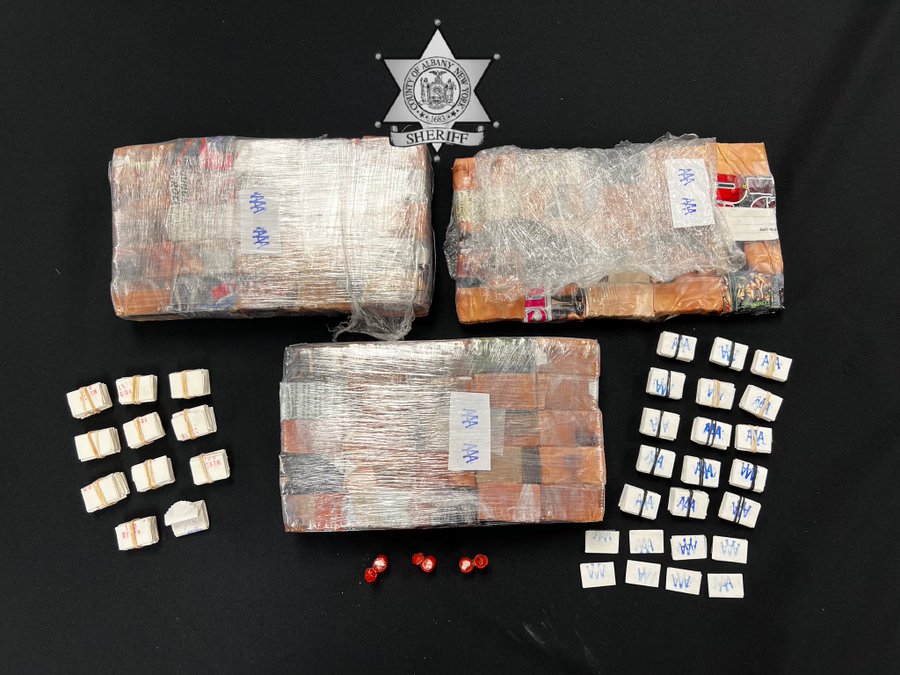
Medetomidine-linked overdose deaths in New York City rose from 18 in 2024 to 134 in 2025, according to preliminary death certificate data. This photo depicts $55,000 worth of heroin and fentanyl seized during a traffic stop by Albany County sheriff’s deputies.
Albany County Sheriff’s Office
ALBANY — A veterinary tranquilizer that can knock users unconscious for hours and trigger a dangerous withdrawal has quietly become one of the most common hidden ingredients infiltrating New York’s illicit opioid supply, according to new peer-reviewed research from state and New York City health officials.

The drug, medetomidine, showed up in about one in every four opioid samples tested at community drug-checking sites in New York from May 2024 through December, according to researchers from the state Department of Health and the New York City Department of Health and Mental Hygiene. Last May, the detection of the drug peaked when it was discovered in more than 44% of samples tested.
Article continues below this ad
The findings offer the clearest picture yet of how fast a new adulterant can take over a street drug market, and of the emerging human toll. Preliminary death certificate data cited in the research paper identified 134 overdose deaths in New York City last year in which medetomidine was a contributing factor, up from 18 the year before.
Medetomidine is not an opioid. It belongs to the same family of sedatives as xylazine, the animal tranquilizer better known as “tranq” that spread through the East Coast drug supply in recent years. It is almost always found mixed with fentanyl, sometimes alongside xylazine.
“It’s one of the higher adulterants that you would see that’s often associated with fentanyl,” said Dr. David Holtgrave, an adviser to the state Department of Health commissioner and a co-author of the study. “Xylazine was an earlier one, also a veterinary tranquilizer, and this one has come close to that.”
Make the Times Union a Preferred Source on Google to see more of our journalism when you search.
Add Preferred Source
Because the sedative does not respond to naloxone, the standard opioid-overdose reversal medication, responders face a more complicated response when treating it. Holtgrave said bystanders should still give naloxone because fentanyl is usually present, then stay with the person, protect their airway and call 911.
Article continues below this ad
Hospitals have been seeing patients arrive in a deep sedation, often with very low blood pressure and shaking, followed by severe withdrawal marked by racing heart rates, heavy sweating and uncontrollable vomiting.
State and city officials first detected medetomidine in an upstate sample in May 2024 that had been sold as heroin but produced unexpected sedation. Within months, routine testing picked it up in more than 20% of opioid samples, and the levels have stayed around 30% recently.
The state Department of Health began distributing 15,000 medetomidine test strips to partner organizations in January, and has issued public alerts to drug users, harm reduction groups and clinicians.
The death toll figures are not final. The study notes cause and manner of death for 2024 and 2025 cases are still being investigated, and additional medetomidine-linked deaths could be identified. It is also possible that part of the documented rise reflects expanded testing rather than a pure increase in prevalence, though Holtgrave said the persistence of the drug in recent months suggests a real market shift rather than a testing artifact.
Article continues below this ad
He acknowledged the data cannot explain why medetomidine spread so quickly, only that it did.
“We may not always know exactly the cause, why it has increased so much, but the first thing that we need to be able to do is to identify these trends,” he said.
For Holtgrave, the deeper question is whether New York can catch the next unknown substance earlier than it caught this one. The state’s public drug-checking dashboard now tracks a growing list of adulterants, and officials plan to add new ones as tips come in from users and labs.
Article continues below this ad
“Every overdose is too many,” he said. “When we see the numbers moving like that from one year to the other, it really tells us this is a time-sensitive issue.”