
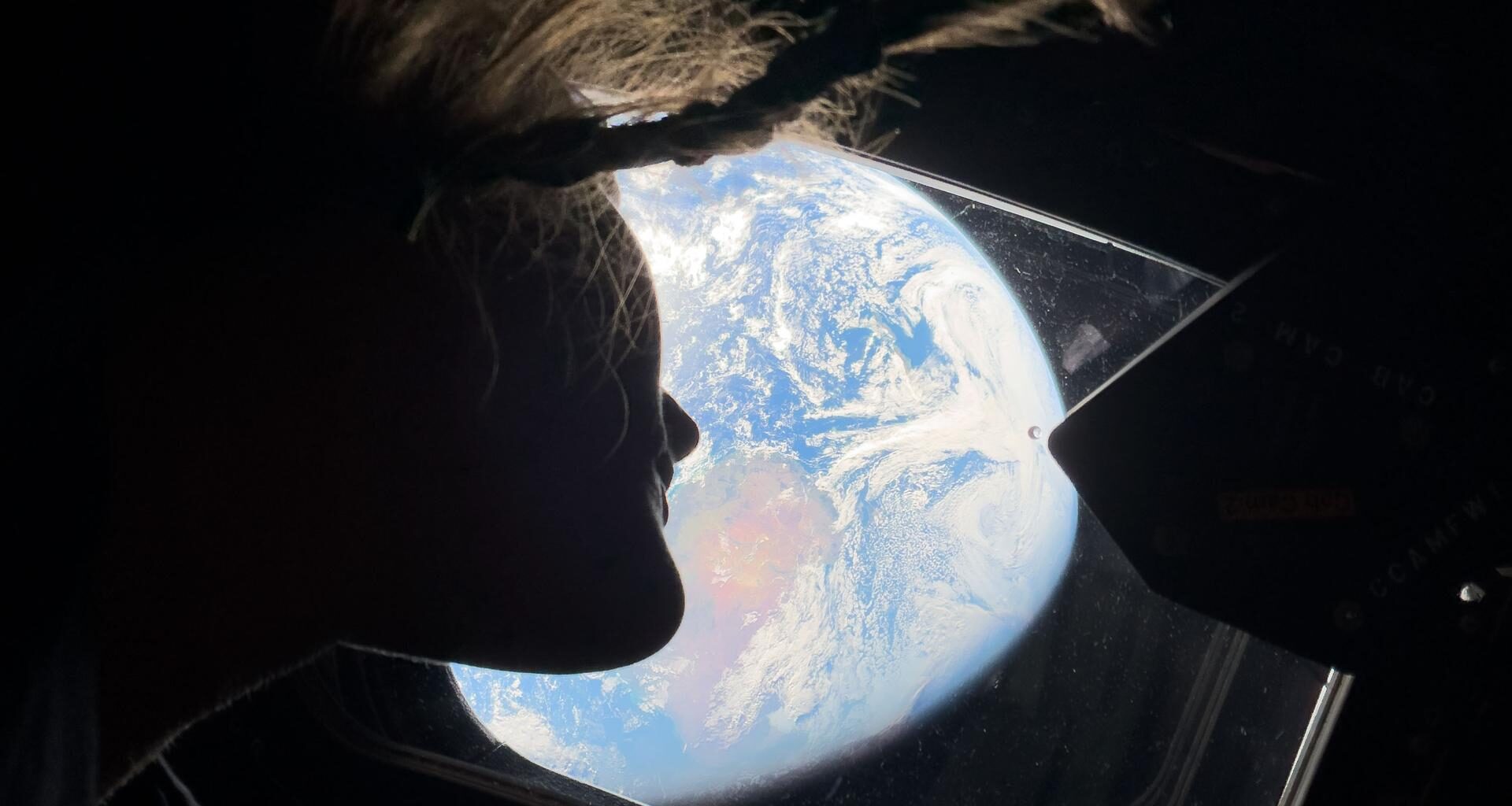
NASA astronaut Christina Hammock Koch peers out of one of the Orion spacecraft’s main cabin windows, looking back at Earth, as the crew travels towards the moon on April 4, 2026.
NASA
Artemis II was more than a moonshot.
It was a chance to board the Orion spacecraft with four astronauts who loved their jobs, worked cohesively as a team and successfully flew around the moon.
Their joy was contagious. Their accomplishments were awe-inspiring. And humanity is still “Basking in Reflected Glory” – or BIRGing, as psychologists call it. It’s the phenomenon that occurs after a sports team wins.
Article continues below this ad
“I didn’t have anything to do with these astronauts going on this mission around the moon, but it makes me feel proud of humans and what we can do,” said Eden King, a psychology professor at Rice University. “And I can bask in that as well.”
ARTEMIS: What’s next for the Artemis program? When NASA could return to the moon — and its race with China
The Artemis II mission lasted nine days, one hour and 32 minutes. Its novelty – flying humans around the moon for the first time since 1972 – snagged headlines in a fragmented, 24/7 news cycle.
Then NASA’s live video helped people connect with the crew: NASA astronauts Reid Wiseman, Victor Glover, Christina Hammock Koch and Canadian Space Agency astronaut Jeremy Hansen.
Article continues below this ad
Glover was the first Black man to fly around the moon. Koch was the first woman, and Hansen was the first Canadian.
People saw themselves in this crew. And with the live video, they watched as the astronauts worked inside their capsule. They listened as the crew excitedly described seeing the Earth and moon.
And many of the astronauts’ comments focused on unity and the beauty of humanity.
“You look amazing. You look beautiful,” Glover said to those on Earth, speaking in an interview with ABC News. “And from up here, you also look like one thing. Homo sapiens is all of us, no matter where you’re from or what you look like. We’re all one people.”
A poignant moment came after the crew suggested naming a crater for Wiseman’s late wife, Carroll, who died from cancer in 2020. The Artemis II astronauts could be seen wiping away tears and embracing in a group hug.
Article continues below this ad
King at Rice said humans subconsciously compare themselves to others — especially others that look or act like themselves. The astronauts’ openness to sharing their perspectives made a difference on this mission.
“When we see and get to know these people through their public relations, and when they look like us, they genuinely inspire us,” King said of the Artemis II astronauts. “We make those associations between what they’re doing and what we could possibly do.”
Craving a shared experience
Humans are not new to space. The International Space Station has been sheltering people for an uninterrupted 25 years, and its crew members often share photos and participate in live videos.
But King said the station’s longevity no longer interrupts human consciousness. It has been taken for granted. The Artemis II mission was new — and just short enough to remain relevant for today’s attention spans.
Article continues below this ad
PHOTOS: NASA’s Artemis II mission captures stunning photos of the Earth, moon and Orion spacecraft
King also believes people were searching for good news. The joy and excitement across NASA was contagious.
Josh Hicks, a professor of psychological and brain sciences at Texas A&M University, believes people have been craving this type of shared experience. Artemis II gave them a sense of connection and trust.
“We’re in a funk as a country,” Hicks said. “We’re divided. People are stressed. People are distrustful of other people. Everyone — on both sides of the political spectrum — kind of hate the state of the world right now. It’s just so divisive.”
‘Most people want things to be all right’
Hicks studies how people experience a state of awe, which he described as an emotion felt in the presence of something bigger than oneself. It’s standing at the rim of the Grand Canyon or listening to an inspiring speech.
Article continues below this ad
He believes watching the Artemis II launch, seeing its moon pictures and welcoming the astronauts back home gave people that awe, which triggered hope and curiosity for the future. It also reaffirmed their sense of connection.
“Most people want peace. Most people want to trust their neighbors,” Hicks said. “Most people want things to be all right again. And I think seeing these stories reminds us of the good in humanity.”
HOME: The four Artemis II astronauts made an emotional return to Houston. Here’s what they said.
People also love a good mystery, Hicks said. And the questions around what the astronauts would see, experience and learn were a chance to feel wonder and to think about new possibilities.
For King, Artemis II highlighted a psychology theory called shared or superordinate identity. She said giving people a shared goal can highlight their similarities and reduce conflicts.
Maybe, she said, seeing the Artemis II mission was a reminder of “the shared humanity within all of us.”
“We see these amazing humans,” King said, “and we think, ‘Wow, we can be amazing humans, too.’”