
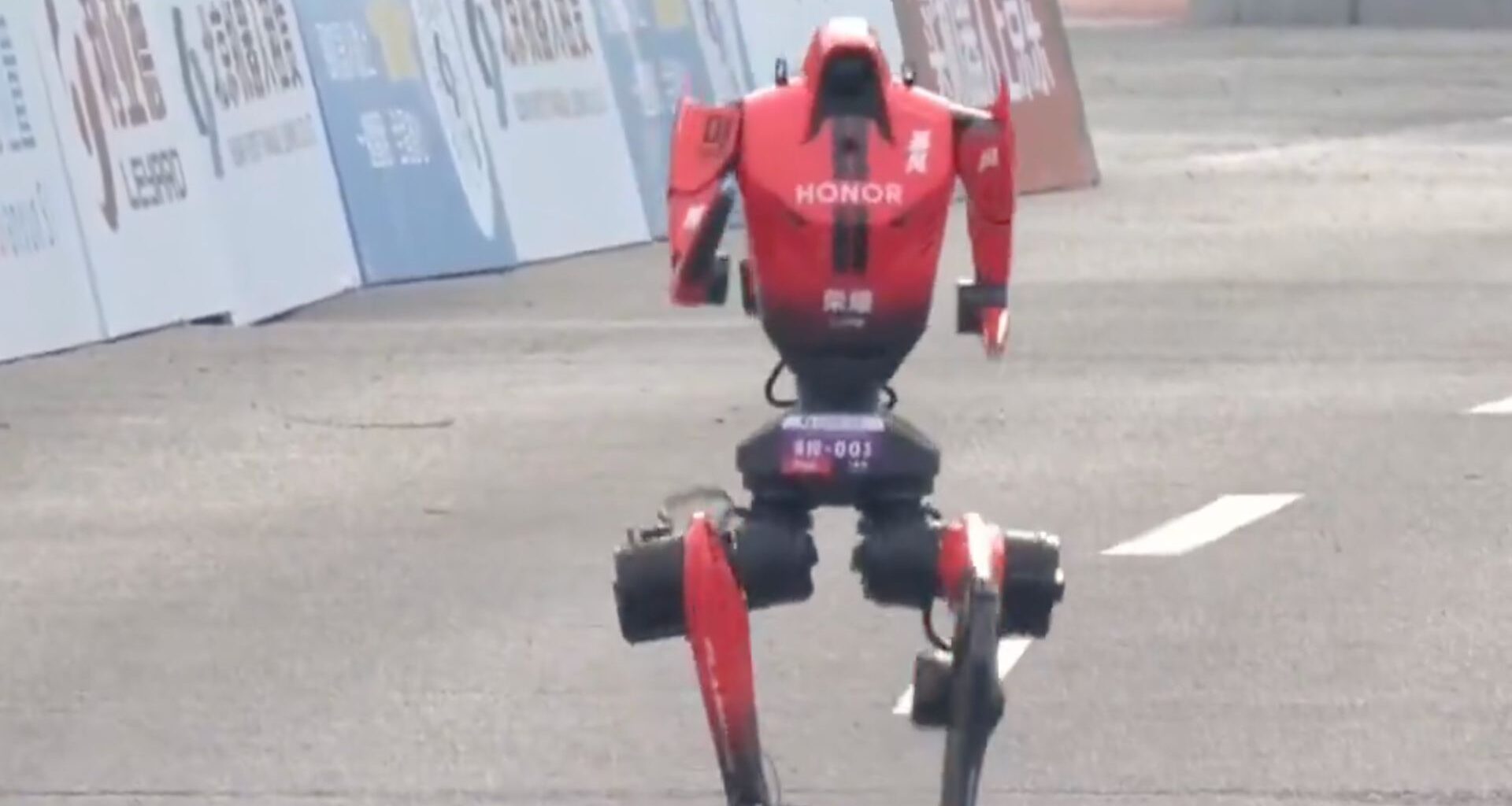
Beijing has officially hosted its second Robot World Humanoid Robot Games half-marathon on Sunday (April 19). Won by team Honor’s “Lightning,” the humanoid runner completed the race in just 50 minutes and 26 seconds.
However, it was not the fastest robot; a remotely controlled variant of the same robot completed it in 48 minutes and 19 seconds. But, due to the rules of the race, only the autonomous navigation variant was given the prize.
Standing at around 5.54 feet (1.69 meters) tall, the mecha-style “Lightning,” according to reports, was the first consumer-grade humanoid to complete. It was “several minutes faster than the world record set by Jacob Kiplimo last month in Lisbon,” reported The Guardian.
According to reports, a total of 100 teams running 300 robots from 26 brands entered the competition. Five of the teams were international, with the others domestic. That’s about five times larger than the inaugural race, with international teams from France, Germany, and Brazil present.
Second robot marathon a success
Notable entrants included Honor’s Yuanqi Zai and Lightning, Unitree’s H1, Tiangong 1.0 Ultra, Tiangong Ultra-2026, Tiangong Ultra-2025, and Noetix Robotics’ B2. 2025 Runner-up team, Songyan Dynamics, sent six of its own autonomous navigation teams and six remote-controlled teams, all equipped with its self-developed full-size humanoid robot B3.
Standing at 6.56 feet (2 meters) tall, this particular robot comes with a 72-volt high-voltage platform and a water-cooled motor system. Other robots, like Unitree’s H1, in particular, are capable of reaching speeds of about 22.37 mph (10 m/s) over short distances.
To put that into perspective, one of the fastest humans on Earth, Usain Bolt, managed to reach 23.55 mph (10.44 m/s), so humanoid robots are catching up fast.
Entrants had to meet some basic criteria, including either being fully autonomous (making their own decisions using AI and sensors) or remotely controlled (piloted by a human), with the competition putting an emphasis on the former over raw speed.
Compared to the inaugural race in 2025, the performance of entrants this year was very impressive indeed. Last year’s winner, Tiangong Ultra, completed the race in 2 hours and 40 minutes.
With a winning time of just under 50 minutes this year, that’s something close to a 3x improvement in performance in just a single year. However, since the first race was something of a proof-of-concept, we can view this year’s results as more reflective of the technology.
Big improvement on the previous marathon
In fact, the first race was filled with technical issues, including many entrants not even starting the race. Many also failed, collided, or simply failed to finish.
This year’s competitors, on the other hand, all started cleaning, were able to maintain a stable pace, and ran with a much more “natural” motion. Given the technical difficulty of the task, it is truly impressive and reflective of just how far the technology has come.
Making a robot run is not a simple task and requires precise balance control, terrain handling (uneven surfaces), endurance, navigation, and anti-interference capabilities (noise, obstacles, etc).
Outside of entertainment, mastering these issues will greatly improve humanoid robot utility in things like search and rescue, military use, industrial use, and logistics.