Adding on to the transition guidance from last week, the Director of the United States Wildland Fire Service, Brian Fennessy, has released a new memo assigning authority within the USWFS. This document establishes authorities inside the USWFS covering:
Here is the body of the memo before we get into the assigned authorities. The effective date of this policy memorandum is May 17, 2026.
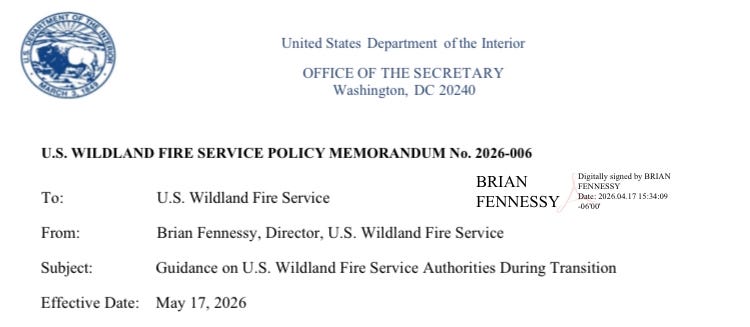
Purpose: This Policy Memorandum sets clear standards for assigning authority within the U.S. Wildland Fire Service (USWFS) to ensure effective, legally compliant management during the transition to unified wildland fire operations. It supports coordination across USWFS and Departmental Bureaus, promotes efficient decision-making at appropriate levels, and upholds strong interagency relationships in alignment with the Department’s mission.
Background: Secretary’s Order No. 3448, Establishment of the U.S. Wildland Fire Service, established a unified, national wildland fire organization charged with delivering safe, effective, and consistent fire management across the Department of the Interior through the USWFS. As we continue to build and mature this organization, it is imperative that every employee understands how authorities are structured and assigned within the USWFS and that there are no negative impacts to the Department’s wildland fire operational capability, readiness, or other missions.
The attached USWFS Authorities/Actions document provides clear standards and procedures for assigning, exercising, and reassigning authorities across the USWFS. This policy clarifies roles and responsibilities and enables decisions to be made at the lowest practical level, consistent with legal and Departmental requirements. This framework is essential to ensure consistent and efficient operations, particularly as we operate alongside our land-managing Bureau partners and within interagency environments. Many of you have deep ties to the Bureaus’ missions, and those values should continue guiding your work across all phases of wildland fire management. Recognizing communication as a core tenet of all fire operations, there is an expectation of professionalism in all communications with the Bureaus, while maintaining strong relationships and leading positive change.
All personnel should review this policy carefully. Geographic Area Fire Chiefs, Unit Fire Chiefs, and supervisors at all levels must ensure that authority assignments within their organizations are documented appropriately and that personnel understand their scope of authority, including any limitations. Authority must be exercised within established, legally compliant structures.
As with any new policy, questions will arise as we put these processes into practice. You are encouraged to work through your supervisory chain to resolve issues at the lowest appropriate level.
This policy represents a milestone in strengthening the foundation of the USWFS.
Thank you for your continued professionalism and commitment as we advance our mission and service to the American people.
The authorities are grouped by the official to whom each is assigned.
D/DD: Director or Deputy Director
GA FC/GA DFC: USWFS Geographic Area Fire Chief and Geographic Area Deputy Chief, Fire Chief
Unit FC: USWFS Unit Fire Chief
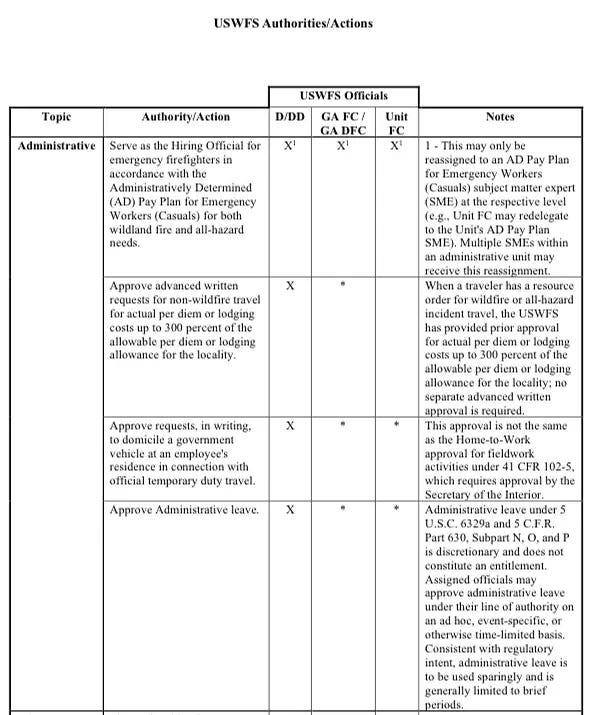
Administrative: Hiring, Non-Fire Travel, Gov Vehicles, Admin Leave
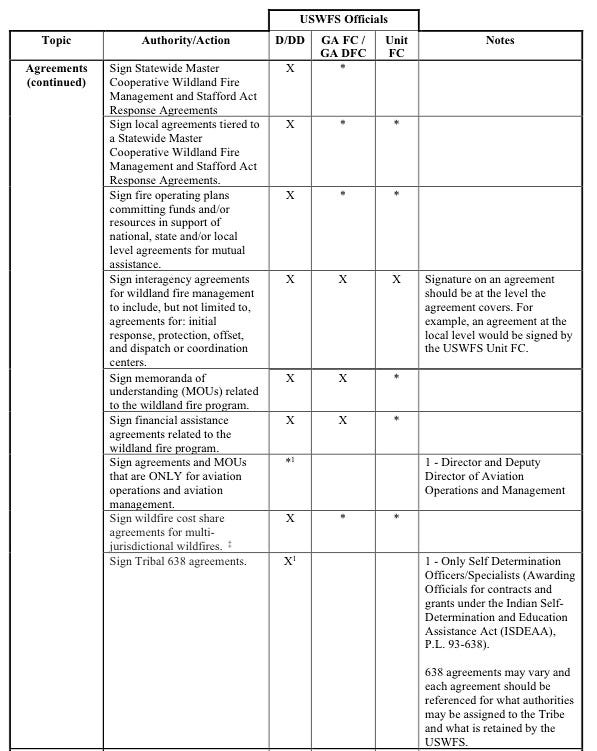
Agreements: National Mutual Aid, Master Agreements, Cost Share, etc.

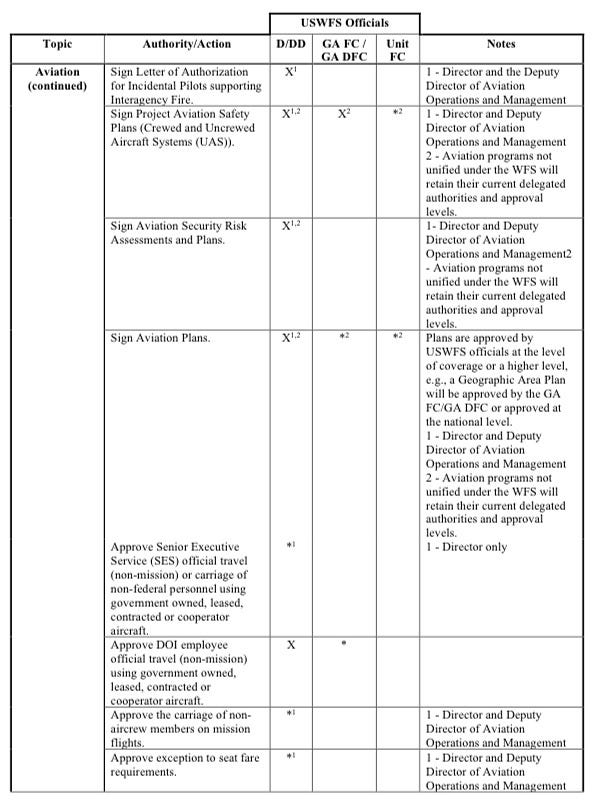
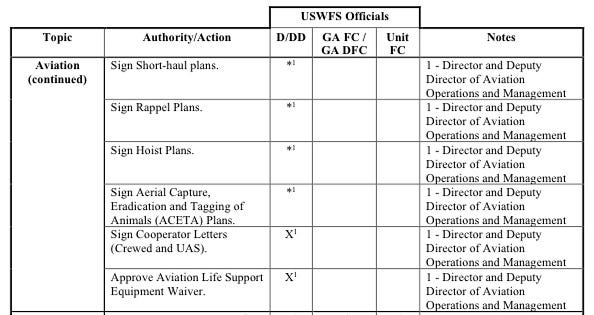
Aviation: STEP Plans, Pilot Authorization, UAS and Crewed Aircraft Safety, Short Haul, Hoist, etc.

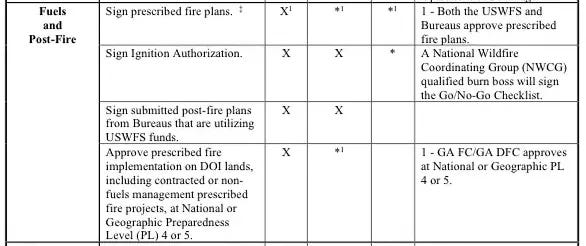
Fuels and Post Fire: Burn Plans, Ignition Authorization, Post Fire Plans, Prescribed Fire Approval at National PL4 or 5.
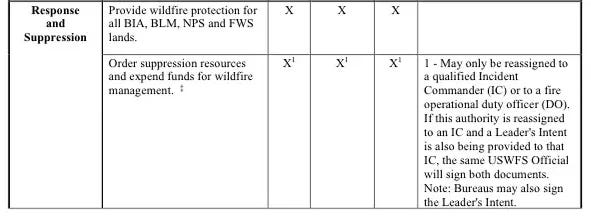
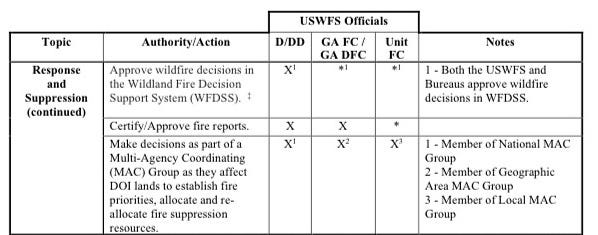
Response and Suppression: Jurisdiction, Ordering and Funds, Reallocating Wildfire Resources, etc.
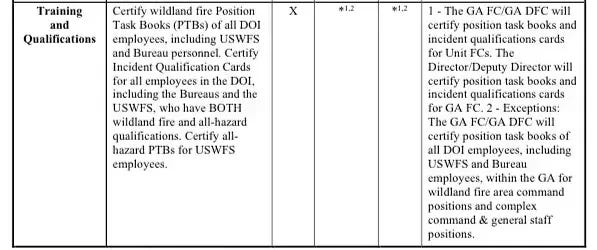
Training and Qualifications: Taskbooks, IQC Cards, etc.
An important note on reassigning authority and employees in detailed or temporarily promoted positions:
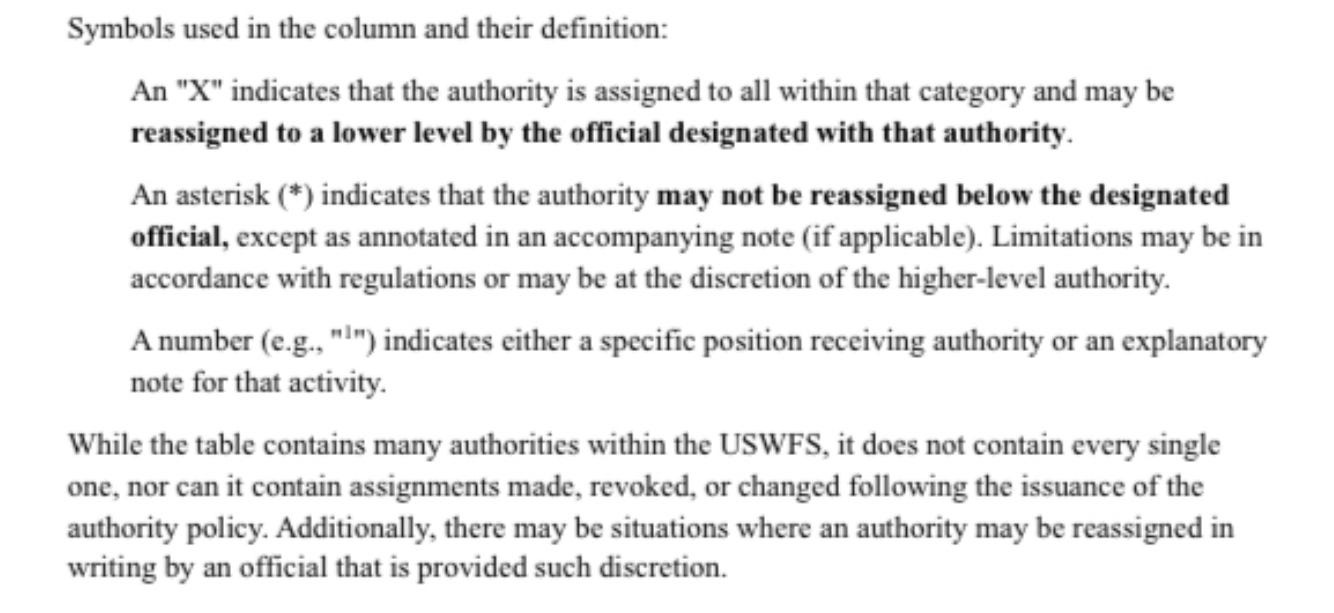
Any official to whom authority is assigned in the table below, or to whom authority has been assigned by other appropriate means, may, in writing. reassign or authorize reassignment of such authority, unless reassignment of authority is specifically prohibited or is limited. The written notice must be signed by the official reassigning the authority and sent to the position receiving the authority. Assignments must be limited by either an end date or an end condition (e.g., “until the wildfire is called out or “until superseded or revoked”).
Employees detailed or temporarily promoted to positions covered in this authority policy will assume the responsibilities and ability to exercise authorities assigned to that position and will sign documents as “Acting.”
An individual may be designated as an acting official for a specified period of time if the USWFS position with the assigned authority is unavailable. These designations must be in writing and include the specified time period an individual will serve in an acting capacity. Individuals serving in an acting capacity must use judgment in exercising these authorities. This includes considering the relative importance of an issue, whether the issue could or should be deferred, and the known preference of the individual for whom that person is exercising authority.
Actings may be designated either by individual designation (e.g., Mark Pierce will be acting from January 12 – January 15 or Mark Pierce will be acting from July 3 until further notice.) or by a standard acting rotation (e.g., Joe Smith will be acting for January, Mary Johnson will be acting for February, etc.). These designations should also include any necessary limitations on authorities for an individual serving in an acting capacity.
Only one individual may be designated to exercise authority for a specified period of time, unless a unique situation applies.
Unique Situations:
Individuals serving in an exercising authority capacity assume all the authorities of that position unless authorities are withheld. If an authority is withheld, a designated exercising authority official for that authority will be assigned to ensure continuity of operations. An example for the USWFS of a unique situation would be if a local unit had multiple wildfire incidents with incident management teams assigned and needed additional support to serve as the USWFS Agency Administrator, who is assigned the ability to exercise wildfire authorities such as signing a cost share agreement, for each incident.
The USWFS Unit Chief could provide a reassignment of authority to a USWFS employee to be the acting USWFS Unit Chief for an individual incident, reassigning only the authorities related to wildfire incidents for a USWFS Agency Administrator, but would withhold the other authorities held by a USWFS Unit Chief.
Reassignment of an authority does not preclude that USWFS official from later revoking that authority from the lower level or requiring concurrence to exercise that authority from a higher-level official. An assignment or reassignment of authority may be revoked at any time by providing written notice to the position(s) involved.
That’s the policy memo. I welcome any thoughts on what has been released.
THE HOTSHOT WAKE UP — Thank you to all of our paid subscribers. Your support allows us to donate generously to firefighter charities and supports all of our content. You also receive all of our article archives, more podcast episodes, Monday morning workouts, and also entered into our giveaways, plus more.