
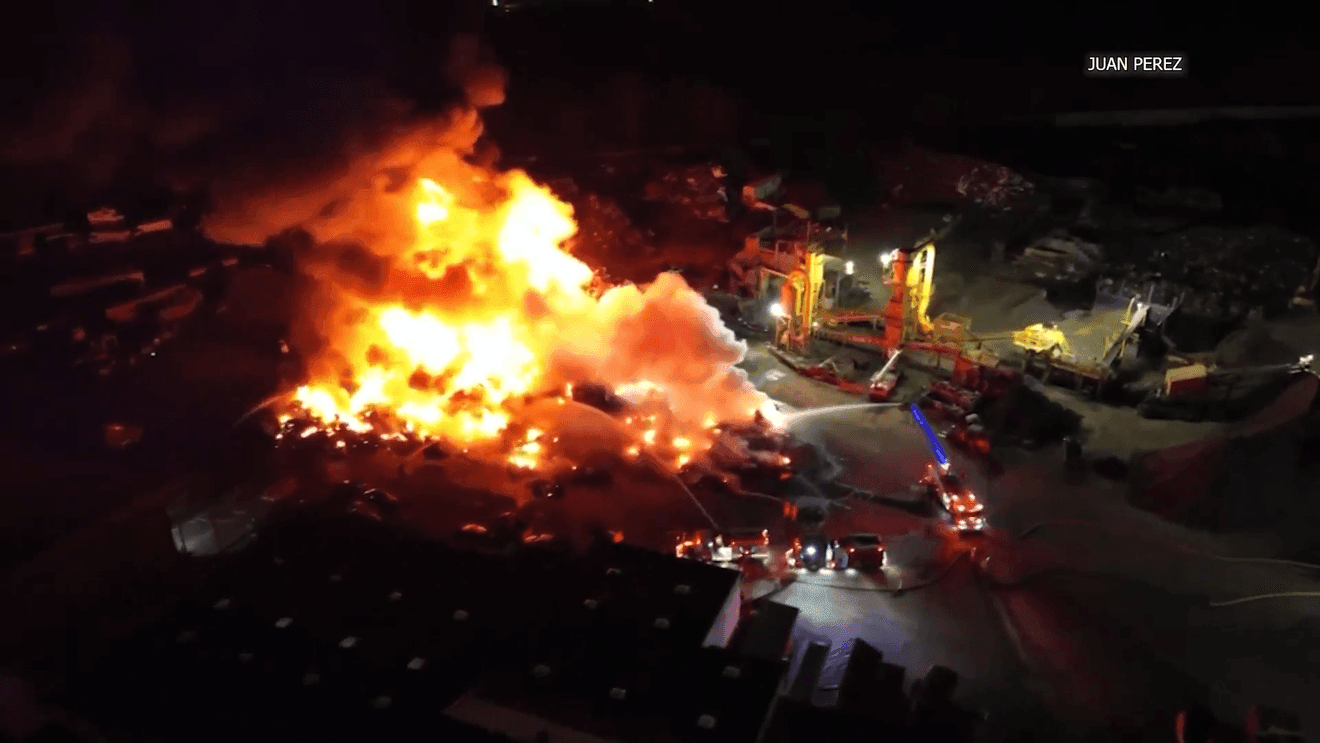
KALAMAZOO, Mich. — Following a large fire at Kalamazoo Metal Recyclers Inc. on March 9, the city’s Environmental Concerns Committee (ECC) is calling on city commissioners to take a closer look at the environmental impacts.
Clerk Scott Borling shared the formal recommendation during Monday night’s city commission meeting.
The metal recycling plant caught fire after 7:30 p.m. on March 9 and crews worked to put it out for more than 10 hours, using over one million gallons of water to eventually extinguish it, according to emergency responders.
Black smoke and the glow of flames could be seen miles away from the plant.
No one was hurt in the fire and Kalamazoo Department of Public Safety (KDPS) said in late March the fire’s cause is officially labeled as “undetermined.”
The flames were contained to a pile of metal waiting to be recycled, according to initial reports.
However, following the initial response, KDPS crews said near the scene higher-than-normal levels of small air particles called of PM2.5 were recorded, which can cause lung irritation and breathing issues.
City officials also said they would be monitoring waterways and storm sewers for oil.
During Monday night’s public comment period, a couple of residents called this approach the “bare minimum,” echoing the ECC’s request for more to be done.
At their March 18 regular meeting, Kalamazoo’s ECC voted unanimously to ask the city for a report on the fire’s environmental impacts, stating an “inadequacy of current monitoring protocols,” according to meeting minutes.
They want the city to follow-up on four questions:
What air pollution was released (including the precise composition of the PM 2.5 pollution)?What potential water pollution has been washed into the waterways (in addition to oil)?How the City of Kalamazoo is going to communicate this information to all residents, particularly those in impacted areas?What steps the City of Kalamazoo is going to take to continue to monitor the environmental impacts of this fire?
City Commissioner Jeanne Hess reported that Michigan’s Department of Environment, Great Lakes and Energy (EGLE) found “no issues with contaminated runoff,” however, ECC committee members emphasized a need for more “granular data.”
ECC Associate Member Katie Meyer Teper said “surface wipe sampling” and “soil testing” should be performed within a five-mile radius to detect lithium-ion contaminants or heavy metals that may have settled after becoming airborne.
Several community members spoke at ECC’s March 18 meeting to express concerns about the fire, including a lack of transparency regarding what the burning metal was made of, and subsequently, what it let off into the air as it burned.
The ECC’s initial resolve involved asking the city to send out a public statement regarding the status and stage of the fire investigation, a formal plan for improved resident communication during emergencies and protocol for long-term environmental monitoring of impacted areas.
Their letter shared with the commission during Monday night’s regular meeting, however, only addressed the environmental impact report.
Aside from the clerk’s report of receiving the ECC letter and a couple public comments, there was no further discussion about the issue during Monday night’s meeting.