
For the 2025 Detroit Lions, there were basically two different seasons. There was the 5-2 mark they put up before their bye week… and then, there was the 4-6 mark down the stretch as the team’s injury history was even worse than it was in 2024. For the second time in the last four seasons, Detroit finished 9-8 and missed the postseason. The first time was in 2022, when general manager Brad Holmes and head coach Dan Campbell were building the team that went a combined 27-7 in the 2023 and 2024 regular seasons.
Now, Holmes and Campbell are trying to get things back on track, and the draft is going to be a major part of that equation.
“Not really,” Holmes said on April 13, when asked if he feels more pressure to draft for need when his team is now an every-year contender. “I actually think you can get in trouble by doing that, because you might start to reach for a certain player because you feel like you need that position, and you never want to feel that way when you select a player. You passed up a really good player that you liked even more, but there is a question mark on your roster, so you just go ahead and get that player that you weren’t as excited about.
“I know for me, it’s hard to sleep at night when you do that, when you don’t get the player that you really, really wanted because you reach for a need. If that reach – you already reached for it – so you already reached for a player that you weren’t as fired up about, but it fits a certain position, what if the player shows or demonstrates the reason you weren’t as fired up about him? So now, you’ve reached for the guy, and the guy’s not even performing up to standard – the same reason why you had reservations about him. Now you’re really in trouble. That’s why I think you have to be careful.”
With that said, here are six prospects at positions of need who present ideal fits for what the Lions want to do and where they need to improve.
Monroe Freeling, OT, Georgia

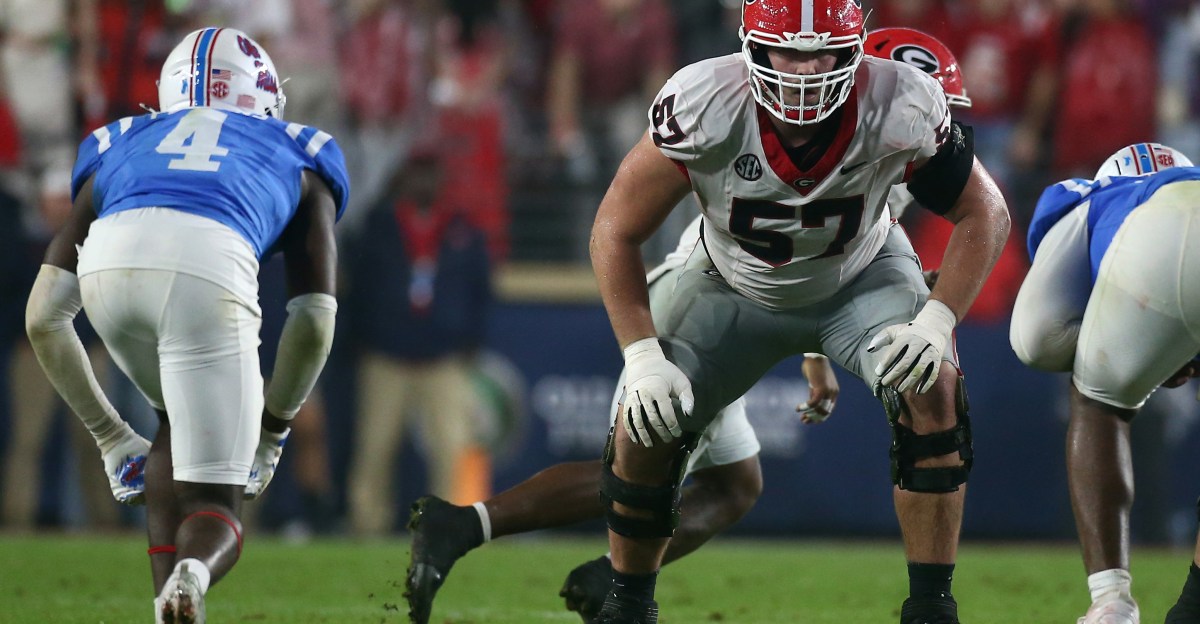
NEW ORLEANS, LA – JANUARY 01: OL Monroe Freeling #57 of the Georgia Bulldogs readies to block during the College Football Playoff Quarterfinal at the Allstate Sugar Bowl between Ole Miss Rebels and Georgia Bulldogs on January 1, 2026, at Caesars Superdome in New Orleans, LA. (Photo by David Buono/Icon Sportswire via Getty Images) Icon Sportswire via Getty Images
When Holmes said this about offensive tackle prospects in that April 13 pre-draft presser, and I read the transcript, I immediately thought of Monroe Freeling, and the need for a Taylor Decker replacement.
“I think any time you’re dealing with a rookie, I don’t care where you’re drafting, you’re going to have to be prepared for a little bit of a growth period. It’s hard to say. Some guys may be a little bit more ready, but you just never know. I can’t really give you a good answer on that one in terms of day one right now because any time you draft a rookie, you have to be prepared for some development and growth period.”
Which would bring Freeling into the discussion, because the athletic traits and the good tape are NFL-conversant right now. Last season for the Bulldogs, the 6-foot-7⅜, 315-pound Freeling allowed two sacks and eight total pressures in 469 pass-rushing snaps, and his run-blocking when he was in phase was top-tier. ”When he was in phase” is a phrase that does a bit of lifting here, because at this point in his development, Freeling is still getting the hang of the nuances of the left tackle position. He needs to improve his technique and leverage, which is not uncommon for a guy who started for a year and a half in college, but when you look at the movement skills… well, that’s All-Pro right now. If Freeling was now the player he could be in a year or so, he’d be a top-five pick. That he could well be there at 17 speaks to the growth period Holmes understands and accepts.
Max Iheanachor, OT, Arizona State

INDIANAPOLIS, INDIANA – MARCH 1: Max Iheanachor #OL29 of Arizona State participates in a drill during the 2026 NFL Scouting Combine at Lucas Oil Stadium on March 1, 2026 in Indianapolis, Indiana. (Photo by Lauren Leigh Bacho/Getty Images) Getty Images
While Freeling is the option if the Lions keep Penei Sewell on the right side (which I think they should do), if they do move No. 58 over to his college position, that’s where Arizona State’s Max Iheanachor could come in — perhaps in the second round with the 50th overall pick. In 2025, the 6-foot-5⅞”, 321-pound Iheanachor allowed no sacks and 14 pressures in 484 pass-blocking reps, and as a run-blocker, he can demolish people inline or on the move.
Yes, lack of experience comes in here — Iheanachor’s family moved to California from Nigeria when he was 13 years old, and he was all about basketball until he graduated high school, when he enrolled at East Los Angeles College as a 240-pound tight end prospect once he caught the football bug. He didn’t become a big-school starter on the line until 2024, his second season with the Sun Devils, and there is an understandable developmental curve here, as well. But when you see the year-to-year improvements, and you understand how the movement skills Iheanachor developed in soccer and basketball transfer to the football field, this would be another investment in potential over finishing traits that could really pay off sooner than later.
Bottom line is, when you’re looking for offensive tackles in a generally underwhelming class, you have to pick your non-negotiables.
Nadame Tucker, EDGE, Western Michigan

Feb 26, 2026; Indianapolis, IN, USA; Western Michigan defensive lineman Nadame Tucker (DL61) during the NFL Scouting Combine at Lucas Oil Stadium. Mandatory Credit: Kirby Lee-Imagn Images Kirby Lee-Imagn Images
The Lions’ generally sketchy Edge Disruption Industrial Complex outside of Aidan Hutchinson got even sketchier when former Secret Superstar Al-Quadin Muhammad took his 12 sacks and 53 pressures (his 2025 numbers) to the Tampa Bay Buccaneers on a one-year, $4 million contract with $2.5 million guaranteed. Take Hutchinson and Muhammad out of the picture, and the 2025 Lions’ edge group as it stood was good for a total of five sacks and 22 total pressures.
Given how the Lions were limited in free agency by their cap situation, any help is going to have to come through the draft, because while DJ Wonnum (another former Secret Superstar) is a nice addition on his one-year, $3 million contract, having two true alpha bookends as edge disruptors is the ideal.
So, we’re going with two outside guys here. Western Michigan’s Nadame Tucker is more the pure speed end, and Auburn’s Keldric Faulk is the multi-gap power player. Let’s start with Tucker, who exploded onto the scene with the Broncos last year after three nondescript seasons at Houston. He had 14 sacks, 61 pressures, six tackles for loss, four forced fumbles, 31 solo tackles, and 37 stops. And if you’re concerned about strength of competition, look no further than the 2025 season opener against Michigan State, when Tucker blew out two different left tackles on his way to a two-sack, seven-pressure performance.
Keldric Faulk, EDGE, Auburn

AUBURN, ALABAMA – OCTOBER 11: Keldric Faulk #15 of the Auburn Tigers lines up against the Georgia Bulldogs during the second quarter at Jordan-Hare Stadium on October 11, 2025 in Auburn, Alabama. (Photo by Kevin C. Cox/Getty Images) Getty Images
Now, if the Lions would prefer to pair Hutchinson with more of a power guy, I’m very positive on the potential of Auburn’s Keldric Faulk. The question teams are asking about the 6-foot-5⅞”, 276-pound Faulk is this: Are we getting the Keldric Faulk who put up nine sacks and 45 pressures in 2024, or the Keldric Faulk who had two sacks and 30 pressures in 2025?
I would argue that you’re getting the same player who, in 2024, was better-utilized as a multi-gap spinner who used his size and athleticism to work gaps to the quarterback. Faulk was more of a traditional edge-rusher in 2025, and while that worked well at times — he gave Alabama’s Kadyn Proctor all kinds of hell on several almost-sacks, for example — we should also remember that Proctor turned 20 last September 7, and he’s still putting things together.
So, at his best, maybe Faulk isn’t the best pure edge guy in a very deep class, but that will likely push him into the second round, and the splash tape is good enough to make you think that over time, he could be, and in the interim, he could be a real problem for opposing offenses as a guy who will line up everywhere and make protection calls more difficult than those offenses would prefer.
Jake Golday, LB, Cincinnati

CINCINNATI, OH – OCTOBER 25: Cincinnati Bearcats linebacker Jake Golday (11) in action during the game against the Baylor Bears and the Cincinnati Bearcats on October 25, 2025, at Nippert Stadium in Cincinnati, OH. (Photo by Ian Johnson/Icon Sportswire via Getty Images) Icon Sportswire via Getty Images
We all remember when everybody thought that the Lions were nuts for taking Jahmyr Gibbs and Jack Campbell in the first round of the 2023 draft, because running backs and linebackers don’t matter, and how that actually turned out in both cases. Anytime you can get true tone-setters on both sides of the ball in one first round, that’s pretty good.
One reason that Campbell has been so important to the Lions is his two-level ability — not just as an off-ball linebacker, but also as a weapon on the edge from time to time. Last season, Campbell spent 20% of his snaps on the defensive line, and that’s where two of his five sacks, and six of his 17 pressures, came from. Detroit also has Derrick Barnes as a workable two-level ’backer, but with Alex Anzalone off to Tampa Bay, there’s a need for an athletic rover who can help out in multiple roles.
And that’s where Cincinnati’s Jake Golday comes in, probably in the second or third round. Last season, the 6-foot-4½”, 239-pound Golday had 70 tackles, 43 stops, four tackles for loss, a forced fumble, four sacks, 18 pressures, and in coverage, he allowed 25 catches on 35 targets for 217 yards, 121 yards after the catch, two touchdowns, no interceptions, three pass breakups, and an opponent passer rating of 106.5. Golday could help immediately as a rotational edge player—he played 52% of his snaps last season somewhere on the defensive line and 49% on the edges—but he also can blow up run fits and cover everywhere from the box to overhang. Golday is the type of player whose acumen matches his athleticism pretty well already, so he’d be a functional piece of the defense sooner than later.

MIAMI GARDENS, FLORIDA – JANUARY 19: Keionte Scott #0 of the Miami Hurricanes reacts during the second quarter against the Indiana Hoosiers in the 2026 College Football Playoff National Championship at Hard Rock Stadium on January 19, 2026 in Miami Gardens, Florida. (Photo by Megan Briggs/Getty Images) Getty Images
There are players you love because of what they can do; other players just stick and stay on your radar because of who they are. Miami defensive back Keionte Scott is one of those guys who impressed me in both ways. The tape and metrics are accentuated by a pro day performance in which the 5-foot-11¼”, 193-pound Scott ran a 4.33-second 40-yard dash with a 1.53-second 10-yard split, and good overall testing numbers.
As a player last season, Scott had 51 solo tackles, 36 stops, eight tackles for loss, two forced fumbles, and in coverage, he allowed 39 catches on 56 targets for 332 yards, 214 yards after the catch, no touchdowns, two interceptions, four pass breakups, and an opponent passer rating of 69.9.
Built like a linebacker/safety hybrid with a strong lower body for his size, and no issue whatsoever getting grimy when it’s time to tackle, Scott does need to work on the randomness to a point (15 missed tackles last season), but I’d work on that while I enjoy his all-out play style and field intuition as a box/slot/overhang enforcer. His addition to this defense would allow Kelvin Sheppard to deploy Brian Branch more as a deep defender, and the aggression would make Dan Campbell consume even more quad espressos after his Pantera-fueled morning workouts.