
Sign up for the Slatest to get the most insightful analysis, criticism, and advice out there, delivered to your inbox daily.
Like many twentysomethings, I ask my dad a lot of questions. What’s an easy weeknight recipe? How do I fix the leak under my sink? What does “federal withholding” mean? Lately, his answer is simple: Ask ChatGPT.
My dad, 57, got hooked on ChatGPT last year and hasn’t looked back. He uses it for everything, including home repair, precision online shopping, weather reports, and, oddest of all, planning hiking trips. My dad used to own a travel-guide bookstore. For the duration of my childhood, he planned every trip with a map in one hand and Lonely Planet in the other. When I asked him if he missed the old way, he shrugged. “The books were always getting outdated and they never had all the information,” he said. “It’s like being nostalgic for a rotary telephone.”
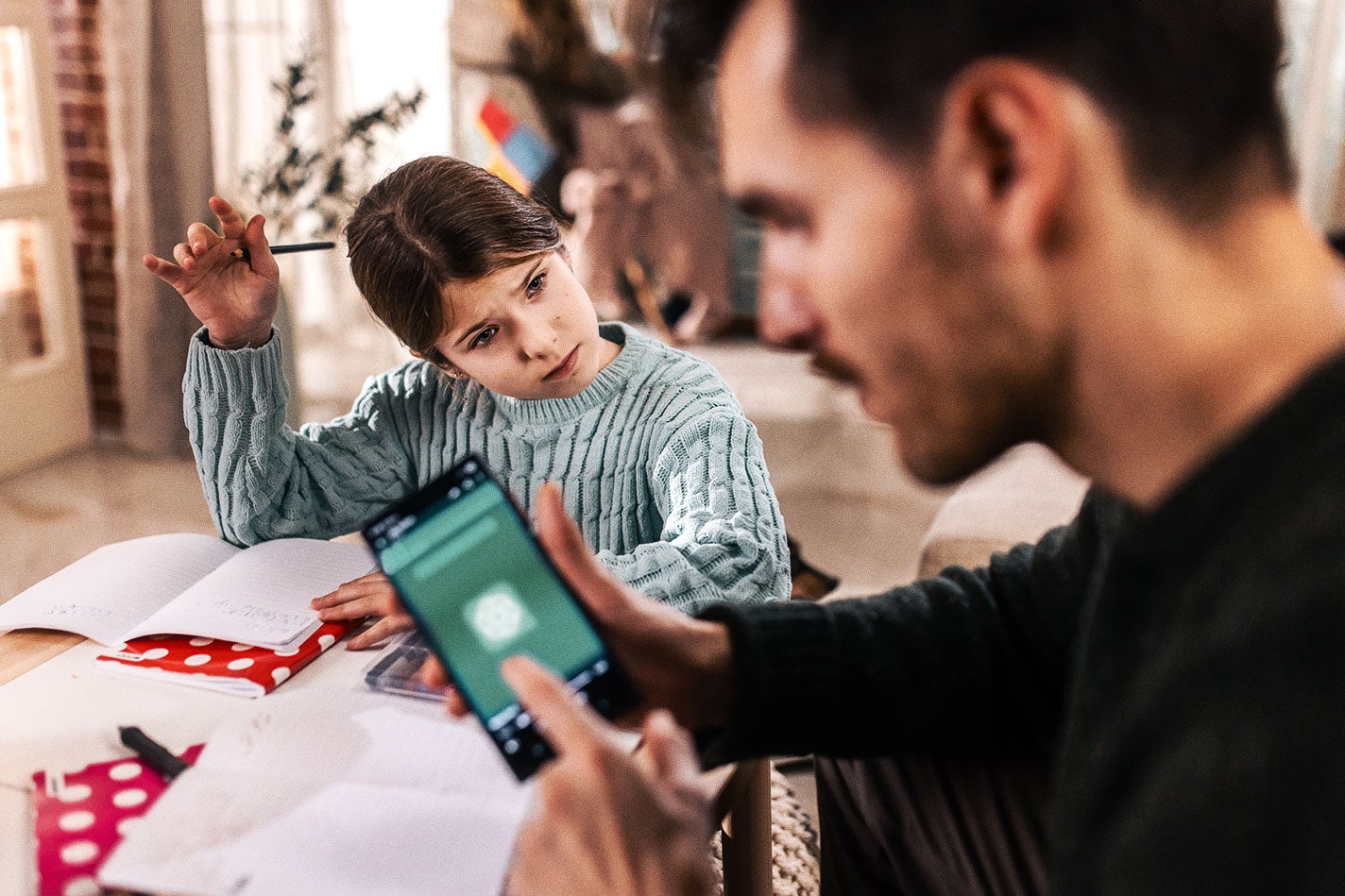
When he cooks dinner during my visits home, my dad introduces the meal like he always does, but he now acknowledges his sous-chef, ChatGPT, who developed the recipe. His eyes widen when he asks the chatbot a question during dinner-table conversation, holding up his phone so a robovoice can read the answer. It’s annoying, and it breaks my heart a little. My dad already knows how to cook dinner, plan hiking trips, and answer my questions—why does he need artificial intelligence? It feels like he adopted a robot child, and that child will stop at nothing to wedge a divide between my dad and me.
My dad is surprised by my aversion to ChatGPT; it’s usually the younger generation’s job to be tech-savvy. A 2025 Pew Research Center survey found that just 25 percent of U.S. adults ages 50 to 64 say they’ve used ChatGPT, compared to 58 percent of adults under 30. Statistically, I should be the one using ChatGPT at the dinner table. But we’re not the only parent-child duo experiencing this role reversal. There are plenty of other ChatGPT-obsessed parents, or as one TikTok user puts it, “ChatGPDads.” I’ve seen countless TikToks and Reddit threads highlighting this phenomenon. No matter what these parents are using ChatGPT for, from picking questionable bathroom paint colors to creating goofy images of themselves, there is one constant: an endearing sense of wonder. Parents like my dad repeatedly proclaim, “Can you believe it can do that?” or proudly say “Chat did this for me,” and are always on the lookout for new and unexpected ways to use their digital bestie. They’re enamored and trusting—so much so that it can worry their kids.
Of course, there are practical uses for A.I., and older generations aren’t exempt from in-office mandates to use the technology. Ken Potter, 61, lit up when he told me about how he uses large language models for his job as a real estate developer. He is endlessly impressed by how he can give the chatbot an image of an empty, dilapidated room and have it spit out a beautiful image for the contractors to copy. But he’s also discovered a use case in his family life: using LLMs to understand his teenage daughter. “She doesn’t know this, but sometimes she’ll do something and I just don’t get it. So I’ll ask it for advice and it’ll give me a bit more of her perspective,” said Potter. Recently, he asked his chatbot why Ellie, his 17-year-old, wakes up so late sometimes.
As a writer, I’m terrified of the ramifications of A.I. use for creative employment. Meanwhile, my dad is using it to write jokes. When a friend asked him whether he should serve bacon at his son’s bar mitzvah, my dad rushed to ChatGPT for a “funny Jewish good sayings line” for the situation. He went with: “Oy vey! Who knew the Torah portion came with a side of barbecue sauce?” Elsewhere online, people have chronicled their parents sending them A.I.-generated images of silly faces, videos of their kids turning into animals, and even songs. “I wake up to a new AI generated song based on our text messages every morning,” one daughter wrote about her dad. “I would almost understand his fascination if he didn’t have a literal fine arts degree.”
The work that LLMs can do is objectively impressive, but it doesn’t inspire awe in me the way it does for my dad. After all, I’ve had world-altering technologies introduced every so often for my entire life.
My generation grew up with limitations on technology: In school, we had rules about plagiarism and screen time, and lessons about how to spot fake information online. We’re trained to approach tools like ChatGPT with healthy apprehension. “You get some sort of uncritical, unreflective adoption amongst Gen X that you might not see as much [in] slightly savvier, younger generations,” said Elaine Kasket, a cyberpsychologist and author of Reset: Rethinking Your Digital World for a Happier Life. Gen Xers came of age during the inventions of the computer, pager, and cellphone, and the dot-com boom. They’re young enough to be excited about technology, and not as mistrusting as the baby boomer generation above them, said Kasket. (Just 10 percent of adults 65 and older say they’ve tried ChatGPT, per the Pew Research Center study.)
Athena, 18, says her father doesn’t understand that using LLMs in an academic setting is plagiarism. Her dad suggested she use ChatGPT to write her college essays (she didn’t), and then her stand-up comedy sets. (Comedian Gianmarco Soresi posted on X that his dad made the same suggestion.) Athena said her dad’s reliance on ChatGPT makes her nervous, and it’s changed how she views his critical thinking skills. Ever since he started using it, she fears that he’s not thinking for himself.

Foram Mehta
They Were the Most Sought-After Workers in America. Now They’re Unemployable. What Happened?
Read More
Ves Trujillo Navarro, 17, grew up in a family that monitored her screen time; now, it’s her parents whose constant phone use worries her. She said they’re so used to using it for everything that they even plug in directions on the ChatGPT app, despite it not having a GPS. It just writes out how to get somewhere. “Why wouldn’t we use Google Maps? I think [they] forget that there are other ways to function,” said Ves.
There’s a Seductive Recipe Style That’s Taken Over Our Stoves. Think Twice Before You Cook It Again.
My Dad Used to Give the Best Advice. Now He Has a Two-Word Answer to Every Question. I’m Not Alone.
“ChatGPT is like an adviser—he’s a friend. Sometimes he’s my stylist. He’s also like a husband that has no judgment,” said Saskia Rivelli, 53, who I found through her daughter Rhea Eliza’s TikToks. Her 25-year-old daughter tries to warn her mom about the artificiality of the app, reminding her that it’s more of a mirror than a window (not to mention, not a “he”). Rivelli said her daughter’s warnings have helped her pull back on “how deep” she engages with ChatGPT.
When I asked Kasket for advice on talking to parents about A.I. usage, she recommended something I hadn’t thought of: asking for attention. A few years ago, when I’d regularly FaceTime my dad to make sure whatever I was cooking looked safe to eat, he’d give me a full culinary lesson over the phone. Now, I get an enthusiastic referral to a chatbot. But I don’t want A.I.-assisted salmon—I want a family recipe.
I took Kasket’s tip, and told my dad that I missed the parent-child times before ChatGPT. I explained that when I call him to ask a question, I really just want to connect with him. I said I felt like ChatGPT was out to steal his job as an advice-giving father. He thought for a moment before responding. “ChatGPT will never be able to give as good advice as I can,” he said, “but it might give me some good ideas.”

Sign up for Slate’s evening newsletter.