
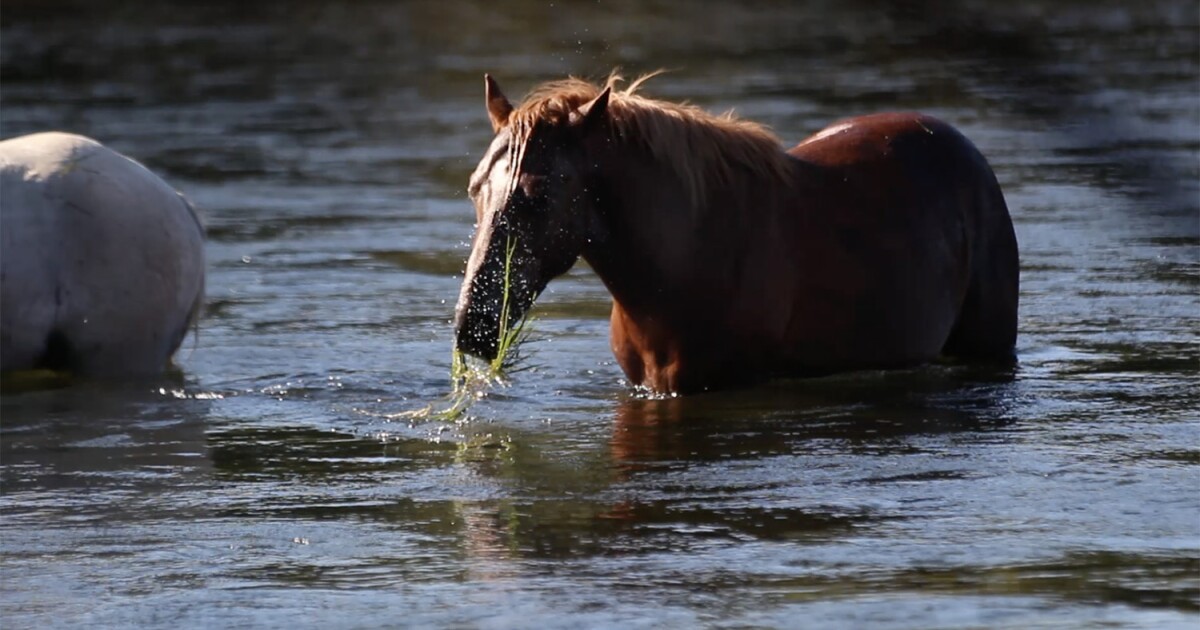
Over half of the Salt River wild horse population could be relocated in the next five years.
The proposal, set forth by the state’s Agriculture Department, intends to reduce the number of horses from 274 to under 120 in five years as part of a larger effort to maintain ecological stability and protect the herd, according to a press release.
But wild horse advocates, like Susie Bell, are calling the reduction plan a more aggressive version of one that expired last year.
Under the original program, the Salt River Wild Horse Management Group was on track to get the number of horses between 150 and 200.
“We would like to just have the governor allow the second half of the 10-year plan, get us to where it needs to be, in between 150 and 200 to have a genetically healthy herd for future generations,” Bell said.
The management group will continue to lead the reduction process under the new program, which was instated in February.
“There is no imperative, emergency to justify … taking such a drastic action, and removing over half of these beloved horses,” Bell said.
Newly appointed state Rep. Cody Reim has introduced a measure that would strengthen wild horse protections guaranteed in the Salt River Wild Horse Act, which was signed into law in 2016.
Angela Ganter is the subject of a new docudrama called “Outriding the Devil,” which will screen at Pollock Cinemas in Tempe on April 25. The Show spoke with her recently about the origins of her love of rodeo and living much of her life on horseback.
ASU and University of Arizona researchers are among more than 20 coauthors of a new article in the journal Science about a deadly split in a large group of chimpanzees.
Mexican gray wolves are one of the smallest wolf species in the world and among the most endangered. The animal’s habitat once spanned the mountains of central Mexico, up to southeastern Arizona, southern New Mexico and southwest Texas.
The FIGHT Act is co-sponsored by 165 member of Congress, including Sen. Mark Kelly and Reps. Greg Stanton, Juan Ciscomani, and David Schweikert.
There are grassy fields, tree-covered mountains, desert scrub and riparian preserves. In fact, it’s one of the top biodiversity hot spots in the world, especially for birders.
Load More