
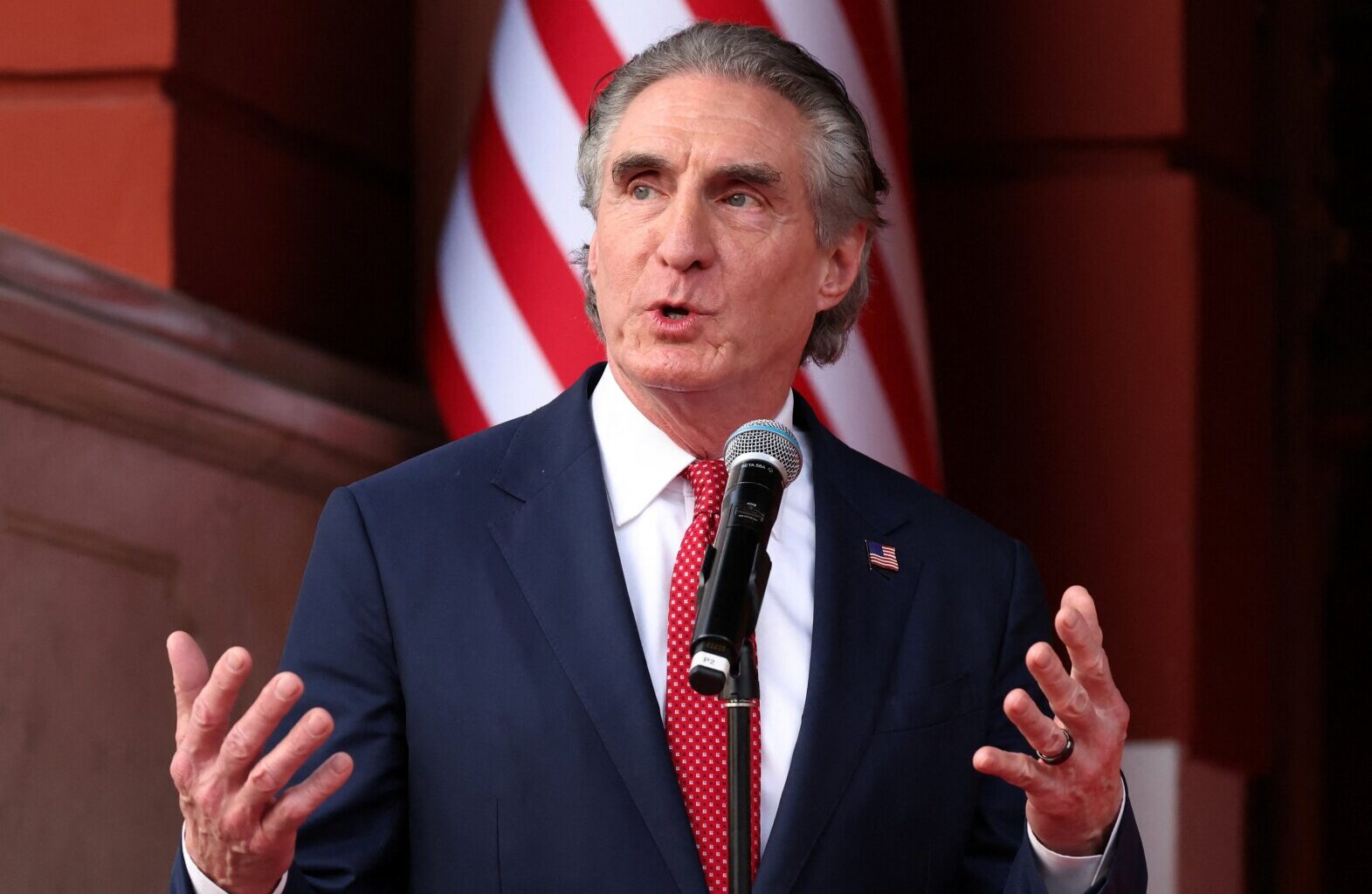
MINOT — Watching Doug Burgum debase himself — sacrifice his ideals and his legacy on the altar of ambition — so he could run quixotic campaign for president and ensconce himself among the yes-men President Donald Trump has surrounded himself with,
has been a grotesque thing to observe.
But the former governor, now secretary of the Interior, isn’t wrong about federal energy policy.
Burgum is currently taking it on the chin for supposedly
development of wind and solar energy projects on federal lands, but that claim needs some perspective. Wind and solar have benefited from a lavishly generous “most favored” status under federal policy for decades. Particularly during the administrations of Presidents Barack Obama and Joe Biden. Burgum, in a manner aligned with Trump’s policies, has ended the special treatment.
To put it bluntly, baseload power sources like coal, nuclear and natural gas, which aren’t preferred by our friends on the left, were the ones getting kneecapped. What Burgum has done is end the kneecapping.
In July 2025, he signed a directive
(in conjunction with Executive Order 14315)
to eliminate right-of-way and capacity fee discounts that wind and solar projects previously enjoyed. By removing these discounts, Burgum claims he is
He argues that if a project is not “economically viable” without federal handouts and fee waivers, it should not be prioritized over “dispatchable” sources like natural gas and “clean coal.”
With that same directive, Burgum also ordered his office to review 68 different types of previously-issued regulatory actions related to renewable energy projects, from NEPA assessments to
Critics argue that this is evidence of regulatory bottlenecking; Burgum argues that previous streamlining for renewables allowed them to bypass critical environmental and wildlife reviews, like eagle take permits, that other industries have to follow strictly. He maintains that this ensures all energy projects are held to the same “rigorous and deliberative” standard.
How is it “kneecapping” to hold renewables to the same regulatory standards as more traditional forms of energy?
Burgum also has a point about what his office has been calling “capacity density.” The Department of the Interior is now using this as a primary metric for project approval on federal lands, and it makes a boatload of sense if our objective is to leave as many acres of land as we can undisturbed. Essentially, “capacity density” is how much energy a project can produce per unit of land it occupies.
The DOI cites
Energy Information Administration data
showing a massive disparity in footprints between traditional, baseload power sources and renewables. As one example, a nuclear plant produces roughly 33.17 megawatts per acre, while an offshore wind farm produces approximately 0.006 megawatts per acre.
Burgum argues that permitting something like a solar or wind farm that requires thousands of acres is an
of federal land when a gas or nuclear plant could provide the same power on a fraction of the land.
Critics of this approach say Burgum has a bias for fossil fuels, and I’ll accept that this is true. He does. He certainly did as governor of North Dakota, and though he’s abandoned many of his principles to serve in the Trump administration, his belief in baseload power has carried through to his federal service.
But I’m not sure these examples demonstrate that bias. Far from giving coal, gas and nuclear preferential treatment, he’s ending the preferences given to renewable so that these energy sources are treated equitably. And while it may seem somewhat paradoxical, in other ways Burgum’s policies are also recognizing that renewables are fundamentally different from baseload energy in some important ways.
It’s long been taken as an article of faith by some that wind and solar can just replace coal or nuclear plants, but that’s not true. They don’t operate the same. Renewable power is intermittent power. Coal plants and nuclear power are not. They produce power when the wind isn’t blowing and the sun isn’t shining, and that matters in a country where demand for energy is going through the roof,
and not just because of data centers.
During an interview earlier this year with Bloomberg, Burgum pointed out that it was baseload power, not renewables, that kept the lights on during a powerful winter storm in the northeast part of the country. “We would have had millions and millions of people in this country without power if coal hadn’t stepped up,” he said. “Coal was the hero of keeping the lights and the heat on in America.”
Coal and gas detractors can talk about emissions, sure, but it’s true that baseload power facilities have a much smaller land footprint, are not so dependent on government subsidies and preferential treatment to stay afloat, and are far more reliable for meeting our nation’s energy needs, particularly in times of distress.

Rob Port is a news reporter, columnist, and podcast host for the Forum News Service with an extensive background in investigations and public records. He covers politics and government in North Dakota and the upper Midwest. Reach him at rport@forumcomm.com. Click here to subscribe to his Plain Talk podcast.