
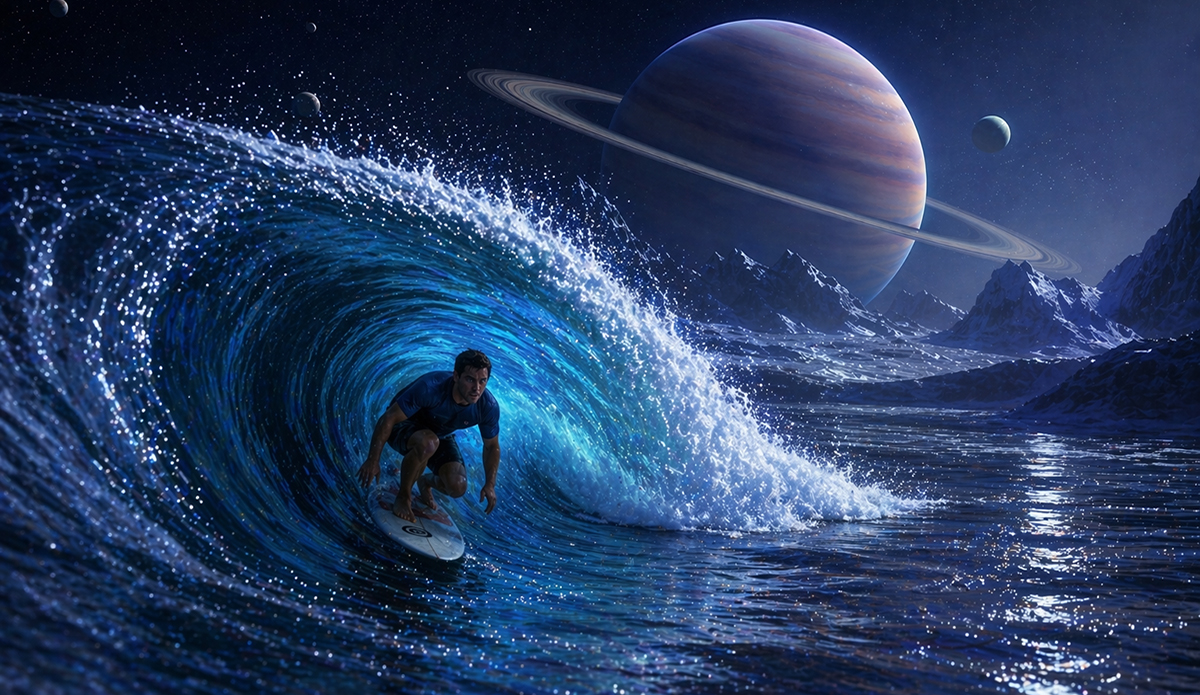
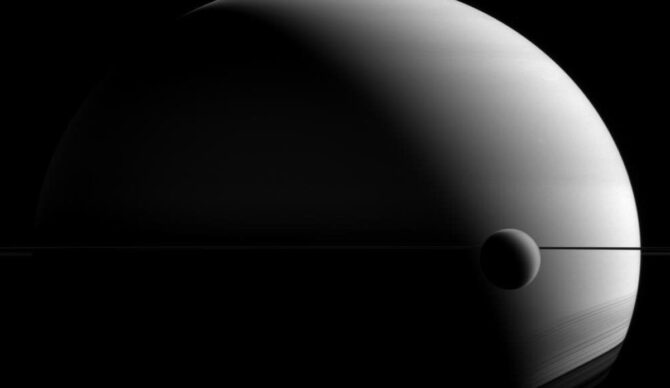
Scientists believe that methane lakes on Saturn’s moon, Titan, could be ripe for making waves. Photo: NASA/JPL-Caltech/Space Science Institute

Scientists at MIT and Woods Hole Oceanographic Institute have been wondering if the surf’s up on other planets. Well, not exactly. But they did create a new model that predicts how waves might form in bodies of liquid on other planets, and Nautilus, a science publication, went a step further, pondering what it would be like to ride these waves.
The model inputs factors like gravity, wind speed, atmospheric density, liquid viscosity, and ocean depth to imagine how these liquid bodies react to wind blown on their surfaces. They applied this model to five planets, two “close” to Earth and three distant.
In our solar system, they imagined waves on Saturn’s largest moon, Titan, and an ancient version of Mars that used to be covered in water.
On Titan, it would only take minimal winds of 11 miles per hour to make waves 16 feet high on its methane lakes. But the waves would be gliding slowly across the surface, given that gravity is only 14 percent of that on Earth. You’d need to bring your thickest wetsuit for the -294 degree Fahrenheit temperatures.
Researchers imagined a version of Mars three-billion years ago where water flowed in crater lakes as deep as 32 feet. Gravity on Mars was particularly low at this time, so the waves — and your body — would also be moving slowly compared to surfing on Earth. It would only take 23-mile-per-hour winds to whip up some five-foot waves in the crater lake.
Even though we don’t have a way to transport humans out of our solar system yet, researchers looked at a few distant planets in our galaxy with surf potential. They analyzed oceans of sulfuric acid, planets with such intense gravity that water could withstand hurricane-force winds, and lava waves on planets with temperatures up to 4,000 degrees Fahrenheit.
If surfing ever gets too crowded here on Earth, maybe extra-planetary lineups are the solution. Let’s ask the scientists at NASA to report back on conditions the next time one of their space cameras flies by Saturn.