
Lea el artículo en español aquí.
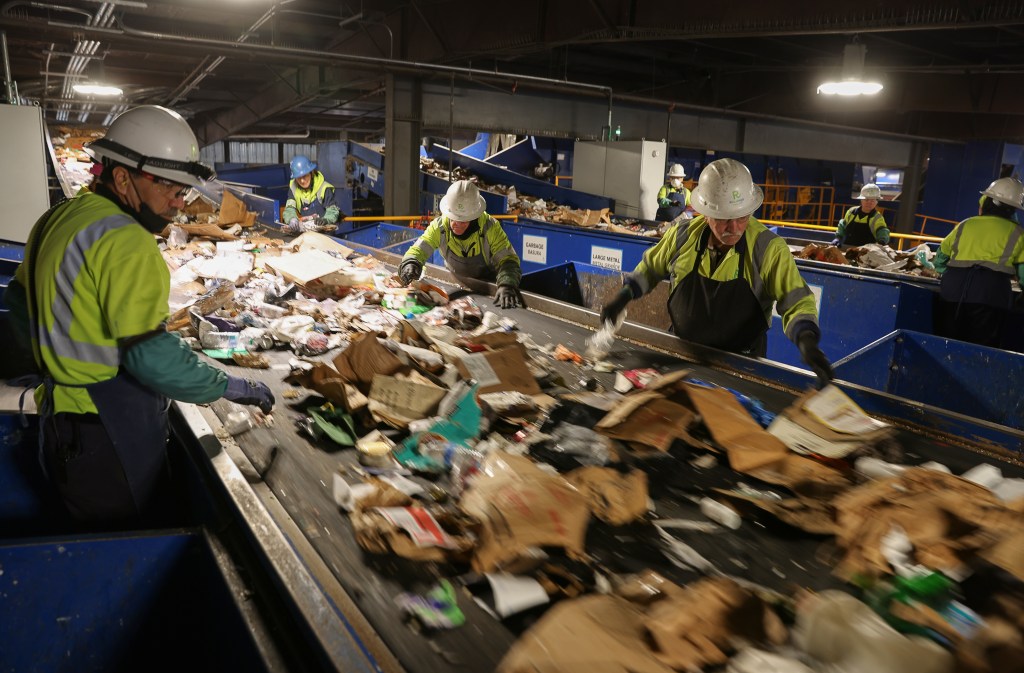
At an 85,000-square-foot solid waste plant in south Santa Rosa, a tractor loader scooped up the blue bin contents from hundreds of Sonoma and Marin County curbside garbage customers. The mix of recyclables was then funneled through a maze of conveyor belts, chutes and optical sorters.
Paper traveled up along a fish ladder to be baled, while heavier materials continued down the line, where a separator diverted aluminum in one direction and a magnet pulled steel cans off the line and flung them into a cage. People posted along the way served as a “last line of defense,” as Recology Sonoma Marin‘s Senior General Manager Logan Harvey put it, making sure the discarded containers, cardboard and paper products were headed for the right place.
The whirring high-tech machinery is part of a $35 million upgrade completed two years ago at Recology Sonoma Marin’s Materials Recovery Facility. The Standish Avenue plant, the main destination for blue bin materials across Recology’s service area in the region, now takes in and processes roughly 350 tons of recycling a day — 40 to 50 tons per hour — from 13 communities in Sonoma and Marin counties.

Workers have one final opportunity to pick out any recyclable plastics out of a stream of mixed materials at the Recology Material Recovery Facility in Santa Rosa on Wednesday, February 25, 2026. (Christopher Chung/The Press Democrat)

A loader moves mixed materials at the Recology Material Recovery Facility in Santa Rosa on Wednesday, February 25, 2026. (Christopher Chung/The Press Democrat)

Bundles of aluminum cans for recycling at the Recology Material Recovery Facility in Santa Rosa on Wednesday, February 25, 2026. (Christopher Chung/The Press Democrat)

Different types of plastics are bundled at the Recology Material Recovery Facility in Santa Rosa on Wednesday, February 25, 2026. (Christopher Chung/The Press Democrat)
Show Caption
1 of 4
Workers have one final opportunity to pick out any recyclable plastics out of a stream of mixed materials at the Recology Material Recovery Facility in Santa Rosa on Wednesday, February 25, 2026. (Christopher Chung/The Press Democrat)
Previously, San Francisco-based Recology, the region’s dominant waste hauler, had to outhaul two-thirds or more of what it took in for processing elsewhere, Harvey said. After the upgrades, the Santa Rosa facility boosted its recovery rate of recyclables — the share of discarded materials sorted and sent downstream to be recycled — from 75% to up to 85%.
But challenges remain, and some of them are plainly evident in the sorting process at the plant.
Standing over the first conveyor belt, in the course of two minutes, Harvey pulled off a large stretch of fabric, a hunk of metal, a chunk of wood, a pillow and several plastic bags. Any of these could jam or damage a machine, sometimes forcing a temporary shutdown or repairs that can cost thousands of dollars.
“Contamination is a problem,” said Harvey. Although, the former mayor of Sonoma added that he’s proud of Sonoma County’s comparatively lower rate of contamination, about 10% to 15%.
Addressing that issue comes down in part to people taking greater care as they sort through their waste at home. But consumer behavior is driven, too, by decades of mixed messages on what can be recycled, especially when it comes to plastic.
A wide range of rigid plastics — bottles, clamshell containers, laundry detergent jugs, tubs and lids — are now accepted in blue bins in many communities, including in Sonoma County and surrounding areas. But, while such plastics are promoted as “widely recyclable” by governments, industry and by the companies that produce them, the rates those are actually recycled are dismal.
This year, for the first time, CalRecycle, the state solid waste agency, published recycling rates by material for 2024. No plastic had a recycling rate above 23%, and most were in the single digits. Polypropylene, labeled as #5, had a rate of just 2%.
For comparison, materials like glass, cardboard and aluminum scored much higher — a range of 40% to 70%.
Nationwide, the overall plastic recycling rate is often estimated at around 5%, down from a peak of 9.5% in 2014.
A vexing challenge
The process to recycle metals, glass and paper or to compost food waste is relatively straight forward and cost-effective and has been done for decades. By comparison, plastics, which are made up of thousands of chemicals, are much trickier and more expensive to deal with. Most cannot be turned safely into new food-grade materials because of the toxins involved, especially when it comes to #5 plastic.
That means your grocery store butter tub or yogurt container, if it’s recycled into anything, would more likely be used for something like a traffic cone or battery casing, said Jan Dell, who left a long corporate career in chemical engineering to start The Last Beach Cleanup, a nonprofit dedicated to stopping plastic pollution and waste exports and factchecking recycling claims.
There are few plants that are capable of this task, Dell and other researchers say. And, because it is so much cheaper to produce new plastic, demand is limited for the recycled alternative.
Operations wading into that business also face public scrutiny over concerns about environmental and health effects. Plastic recycling startup Resynergi abandoned plans to expand in Rohnert Park, and signaled it would move out of California, following mounting opposition and regulatory scrutiny.
A 2025 report by Greenpeace identified 21 commercial facilities nationwide capable of recycling #1 plastic bottles and 22 that can recycle #2 plastic containers, with the ability to process around 20% of the waste generated by those products. The authors found only two operational plants capable of processing polypropylene, or #5, with a maximum processing capacity of 2% of what’s produced.
The dominant trendlines — little recycling of plastics in the U.S. and a narrow band of operators capable of doing so — come as the plastic industry has touted strides in the space, pointing to technological advances and expanded community collection of recyclables.
Consumer brands also have made lofty commitments to use more recycled plastic. Many of them benchmarked transitions by a certain year — 2025 for some, 2030 for others.
But researchers and environmental groups have disputed that plastic recycling, now and into the future, will be effective at scale.
“They’re always coming up with some new solution that is still based on plastic waste recycling, and plastic recycling fundamentally doesn’t work,” Dell said.
Brittany LaValley, senior vice president of impact and management with The Recycling Partnership, an industry backed nonprofit, insisted that “the primary challenge isn’t recycling capacity” or a lack of demand for recycled plastic. “It’s household capture,” the amount of waste diverted to recycling bins instead of trashcans, she said.
Still, several plastic recycling factories have failed to get off the ground or shuttered recently. And, a number of companies have also quietly walked or pushed back their recycled plastic commitments.
Meanwhile, new plastic production continues to grow, as does the body of research into impacts from plastics on environmental and human health. According to a 2024 Lawrence Berkeley National Laboratory study, plastics have the strongest growth trajectory of any bulk material, with production expected to double or triple by 2050.
A local experiment
So, how much of our locally discarded plastics end up being processed for recycling?
In late January and early February, Press Democrat journalists put a combination of #5 plastic deli containers and a large McDonald’s plastic drink cup, equipped with location trackers, into their household blue bins.
Several of the trackers died at Santa Rosa’s materials recovery facility. One container went to Sonoma County’s central landfill and recycling site west of Petaluma. One made it as far as Las Vegas, last pinging at waste management giant Republic Services‘ “Polymer Center,” opened in late 2023 as part of a larger push to boost plastic recycling. That facility sources bales of plastic from recycling sorters across the western U.S., but doesn’t actually do the work of turning recovered plastics into new material. Rather, it does “secondary sortation,” according to a spokesperson. From there, bales go to a new factory in Indianapolis that turns packaging into resins to be used in new products.
One tracker was placed in a recycling bin in Sebastopol, which last year switched from Recology to Sonoma County Resource Recovery for waste services. That container eventually ended up at a landfill and recycling site in Suisun City after traveling through Windsor and Ukiah.
What did the dispersal of our tracker-equipped plastics show?
Not much, Harvey, the local Recology manager, suggested.
If any of the containers ended up at a landfill, the trackers may have made them too heavy for the optical sorters or they could have fallen out of the tubs, he said.
Recology’s Santa Rosa’s facility does not send its baled recyclables to landfills, he added.
“We’re duty-bound by our contracts to recycle recyclables. That can result in a contract violation if we were to landfill it, and it’s not what we do as a company.”
Still, other tracking experiments elsewhere have yielded similar outcomes, and Dell said the results overall support what more thorough and scientific data shows — that most of our plastic is unlikely to be recycled in the end.
A vast network
The experiment, however simple and inconclusive, highlights a stark reality about our waste stream and about recyclables in particular. They are moved around, a lot.
The metal, glass, cardboard, paper and plastics gathered and sorted at the Recology’s Santa Rosa plant, for instance, are shipped off to a wide range of destinations that can include a number of stopovers for further sorting or reselling.
People don’t think of recycling for what it is — a global “commodities market based on pricing,” Harvey said, and “certainly the market and the stability of that market is a challenge.” The market “can shift by a lot – $30 to $40 a ton – in a very short period of time.”
Plastics are a particular challenge, especially polypropylene, and this year, #1 and #2 plastic values have dropped. But, “it’s better that it have a chance that it be recycled than it be landfilled,” he said.
Plastics make up about 5% by weight of what is processed at the Santa Rosa plant. Cardboard accounts for the most, at 42%, then paper at 24%, metal, like steel cans, at 16%. Glass accounts for 10% and aluminum for just over 1%. About two tons of polypropylene is sorted and baled per day.
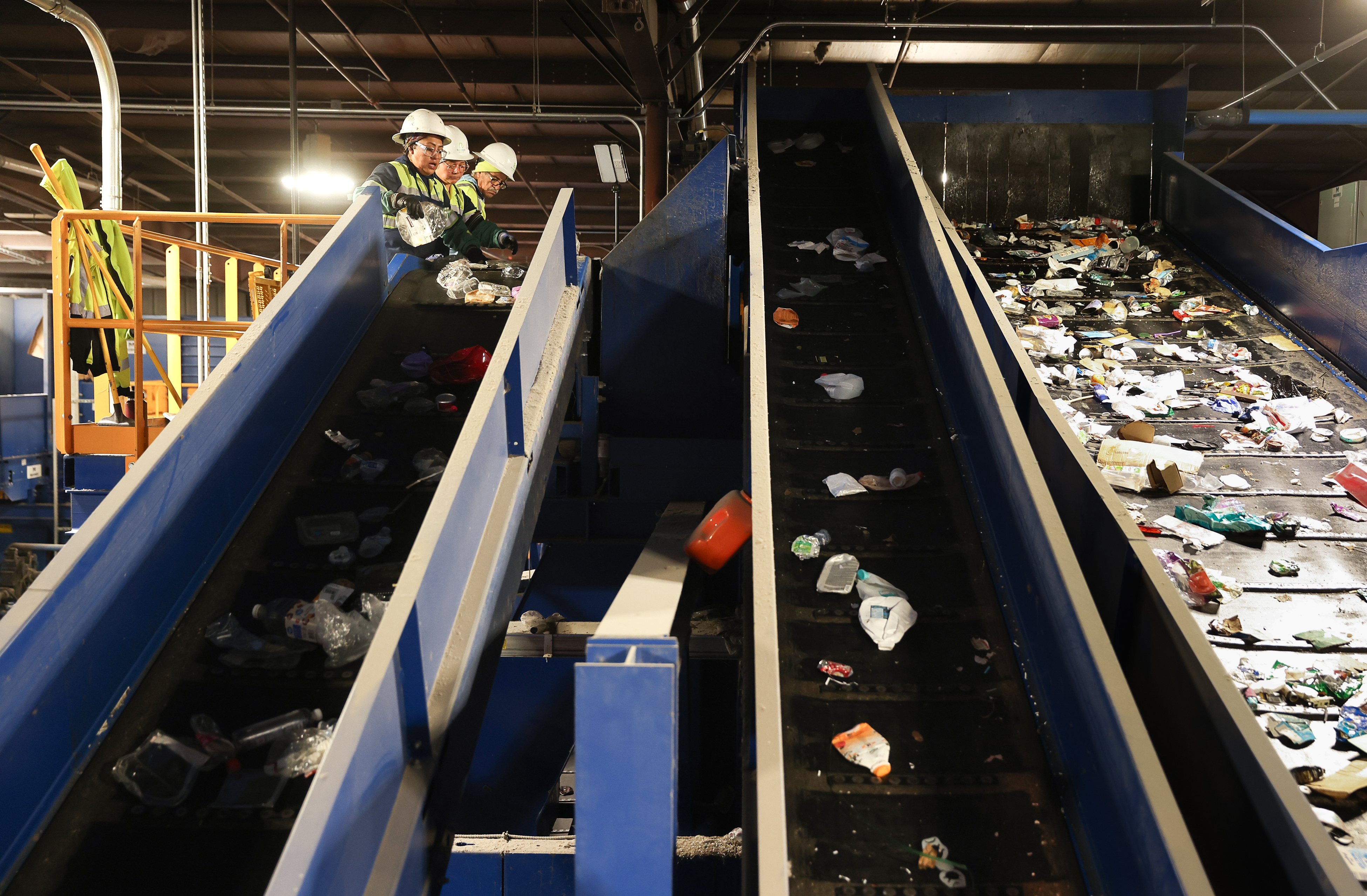
Workers remove contaminants from the plastic materials line at the Recology Material Recovery Facility in Santa Rosa on Wednesday, February 25, 2026. (Christopher Chung/The Press Democrat)
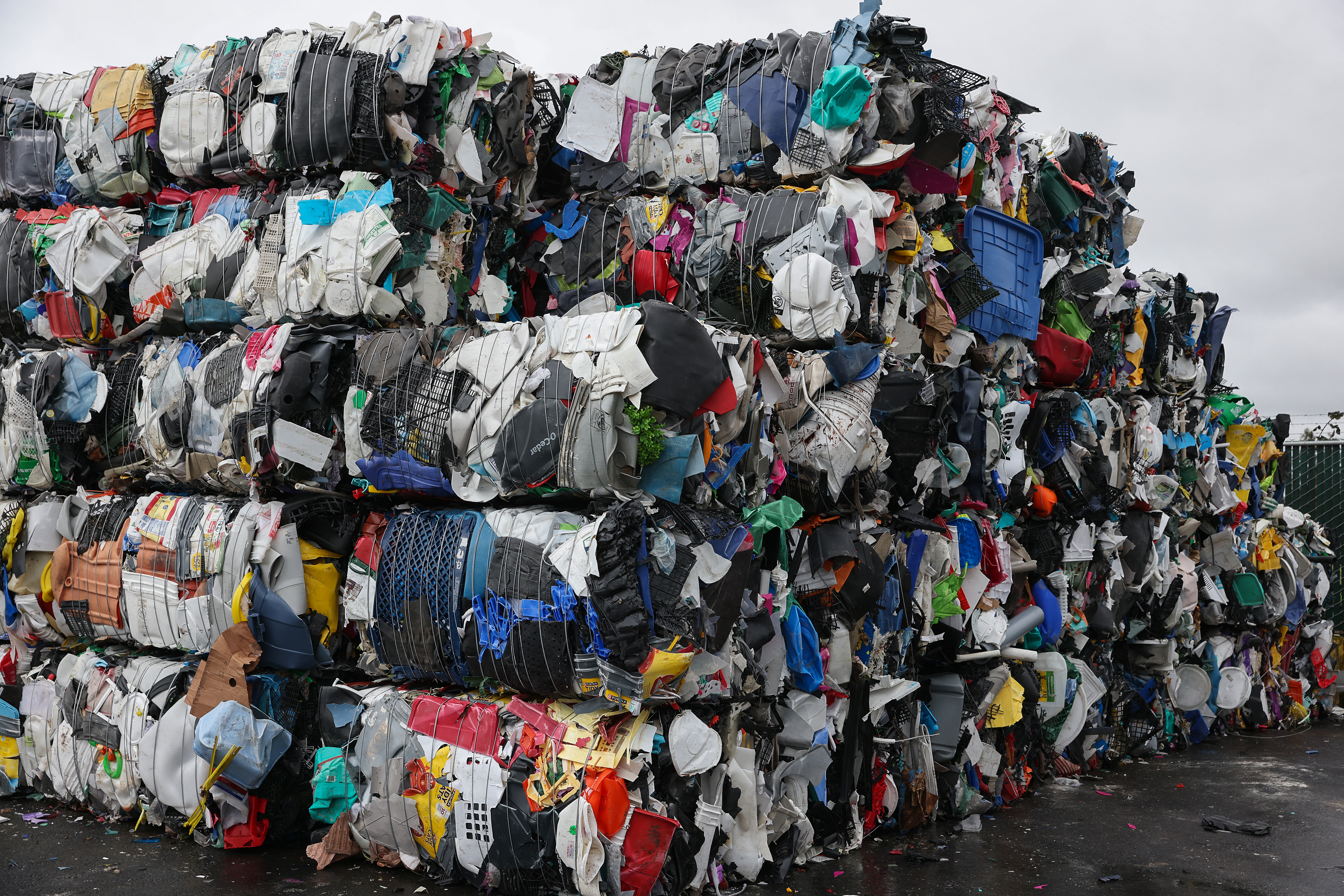
Mixed rigid plastics are bundled at the Recology Material Recovery Facility in Santa Rosa on Wednesday, February 25, 2026. (Christopher Chung/The Press Democrat)
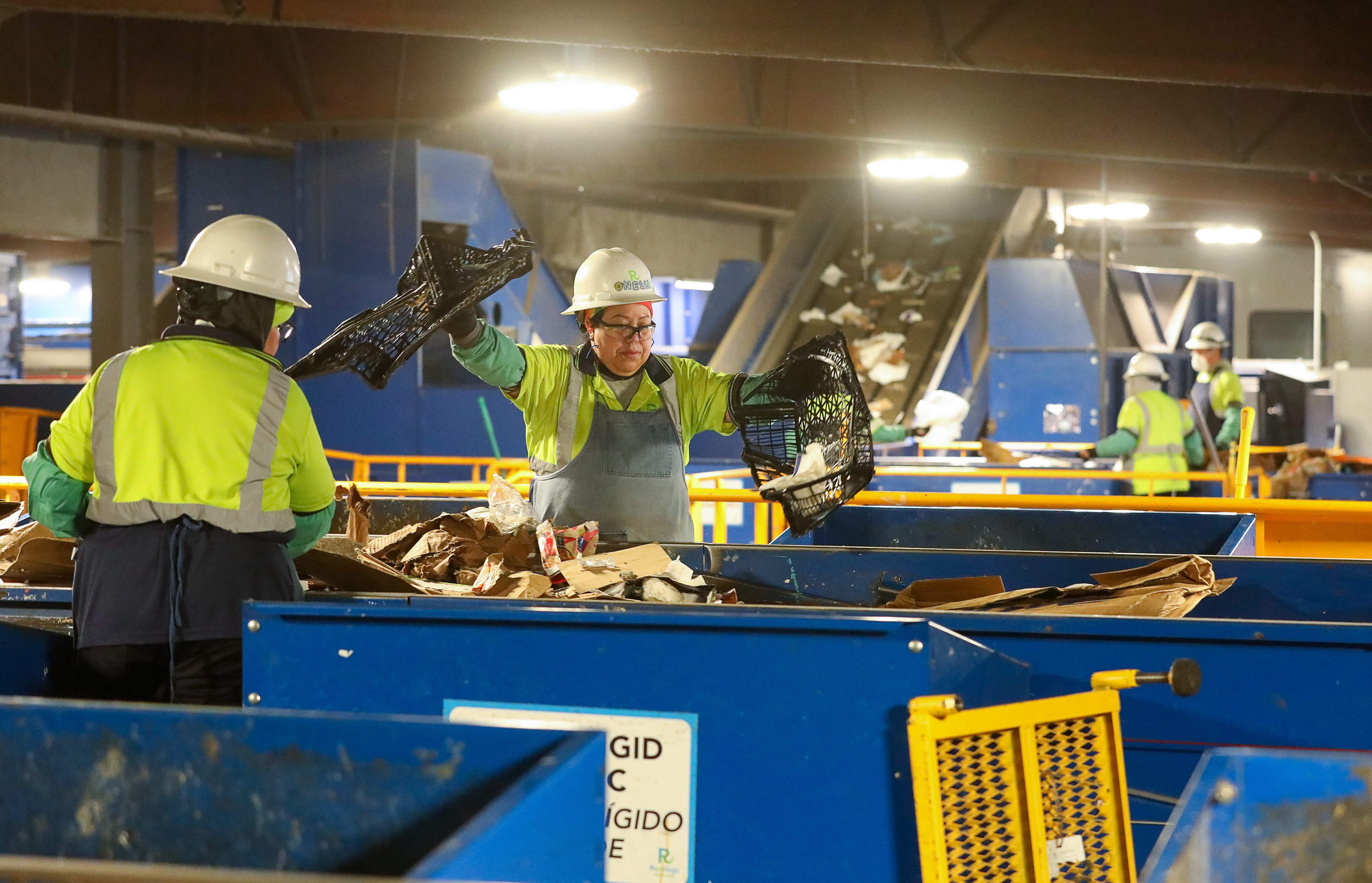
Recology workers remove contaminants from the stream of recoverable materials at the Recology Material Recovery Facility in Santa Rosa on Wednesday, February 25, 2026. (Christopher Chung/The Press Democrat)

A Recology truck offloads mixed recyclables, while a loader gathers materials at the Recology Material Recovery Facility in Santa Rosa on Wednesday, February 25, 2026. (Christopher Chung/The Press Democrat)

A Recology employee removes a large plastic sheet from mixed materials at the Recology Material Recovery Facility in Santa Rosa on Wednesday, February 25, 2026. Items like this can wrap around machinery and cause malfunctions and damage. (Christopher Chung/The Press Democrat)
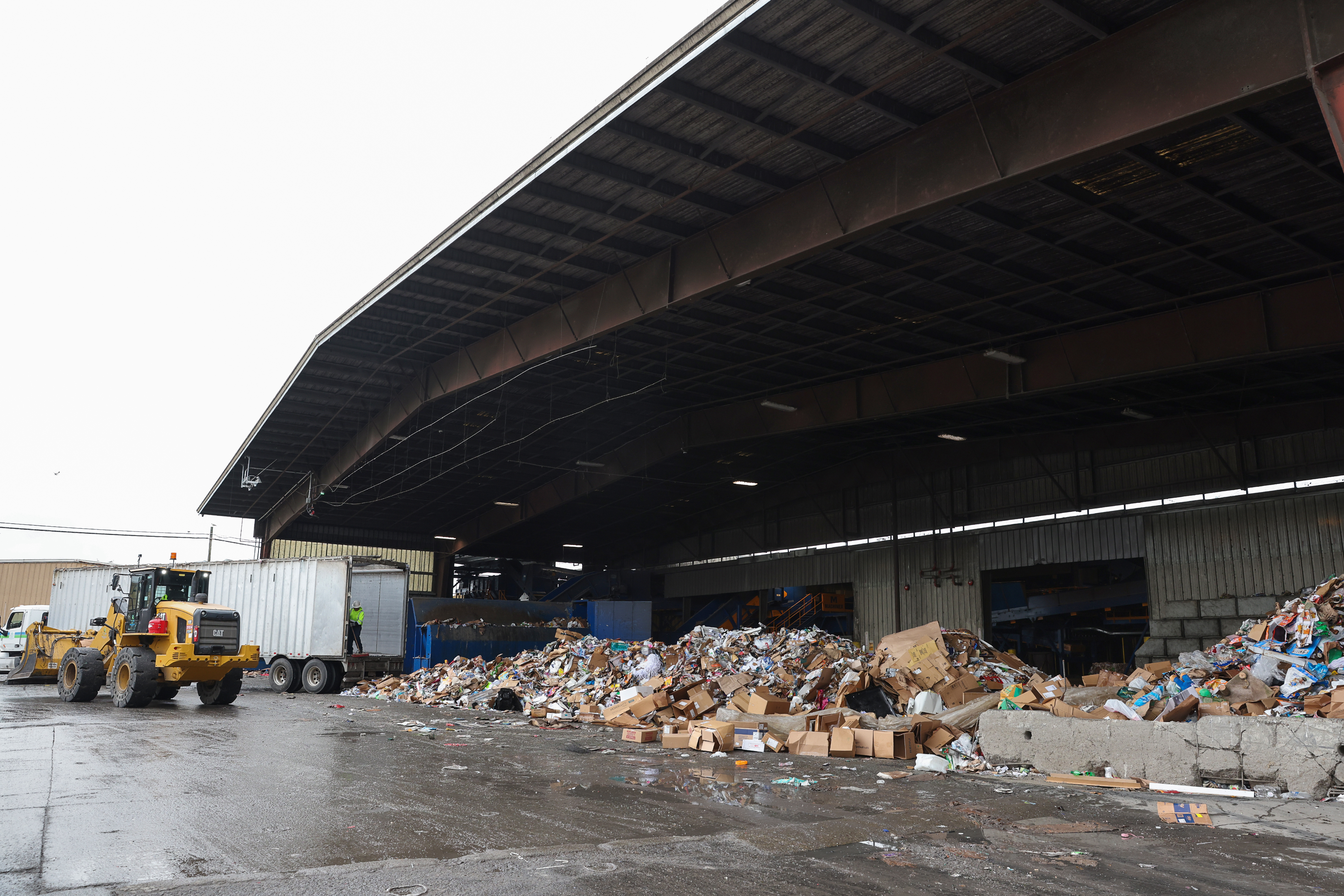
Mixed materials offloaded at the Recology Material Recovery Facility in Santa Rosa on Wednesday, February 25, 2026. (Christopher Chung/The Press Democrat)
Show Caption
1 of 6
Workers remove contaminants from the plastic materials line at the Recology Material Recovery Facility in Santa Rosa on Wednesday, February 25, 2026. (Christopher Chung/The Press Democrat)
The mix of destinations for these materials change every month based on demand and the ability of mills to get new contracts to make recycled products, according to Recology Public Relations Manager Robert Reed, who said the company prioritizes domestic end markets. While the specifics are proprietary, he said, currently from Santa Rosa, #1 plastic water bottles generally go to Nevada, #2 detergent bottles are going to Canada, Lodi and Nevada, mixed paper and cardboard are going to Southeast Asia, steel cans have been heading to Oregon, glass stays in Northern California and aluminum goes to Pennsylvania and Alabama. Most #5 plastic goes to plants in Nevada and Alabama.
But because the huge bales that plastics are packed into can travel through a line of transfer stations or brokers, it’s hard to publicly track or know for sure exactly where they end up and how much is really turned into new materials, experts say.
Industry investments questioned
In the mid to late 2010s, the volume and visibility of plastic pollution globally and China’s refusal to keep taking plastic waste from places like the U.S. forced a reckoning.
An NPR and PBS Frontline investigation and other reporting detailed how, going back to the 1980s, the plastics industry started pushing plastic recycling through public relations campaigns and the now ubiquitous chasing arrows labels despite knowing most plastic would not be recycled. In 2024, California Attorney General sued ExxonMobil, the oil and gas giant that is also one of the world’s largest producers of plastic resins and polymers, for misleading the public about the efficacy of plastic recycling.
In the wake of intensified scrutiny and criticism, oil, gas and petrochemical companies that make plastics and the manufacturers and consumer brands that use and market them have poured more money into plastic recycling efforts, especially for #5 polypropylene. Associations backed by many of the major players and some of the same trade organizations accused of deceptive marketing decades ago, and also some environmental groups, have launched a series of educational campaigns, grant programs and new labeling initiatives, including a “widely recyclable” designation for polypropylene in 2022.
One such group is The Recycling Partnership. Founded in 2014, the organization, “insists on meaningful change across the recycling system and assists communities, companies, and policymakers in enacting such change,” according to its website. “We firmly believe that if you want to recycle, you should be able to recycle. A robust and accessible recycling system is how we achieve this goal.”
U.S. tax records, according to Greenpeace’s 2025 report, show that annual funding for The Recycling Partnership went from less than $1 million to $37 million in 2023.
In 2020, The Recycling Partnership launched the Polypropylene Recycling Coalition to “unlock the full potential of polypropylene in the circular economy.”
Since then, the program has distributed over $19 million across 65 grants for upgrades to materials recovery facilities and community education and outreach. Across the U.S., 48 million more residents can now recycle polypropylene, and 75 million new pounds of the #5 plastic are now captured annually, The Recycling Partnership’s LaValley said in written responses to questions.
Recology’s Santa Rosa facility was one of the Polypropylene Recycling Coalition’s grant recipients — a $250,000 award to install an optical sorter for polypropylene as part of its larger recent modernization.
Industry members and plastic recycling proponents say these campaigns and investments are necessary to finally make recycling promises a reality, but critics contend the efforts are just an extension of the same playbook the industry has been using all along to justify unchecked plastic production.
“It’s just not recyclable. This is the big myth that the industry have promoted for 40 years, and it’s so entrenched, it’s so well funded,” Dell said, adding that she views governments and waste companies as perpetuating that myth.
As a chemical engineer who worked for major corporations all over the world, she called the investments made through grants to local facilities trivial in comparison to the profits made through plastic production. Going further, she said, they “block progress” by telegraphing to consumers that if they put certain plastics in their blue bins, they will necessarily be recycled into something new.
The Recycling Partnership’s LaValley said that polypropylene can be recycled, and processing infrastructure has improved over the years. Despite challenges, she said “improving capture is still effective” because “strong end markets already exist.”
LaValley also said that “recycling is not a permission slip to keep making more plastic,” and cited the importance of honesty “about what can actually be recycled.”
“That means pushing for truth and accountability: better design, clear labeling, less confusing claims, and real investment in the recycling system that’s been underfunded for decades,” she said. “So yes, reduce production and unnecessary packaging. And in parallel, fix the system for what remains. Done right, recycling investments aren’t a distraction, they’re a guardrail.”
Still, current data, including the new California figures, indicate the results remain underwhelming, and plastic recycling markets continue to struggle.
The sorter funded by The Recycling Partnership helps create cleaner plastic waste streams and bales that are easier to sell in “a very competitive market,” Harvey said. “Certainly if we’ve got an ability to take a grant… for us the big question is, can we reduce contamination?”
Recology Sonoma Marin already collected polypropylene and did not add any additional materials to its collection list as a result of the partnership, he added. “We sit in the middle of this whole thing. We are not the consumer, we’re not the producer and we’re not the recycler. At the end of the day, we’re the hauler and the processor.”
Rocky road for regulation
But the prevalence of plastics in the waste stream and the confusion created for customers by industry marketing is also a source of frustration for Harvey and Reed, they said.
Reed pointed to the plastic bags that get tangled in Recology’s equipment that are really trash despite chasing arrows stamps. He also bemoaned unnecessary plastic use, like shrink-wrapped bunches of bananas or plastic labels on plastic water bottles encased as a pack in yet more plastic.
As part of extensive community outreach and education efforts, they said, Recology pushes reuse and conscious consumption and reduced waste in the first place.
“A clever person solves a problem,” Reed quipped. “A wise person avoids it all together.”
Beyond consumer choice, much of how plastics are used now and in the future depend also on how they’re regulated, and there’s a lot in the balance in California.
The state has struggled to finalize sweeping and controversial legislation to cut plastic food waste passed in 2022, SB 54. In January, regulators withdrew the latest proposed rules for further revisions. Meanwhile, however, California’s “Truth in Labeling” law, SB 343 — which prohibits symbols of recyclability, like the chasing arrows, without meeting certain criteria — goes into effect this year.
The plastic industry has a history of fighting such regulatory efforts. Federal legislation introduced by a Texas congressmember, with the support of plastic producers and their associations, according to the Los Angeles Times, aims to preempt California’s SB 343.
The state’s single-use plastic bag ban also went into effect Jan. 1. An initial ban was passed in 2014 and upheld by voters in 2016, but a loophole allowed for the continued use of thicker bags marketed as reusable, and data showed the tonnage of discarded plastic bags between 2014 and 2022 shot up almost 50%.
At the Santa Rosa Recology plant, where hundreds of tons of waste is dumped every day, Harvey likes to stand and reflect on the massive pile waiting to be sorted.
“In my head I go, ‘this is one county in one state in one country,’” he said.
“It’s kind of like the producers produce what they produce. We as consumers, consume it, and then, yeah, it just goes away… But there is no ‘away.’”
Update (1:30 p.m., April 22, 2026): This story has been revised to include additional details about the tracking experiment.
You can reach senior reporter Marisa Endicott at 707-521-5470 or marisa.endicott@pressdemocrat.com. On X @marisaendicott and Facebook @InYourCornerTPD.
Recycling tips
Tips for optimizing recycling, and what to avoid:
Recycling must be clean and dry. Give containers a light rinse beforehand.
Recyclables can’t be in a plastic trash bag.
Avoid multi-material packaging, which can be difficult to impossible to recycle.
Flatten cardboard boxes.
Do not put batteries, including battery-powered devices like e-cigarettes, in bins. If compacted they can start fires at sorting facilities, endangering workers and equipment.
Polypropylene political campaign signs are likely not recyclable.
Buy glass, aluminum or paper-based products instead of plastic whenever possible.
Buy less. Reuse more — re-purpose containers at home, bring reusable mugs to coffee shops.
Compost. But, note that plastic items marked as “biodegradable” or “compostable,” like green produce bags, cannot be composted in backyards or put in curbside bins.
Zero Waste Sonoma has more information on how to dispose of specific materials, local facilities, sites and waste haulers and other tips: https://zerowastesonoma.gov/