
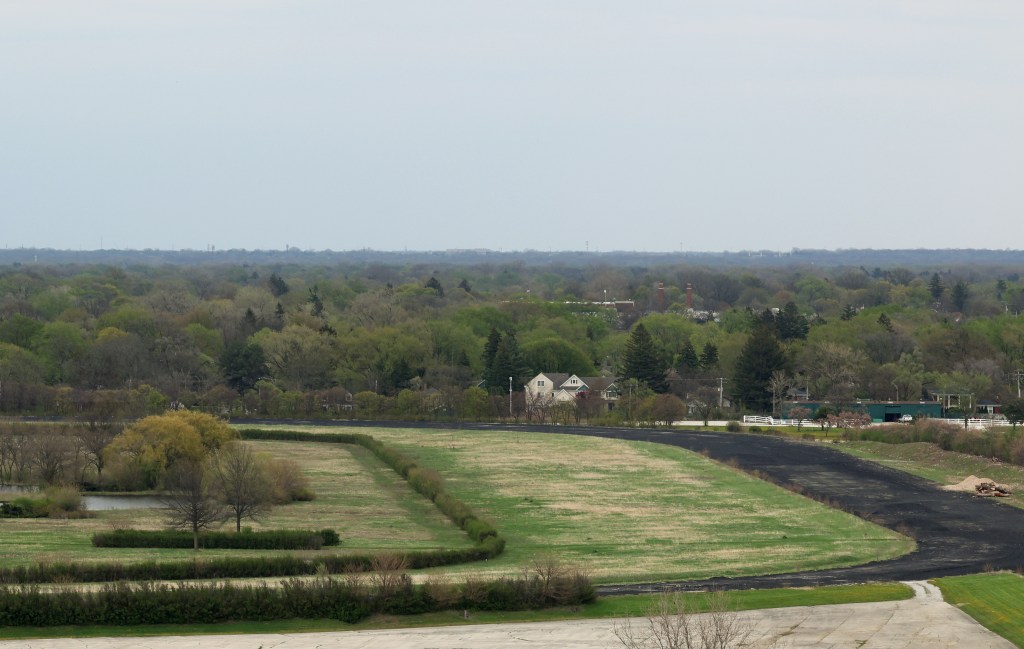
SPRINGFIELD — The Democratic-run Illinois House on Wednesday passed the latest proposal to help the Chicago Bears build a new stadium in Arlington Heights as lawmakers now look to the Senate to gather enough support to keep the team from relocating to Indiana.
The bill spearheaded by state Rep. Kam Buckner of Chicago, who has led House Democrats’ stadium negotiations, passed 78-32. Only a few Democrats opposed the measure, while some Republicans voted for the plan.
“My friends on the other side of the aisle and the governor certainly cannot afford for the Bears to leave the state of Illinois, and more time will cause greater expense,” Republican state Rep. Martin McLaughlin of Barrington Hills, who voted in favor of the bill, said late Wednesday during the House debate. “Let’s face it, guys, it’s going to happen, and the longer we wait, I can’t watch billions of dollars more in incentives be thrown away.”
The latest bill altered Buckner’s earlier proposal for how special property taxes on the Bears and other developers of so-called megaprojects would be divvied up, a move aimed at sweetening a bill viewed as a favor to the Bears by promoting property tax relief for Illinoisans.
Scott Hagel, a spokesperson for the Bears, issued a statement after the bill’s passage Wednesday night that the team welcomes “the progress made on the House’s version of the (megaproject) bill; however, additional amendments are necessary to make the Arlington Heights site feasible for our stadium project.”
“We support Illinois leaders as they determine the path forward to making the essential changes to the (megaproject) bill and aligning on infrastructure funding,” the statement said.
The bill passed hours after it cleared the Illinois House’s Revenue and Finance Committee by a 15-5 vote on Wednesday afternoon.
Chicagoans want to see Bears move to Arlington Heights — not Indiana, a Suffolk-Tribune poll says
The amended plan still would require the Bears and other megaproject developers to negotiate with local governments over payments in lieu of higher property taxes based on updated assessments, but would now direct a share of those payments toward property tax relief for homeowners, both in the immediate area and across the state.
During Wednesday’s committee hearing, Buckner — who represents the area that includes Soldier Field, where the Bears now play home games — stressed the latest bill was aimed at helping big businesses, not just the Bears, while also ensuring regular residents benefit.
“This package matters because there are a lot of things that we’ve tried to do as a state to unlock potential when it comes to larger developments. We know states like Michigan and Ohio and Texas all have similar megaproject-type legislation in their quiver that they use to attract businesses there. This is about making Illinois competitive,” Buckner testified at the hearing. “But it’s also about making Illinois competitive in a way that keeps people at the center and the focus of this.”
To that end, the legislation would require a municipality that hosts a megaproject to deposit half of the negotiated special payment into a locally held property tax relief fund. From there, 60% of the money would be used for property tax rebates for homeowners in areas where the megaproject is located, while 40% would be deposited into a statewide property tax relief fund.
Brian Costin, the deputy state director of Americans for Prosperity Illinois, testified Wednesday that the new legislation resolved some of his concerns about Buckner’s previous bill. But he said the new version still doesn’t go far enough, contending that it could still lead to higher property taxes for homeowners and might be unconstitutional.
“If this were to pass, you would have radically different property tax rates and assessments from inside the megaproject district to outside of the megaproject district,” Costin said. “If I was a business owner, I’d be really scared. I’d try to move into the megaproject district.”
During the full House debate, state Rep. Ann Williams, a Chicago Democrat, said from “a progressive lens” the legislation could spur significant economic development for the city and an influx of tax dollars when more revenue is needed.
“Let’s take a look just at one example in Chicago: Our marquis Museum Campus and Soldier Field. There are proposals out there right now, which can provide significant development opportunities while still preserving our beautiful lakefront. If we utilize the tools presented in this package, this could be a game-changer for Chicago — opportunities for major economic impacts, including state, county and city sales tax revenue, opportunities for jobs, both permanent and temporary construction jobs, which bring with them, of course, employment tax revenues.”
But state Rep. Lilian Jimenez, another Chicago Democrat, said she could not support the bill because she feels the incentives leave some communities on the Northwest Side and West Side behind.
“I do believe that the homelessness situation in our communities needs to be addressed, and I don’t see this project that’s being the solution to that,” she said.
As in the previous iteration of the bill Buckner introduced in February — around the time Republican Gov. Mike Braun of Indiana signed a measure intended to woo the Bears across the state line — Wednesday’s proposal includes the creation of a local review board consisting of members of the local taxing bodies, such as school districts and others, that would decide the amount of the special payment from megaproject developers through a weighted vote. But the new proposal is meant to give the review board more latitude to negotiate as well, Buckner said.
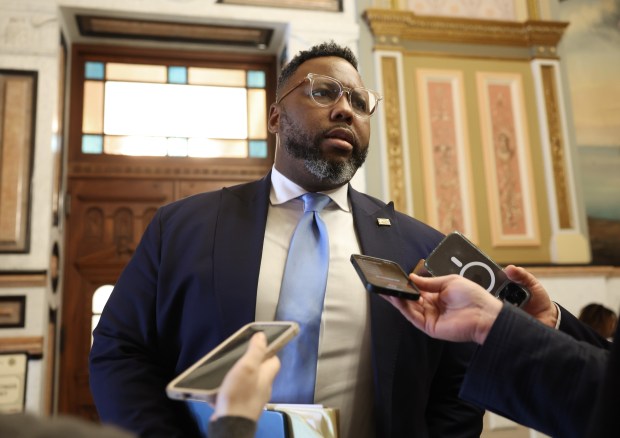 State Rep. Kam Buckner answers reporters’ questions at the Illinois State Capitol on May 29, 2025, in Springfield. Buckner is leading the Bears stadium negotiations in the House. (John J. Kim/Chicago Tribune)
In a statement late Wednesday, Gov. JB Pritzker’s office said over the past few months, it “brought team leadership, local officials, and legislative partners to the table to craft a deal around public infrastructure improvements, property tax fairness, and affordability measures. Today is an important step, and the Governor’s Office looks forward to working with the Illinois General Assembly to advance a bill that reflects our shared priorities.”
A spokesperson for Democratic Senate President Don Harmon of Oak Park, whose caucus is now tasked with considering the legislation, said in a text, “There are ongoing conversations and the Senate would certainly review any legislation the House sends over.”
House Republican leader Tony McCombie of Savanna, who did not vote on the bill, said in a statement that she was waiting to see whether the bill would be altered in the Senate and that Illinois “faces significant challenges that will not be fixed with half-baked measures intended to create movement, not progress.”
Stacy Davis Gates, who heads the Illinois Federation of Teachers and the Chicago Teachers Union, sent a memo to the IFT’s executive board saying leadership is concerned the legislation “does not go far enough to get schools what they need.”
“We requested as part of our discussions that schools not only see no reduction in funding should a megaproject go forward but that they are able to capture the growth in the value of the new development,” Gates said in the memo. “The bill indeed includes a ‘hold harmless’ provision that sets a funding floor. But as drafted, we don’t believe it sufficiently captures the new property value of these developments, so schools don’t get as much new revenue as we believe they’ll need.”
Meanwhile, school districts covering the area around the proposed Arlington Heights stadium site were taking a more wait-and-see approach in their review of the bill.
“We will continue to work collaboratively with municipal leaders, legislators, and other stakeholders to review the details and advocate for solutions that are fair to taxpayers while ensuring schools receive the resources necessary to serve students effectively,” Palatine School District 15, Township High School District 211 and Township High School District 214 said in a statement.
Buckner’s proposal also calls for freezes on property taxes on redeveloped rail yard land at its pre-development assessed value for 40 years, with special payments substituted in place of taxes on the new value. This provision is intended to make it easier for economic development to occur next to railroad tracks or yards, and House Democrats said it could potentially result in $40 billion in new tax revenues over the 40-year period and increase regional transit ridership by at least 10,000 average daily boardings.
Buckner has said such property needs further remediation for development projects, and he believes certain swaths of land in Chicago would qualify for this under the bill. These include an area of the city known as The 78, which sits south of Roosevelt Road and the downtown area; an area of the South Side at the site of the old Michael Reese Hospital (a site the Bears had reportedly previously considered for a new stadium); and an area just west of Soldier Field known as One Central, which would be a $20 billion mixed-use, transit-oriented development built on about 34 acres.
The new bill also includes a sliding scale for the length of the agreements based on the minimum investments made by businesses in their megadevelopment plans, but for those making investments of more than $1 billion, like the Bears would for a new stadium, they’d enter into an agreement for making special payments in lieu of property taxes for at least 40 years.
But under the new measure, the bill’s underlying legality would expire after seven years. This is to allow future General Assemblies to reassess the law and determine whether changes are needed, Buckner said Wednesday.
The legislation would also allow for infrastructure costs for a new stadium to be paid off with Sales Tax and Revenue, or STAR bonds, which support economic development related to tourism, entertainment or retail projects, but those bonds cannot be used directly for the costs of a stadium. The legislation would also increase the number of STAR bond projects allowed in central Illinois, potentially spurring economic development in Springfield.
The moves at the Illinois State Capitol come as Indiana lawmakers earlier this year authorized the construction of a new stadium in Hammond to try to attract the Bears to play their home games across the border. Kevin Warren, the team’s president and CEO, has said the team would decide where they’d build their new stadium late this spring or early this summer.
Other provisions of the new Illinois legislation require developers and municipalities to check in with the Illinois General Assembly every five years on what’s working and what’s not working with the megaprojects. In addition, data centers, which have contributed to residents’ skyrocketing electricity bills, would not be eligible for incentives under the legislation.
The legislation also bars state or local officials from knowingly accepting a free or discounted ticket to a Bears game or other sporting event at a stadium built as part of a megaproject, “unless the free or discounted ticket is given or sold as part of a promotion generally available to the public on the same terms as generally available to the public.”
Robert McCoppin and Dan Petrella contributed.