
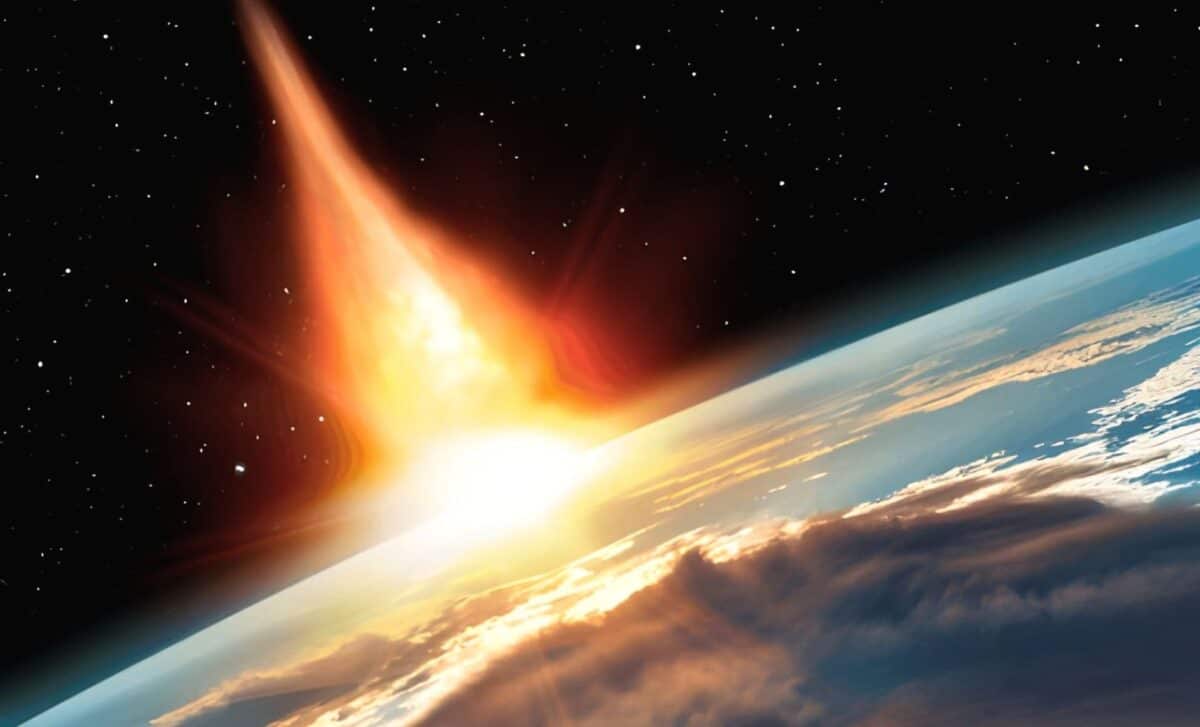
A decades-long fight over what carved a vast crater deep beneath the North Sea seabed has ended. Microscopic “shocked” crystals, forged only under the brutal pressures of an asteroid strike, have settled the matter. Scientists from Heriot-Watt University have confirmed that the Silverpit Crater, buried 700 meters below the seafloor roughly 80 miles off the Yorkshire coast, is the scar of a hypervelocity collision that occurred between 43 and 46 million years ago.
The findings, published this past September in Nature Communications, close a dispute that has run since the structure’s discovery in 2002. The confirmation places Silverpit in a slim category: roughly 33 confirmed marine impact craters scattered across Earth’s ocean floors.
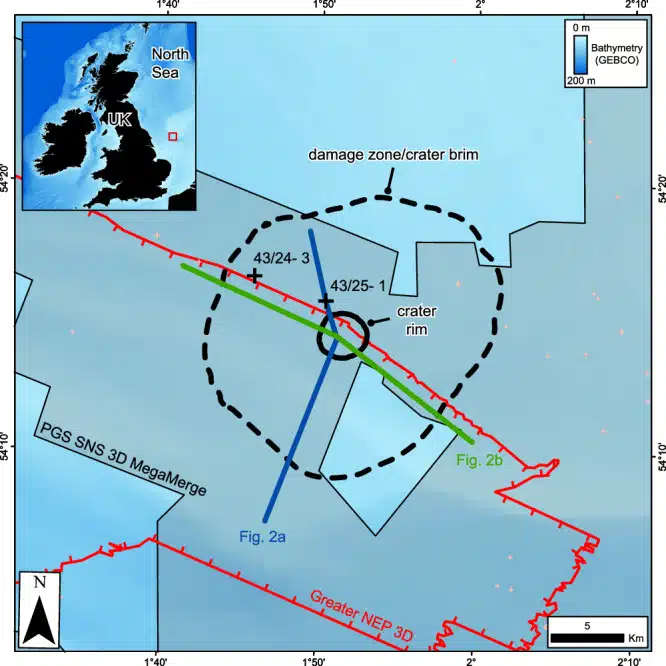 Location map showing the Silverpit Crater and its associated damage zone. Image credit: Nat Commun. 2025 Sep
Funded by the Natural Environment Research Council, the work leans on fresh three-dimensional seismic imaging and the slow, exacting analysis of rock chips pulled from a nearby oil well. That analysis finally turned up what geologists call the “silver bullet” of impact science. Inside the cuttings, researchers located grains of quartz and feldspar split by microscopic planar fractures that require sudden, crushing force to form.
Dr. Uisdean Nicholson, a sedimentologist at Heriot-Watt University who led the study, described the search in a university statement as a “needle in a haystack” effort that proves the impact story “beyond doubt.”
What the Seismic Images Now Show
The impact structure sits smothered under thick sediment. No one can dig down to look at it. For years, lower-resolution scans left the door open to competing explanations: maybe deep salt movement warped the rock, or perhaps volcanic shifting caused the seabed to slump. In 2009, a roomful of geologists actually voted against the asteroid idea.
The new seismic data shuts that door. It reveals a crisp central uplift, a surrounding circular moat, and a wide halo of fractured rock. It also shows a field of secondary craters dotting the old Eocene seabed. The fault patterns around the rim hint at a low-angle hit from the west.
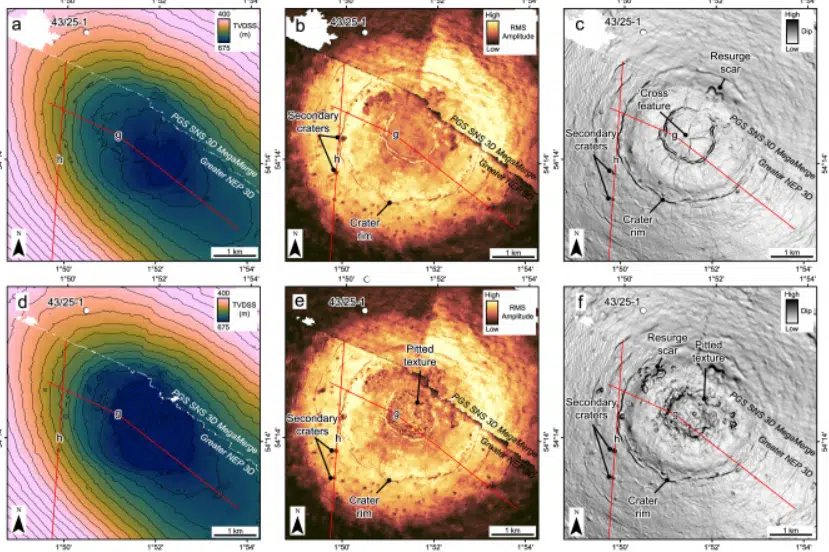 Crater surface morphology and seismic attributes of horizons crater-floor layer 1 and crater-floor layer 2 at the crater floor. Image credit: Nat Commun. 2025 Sep
Professor Gareth Collins of Imperial College London supplied the numerical models that match the observed damage. “It is very rewarding to have finally found the silver bullet,” Collins said. “We can now get on with the exciting job of using the amazing new data to learn more about how impacts shape planets below the surface.”
A Wall of Water Over 100 Metres Tall
Collins’s simulations sketch a violent few minutes during the middle Eocene. An asteroid roughly 160 metres wide slammed into the shallow sea at hypervelocity. The blow vaporized rock and water where it struck. Within moments, a curtain of debris and spray shot 1.5 kilometres upward.
As that churning column collapsed, it shoved a tsunami outward. The wave would have exceeded 100 metres high. The North Sea then was not the North Sea now, but a pulse of water that size would have reshaped coastlines across the ancient basin.
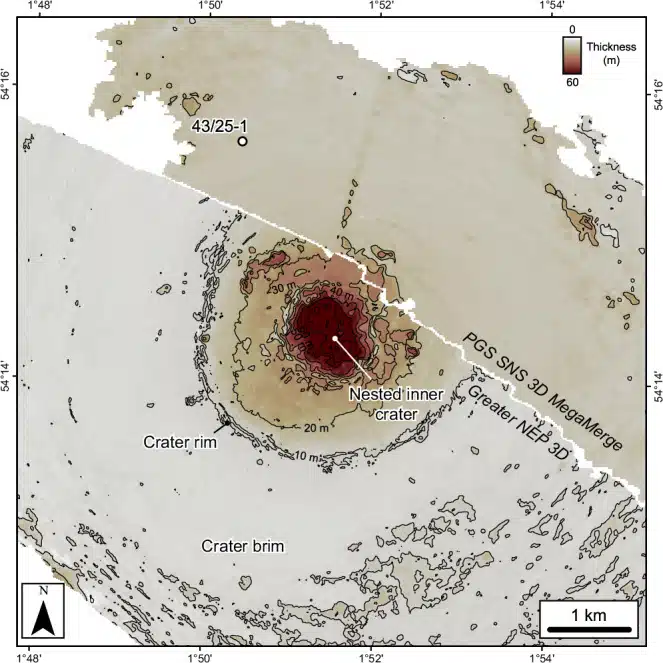 Crater thickness map between crater floor horizons crater-floor layer 1 and crater-floor layer 2. Image credit: Nat Commun. 2025 Sep
The seismic scans also capture a telling detail in the chalk layer that took the hit. The central uplift there appears flat-topped and pitted. That texture points to carbonate rock losing gas content almost instantly under the flash of impact heat, a reaction geologists recognize from other craters punched into limestone.
Two Grains of Sand That Ended a Debate
For two decades, the case against an impact rested on a simple absence. No one had found shock metamorphism. Without those telltale internal fractures in minerals, the crater might still be explained away as a twist of geology. The proof waited in a cardboard box of well cuttings labeled 43/25-1.
Inside the jumble of rock fragments, among chips of reworked ejecta, sat two grains that changed the story. Under a petrographic microscope, both displayed parallel sets of shock lamellae. These hairline internal breaks form only when a mineral endures 10 to 13 gigapascals of pressure. Earth’s slow grind never reaches that range. An asteroid does, and the computed pressures from the Silverpit model align cleanly with the lab measurement. Those two flecks of quartz and feldspar are the reason the argument is over.
Dr. Nicholson noted that roughly 200 impact craters dot Earth’s land surface. Ocean scars are far rarer. Tectonic churn and erosion erase them fast. Silverpit survived because it was buried. It now serves as a preserved laboratory for cratering mechanics, offering a subsurface view that helps researchers interpret similar structures on the Moon or Mars, where digging down is not an option.
The confirmation groups Silverpit with the Nadir Crater off West Africa and the far larger Chicxulub Crater in Mexico, the one tied to the dinosaurs’ exit 66 million years ago.