
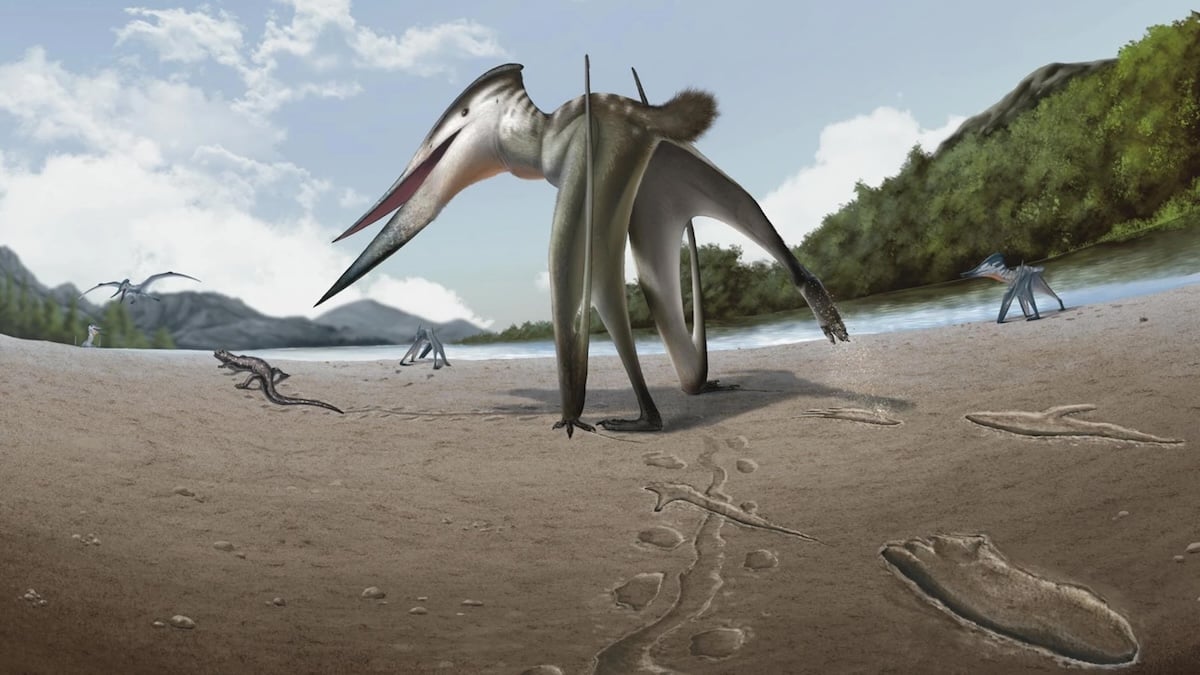
Paleontologists have pieced together a startling story from fossil footprints in South Korea: that of a large, flying reptile galloping across the ground, apparently hunting a small animal.
The brief encounter has been imprinted in a slab of rock for more than 106 million years. The smaller creature entered the scene first, moving at a stroll – before it suddenly changed direction and broke into a run.
The reason seems clear: The distinct footprints of a large pterosaur, galloping quickly on all fours, approach from an angle and follow close behind the other animal.
Both sets of tracks then exit the small window into the past that the slab provides, so it’s impossible to know for sure how the story ended – but there’s a decent chance that it wasn’t a happy one for the smaller critter.
“While trackway association alone does not constitute direct evidence of predation, the convergence of these lines of evidence, particularly in light of the size and ecological inference of the trackmaker, could suggest an interaction scenario,” the researchers write in a paper describing the find.
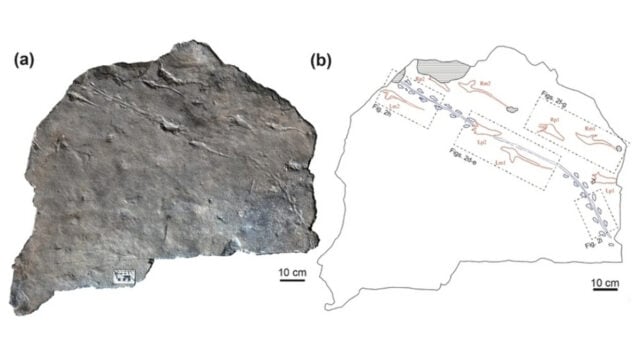 (a) The slab of rock with the footprints embedded in it; (b) a diagram highlighting the two sets of trackways, with the small animal in blue and the pterosaur in red. (Jung et al., Sci. Rep., 2026)
The larger creature is clearly a type of pterosaur – flying reptiles that ruled the skies during the reign of the dinosaurs. But comparisons with other fossils of footprints and bones revealed that it doesn’t neatly fit any known species, leading the scientists to declare it a new genus and species, which they dub Jinjuichnus procerus.
That name is a combination of Jinju – the region of South Korea where the fossil was found – and ‘ichnus’, which means ‘track’, a clear shout-out to the means of its discovery. The specific name ‘procerus’ is Latin for ‘elongated,’ which describes the freaky fingers of its handprints.
The presumed prey is harder to classify, but the footprints seem to be characteristic of a small salamander, lizard, or crocodilian.
It might be natural to ask what business a flying reptile has hunting on the ground, but it does fit our current understanding of pterosaurs. Many are thought to have landed and walked comfortably on all fours, with an almost gorilla-like gait.
These layovers between flights could have been perfect times to forage for food, using what researchers call a “terrestrial stalking” strategy. Pterosaurs are thought to have used this method to hunt lizards, mammals, fish, other pterosaurs, and even small or juvenile dinosaurs, filling an ecological niche similar to modern-day storks.
And they could move with surprising speed.
In this case, the researchers estimated that this J. procerus was moving at speeds of about 2.9 kilometers (1.8 miles) per hour – not a sprint by any means, but showing some serious hustle for an animal that was more at home in the air.
Interestingly, terrestrial hunting has been specifically associated with a group of pterosaurs called the neoazhdarchians – and this was exactly the group that J. procerus was attributed to, based on the claw marks it left and the shape of its hand- and footprints.
Related: Bizarre New Species of Flying Reptile Discovered in Fossilized Dinosaur Vomit
While the researchers can’t completely rule out that the two creatures passed the same spot at different times and didn’t interact, the evidence seems to point towards an encounter that was potentially fatal for one of them.

“Considering the following factors: (1) the probable temporal proximality of the two trackways; (2) the abrupt change in both speed and direction of the small vertebrate trackway; (3) Apparent same direction progression of two trackways; (4) the inferred high speed of the pterosaur trackmaker; and (5) the paleoecological context of neoazhdarchians, an interaction between the two trackmakers appears more parsimonious than coincidental co-occurrence,” the researchers write.
If so, the find also provides more evidence of the fascinating insights into the behavior of extinct animals that fossil footprints can provide.
The research was published in the journal Scientific Reports.