
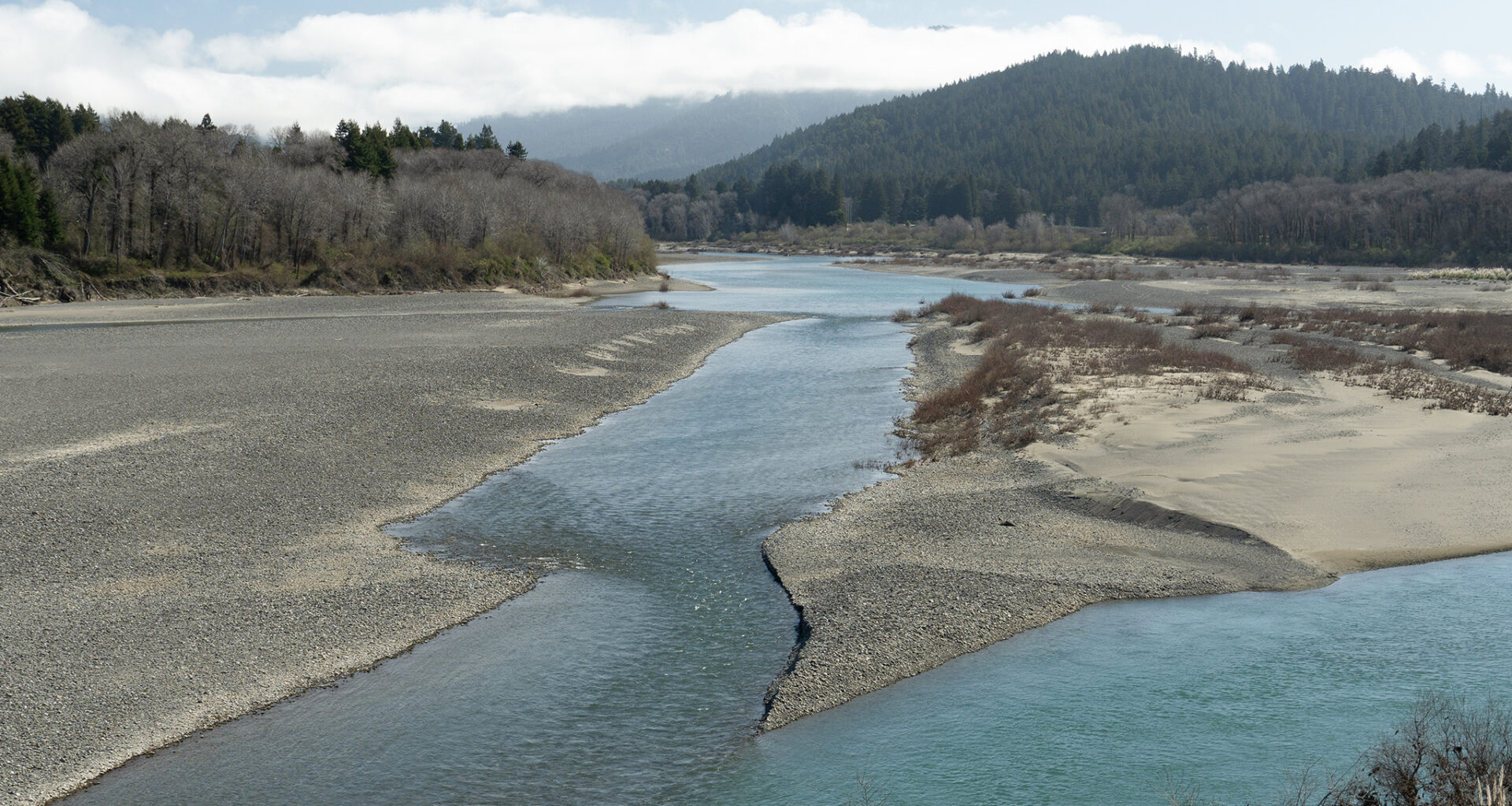
Gravel bar on the Eel River in California.
UCG/Universal Images Group/Getty Images
The Trump administration is urging PG&E to halt plans to remove two aging Northern California dams that play a crucial role in the region’s river system.

PG&E owns Scott Dam in Lake County and Cape Horn Dam in Mendocino County, which together are known as the Potter Valley Project. Those dams divert water from the Eel River to the Russian River, providing water supply to local communities in Mendocino and Sonoma counties. The utility submitted its proposal to decommission the structures in July 2025 and plans to eventually remove them altogether after determining that they are no longer economically beneficial.
Article continues below this ad
Despite the fact that PG&E’s plan has been known — and debated — for years, the Trump administration stepped in several months ago.
The Trump administration’s argument was that removing the dams would cut off critical water supply for farmers and rural communities. In December, Agriculture Secretary Brooke Rollins urged the Federal Energy Regulatory Commission to reject PG&E’s plan. FERC has jurisdiction over the facility as the federal agency that licenses hydropower projects. The Potter Valley Project included a hydroelectric powerhouse until 2021.
Now, Rollins is saying a potential buyer has emerged for the century-old complex.
Make SFGATE a preferred source so your search results prioritize writing by actual people, not AI.
Add Preferred Source
In a Tuesday post on X, Rollins said she spoke with the Elsinore Valley Municipal Water District, which she said is interested in buying the Potter Valley Project. That Southern California water district serves communities in southwest Riverside County, about 500 miles south of where the Potter Valley Project was diverting water. Sylvia Ornelas, a spokesperson for the water district, told SFGATE that officials are indeed “looking at water infrastructure and supply options beyond our immediate service area” but said she could not comment specifically on the Potter Valley Project because it involves a potential acquisition.
Article continues below this ad
Alec Varsamis, a spokesperson for the Department of Agriculture, confirmed to SFGATE that the agency met with the Lake Elsinore water district, which he described as a “legitimate buyer.”
PG&E announced its intent to withdraw from the Potter Valley Project as early as 2019 and tried to look for potential buyers for the facility even last year, but no one came forward. A potential buyer would have had to essentially purchase the regulatory license from PG&E and submit an application for its renewal to FERC, PG&E spokesperson Paul Moreno told SFGATE.
Moreno added that the deadline to take over and keep the project running as a hydropower facility passed years ago.
Now it’s up to FERC to approve the utility’s plans for decommissioning the dams before they are potentially removed.
Article continues below this ad
At this stage, Moreno said, PG&E can’t transfer the operating license, but other groups could still take over parts of the system, like the infrastructure used to move water. The utility said it’s willing to consider proposals from groups that want to own and operate the dams. It received only a joint proposal from Sonoma Water, the Inland Water & Power Commission of Mendocino County, Round Valley Indian Tribes, Humboldt County, California Trout, Trout Unlimited, and the California Department of Fish and Wildlife, he added.
Moreno said PG&E did meet with the Elsinore Valley Municipal Water District earlier this year but hasn’t received any formal proposal from it to purchase the Potter Valley facility.
Beyond removing old, deteriorating infrastructure, PG&E said dismantling the dams could also reopen access to a fish habitat in the upper Eel River watershed that is currently blocked. Environmentalists and Eel River advocates support the structures’ removal so the Eel River can run at full strength again and potentially return a native salmon population to the waters in the process.
But some local community members, primarily farmers and ranchers, have been calling on the Trump administration to intervene to save the project for months. In an April 4, 2025, letter to the administration, the farm bureaus of Lake, Mendocino, Sonoma and Marin counties wrote that they believed removing the dams would be detrimental to the region’s water supply and to the economy.
Article continues below this ad
One of the replacement ideas from PG&E is to build the New Eel-Russian Facility, which would help continue some of the water flows from the Eel River to the Russian River even after the dams are removed, Moreno said.
As for keeping the existing dams instead, experts told SFGATE the Trump administration’s push isn’t feasible.
Jeffrey Mount, the founding director of the UC Davis Center for Watershed Sciences, told SFGATE that he believes rehabilitating the dams is “more political than practical.”
“As PG&E and others have stated, there is currently no viable path to revitalize and upgrade the dams, so decommissioning is the only option,” Mount said in an email.
Article continues below this ad
He called the project “irrelevant in the overall scheme of water use in the state.” He said less than 50,000 acre-feet is diverted per year into the Russian River.
In Rollins’ post on X, she said the administration wants to keep the project specifically for “reliable hydroelectric electric generation.” She said she hopes PG&E is taking the plans “seriously.”
Jay Lund, a professor and vice director for the Center for Watershed Sciences at UC Davis, told SFGATE that even if the Potter Valley Project could stay running, the benefits are not worth the trade-offs, like how much it would cost to upgrade it. He said the dams were built in the 1920s, when there were fewer alternative sources of energy and the overall demands were smaller.
Article continues below this ad
Lund said the most consequential aspect of the project are the small communities that rely on the water supply.
“In the context of the larger California economy and such, it’s nothing,” Lund said.