
(WJAR) — After finding a doctor she adored, Suzanne Levasseur is now among many Rhode Islanders forced to make a change.
“I’ve been with my doctor for about 20 years,” Levasseur said. “I received a letter in the mail about a month ago explaining that he was changing his practice to a different model and it would be an annual fee.”
Levasseur’s doctor transitioned his primary care practice to a concierge model, which includes a $2,600 annual membership fee.
“Honestly, it was a gut punch,” she said. “I was devastated. I’m still devastated.”
Tamara Sacharczyk reports on doctors who change to a concierge style. (WJAR)
Concierge doctors are primary care physicians who operate outside the traditional model.
Their practices offer highly personalized care and enhanced access, including same-day appointments, home visits, and often 24/7 availability by phone or email.
Physicians still bill insurance, but the added membership fee allows them to take on fewer patients, giving those patients more time and access.
Annual fees can range from several thousand to tens of thousands of dollars.
“Concierge tends to be a little more expensive, sometimes with additional services, and they still bill insurance to some extent,” said Dr. Lauren Hedde of Direct Doctors in East Greenwich.
Hedde practices direct primary care, a model like concierge medicine but typically without insurance billing and at a lower cost.
Patients pay a monthly subscription fee in exchange for easier access, longer appointments, and comprehensive care management.
Direct primary care practices also serve significantly fewer patients than traditional offices.
“We have about 300 to 400 patients per physician, versus a traditional practice, which can be anywhere from 1,500 to 2,500 patients per doctor,” Hedde said.
Her patients pay between $80 and $135 per month, depending on when they joined the practice.
While that cost is lower than concierge care, Hedde acknowledged it’s still out of reach for some.
“I don’t think direct care or concierge care can work for the entire system for every patient,” she said.
A new Harvard analysis showed concierge and direct primary care practices surged 83% between 2018 and 2023, raising concerns about worsening primary care shortages and health care inequities.
More physicians are shifting to these models as the traditional insurance-based system becomes increasingly difficult to sustain.
Time is a major factor.
In traditional practices, doctors often see a high volume of patients each day to remain financially viable, leading to shorter visits and heavy administrative workloads.
Concierge and direct care models reduce patient loads, allowing for longer visits and more preventive care.
Insurance-based care also involves extensive paperwork, prior authorizations and billing complexities.
A research letter published this year in JAMA Internal Medicine found burnout among family physicians is about 44% and is linked to a higher likelihood of leaving practice or changing jobs.
“More and more doctors are going to keep choosing it because it allows for better work-life balance and a more sustainable career,” Hedde said.
An NBC 10 I-Team analysis found Rhode Island has one of the lowest physician-to-population ratios in New England.
The state is short roughly 300 primary care physicians, and nearly half of its current doctors are approaching retirement.
“I think a lot of factors have driven that, including low reimbursement rates,” Hedde said.
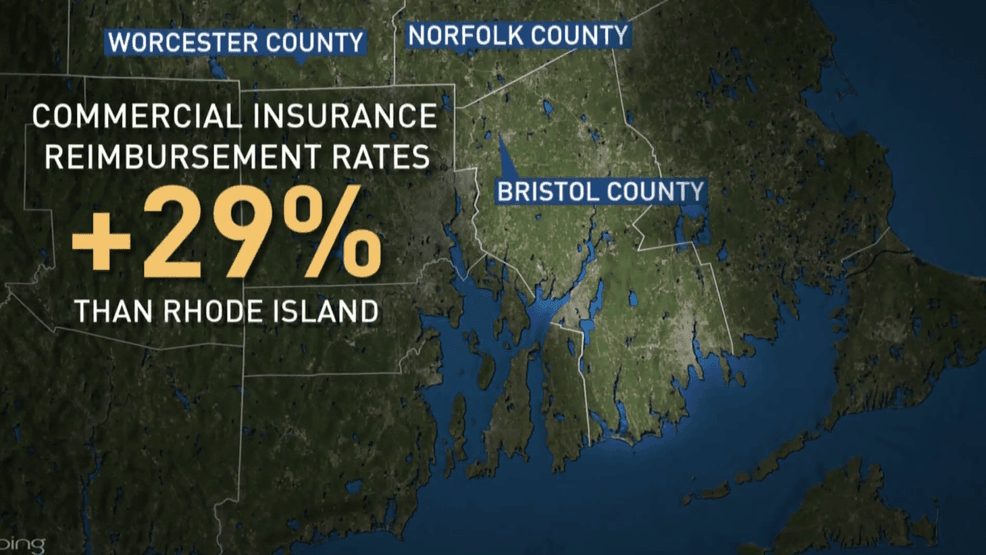
Rhode Island has one of the lowest physician-to-population ratios in New England. (WJAR)
An I-Team investigation found commercial insurance reimbursement rates are, on average, 29% higher in Massachusetts communities bordering Rhode Island.
Last year, Rhode Island raised the target for insurers’ primary care spending from 6% to 10% over the next four years.
The state’s Medicare rates are also lower than those in the Boston area and Connecticut, and Medicaid reimbursements are higher across state lines.
Former Rhode Island Health Department Director Dr. Michael Fine said reimbursement is only part of the issue.
“It’s workload, it’s workforce, it’s making sure we understand how many people we need and have a clear plan to train them,” Fine said. “This has been a problem 40 years in the making.”
Fine said he does not blame physicians for moving to alternative models but worries about broader public health risks.
“The risk is making sure we have enough people in primary care relationships,” he said. “When doctors move to direct care or concierge models, they reduce their patient panel from around 1,700 to 2,300 patients down to 300 to 500. That’s the immediate concern.”
Fine said the issue stems from decades of policy decisions.
“We can’t ask individual physicians to carry the weight of what public policy has failed to address over the past 40 years,” he said.
State leaders are working on long-term solutions, though changes will take time.
Fine is part of a legislative commission recommending the creation of a medical school at the University of Rhode Island focused on primary care.
The proposal would cost taxpayers about $22.5 million annually after an initial $20 million startup investment, totaling roughly $245 million over a decade.
Under the plan, the first class would enroll between 2029 and 2030, with about 100 students admitted each year.
“This needs to be a medical school for Rhode Islanders that creates a pathway for those committed to primary care,” Fine said. “I’d like to see some seats tied to a requirement to practice in Rhode Island.”
In the short term, the state is working to raise reimbursement rates and reduce administrative burdens.
A review of Medicaid reimbursement rates by the state’s health insurance commissioner is due this fall and could bring payments more in line with neighboring states.
Rhode Island also passed the Prior Authorization Act last year, eliminating prior authorization requirements for services ordered by primary care physicians during a three-year pilot program.