
A scene from 1994’s “Forrest Gump,” directed by Robert Zemeckis.
Sunset Boulevard/Getty Images)
Legendary Hollywood film producer Steve Starkey was on a tight deadline. It was the fall of 1993, and he had about a month to finish filming Forrest Gump’s cross-country run for the upcoming Tom Hanks movie.

Most of the 1994 movie is set in the fictional town of Greenbow, Alabama, and filmed in South Carolina and Georgia. But Gump, grieving the death of his mother and the departure of his childhood best friend and lifelong crush Jenny, decides to start running — and just keep going. Starkey needed scenery that represented the entirety of America.
Article continues below this ad
A scene from 1994’s “Forrest Gump,” directed by Robert Zemeckis.
Sunset Boulevard/Sunset Boulevard/Getty Images)
“Throughout this big, vast country of ours, everybody has iconic images in their minds,” Starkey told SFGATE. “And whether it’s the wheat fields of Kansas or the Rocky Mountains, there are things that stand out. It seemed natural to go to those places, if you could, to film.”
He needed a field. And not just any field: a wheat field, glowing in the sun, signifying all things Midwestern with thousands of acres of amber grains.
Unfortunately, the wheat had already been harvested that year in Kansas, Nebraska and across the Great Plains. But as it turned out, there was a perfect field right outside Glacier National Park. It was added to the list of filming locations, with the park as somewhat of an afterthought. The national park itself would come later — and eventually add powerful emotion to the film.
Article continues below this ad
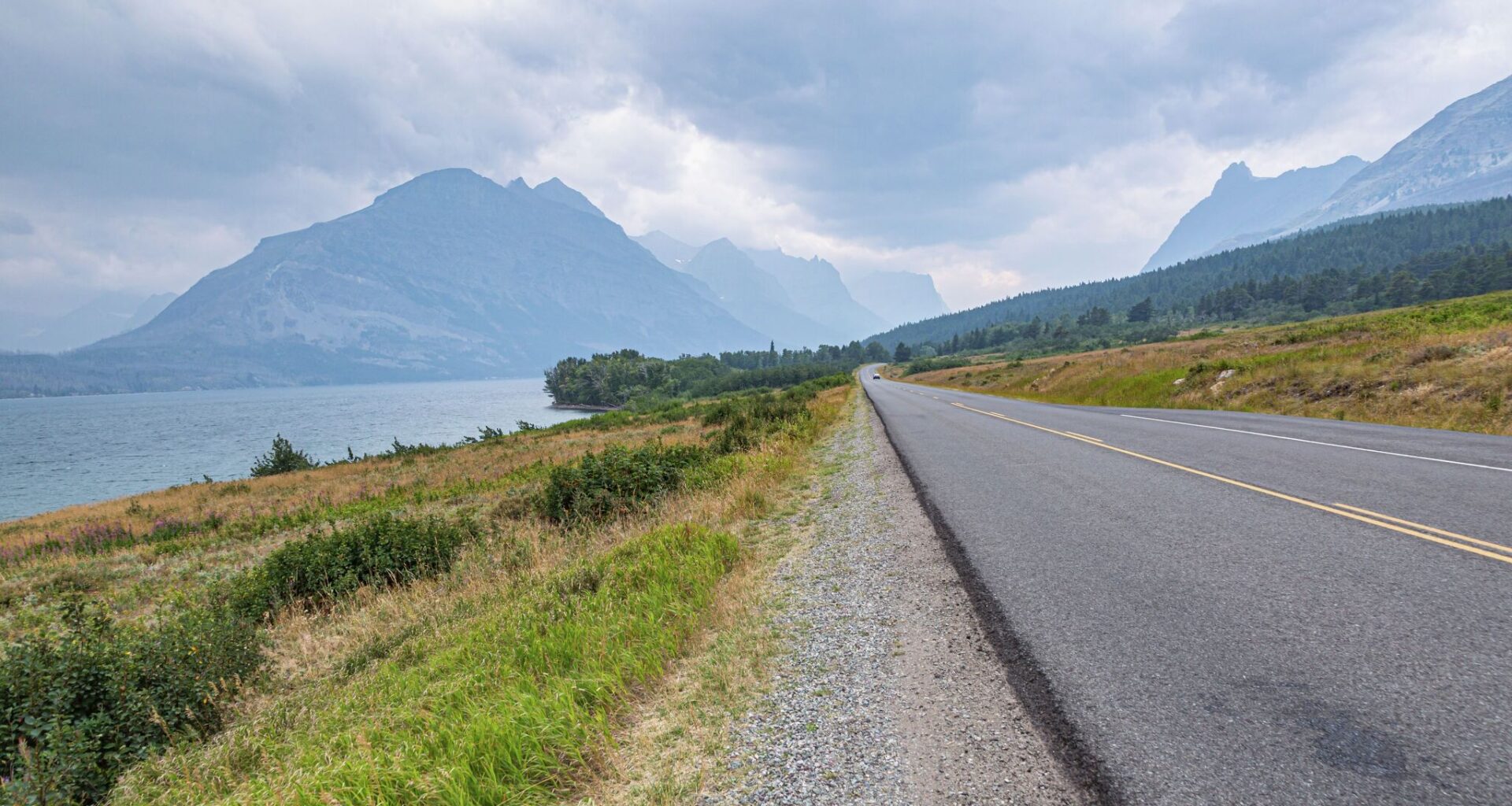
Saint Mary Lake in Glacier National Park, Mont.
UCG/UCG/Universal Images Group via G
From the beginning, production staff were under a time crunch. To get the scenes done even faster, Starkey divided the crew and sent a small group helmed by additional photographer Chris Woods out to Glacier and other far-flung locales to get started. This was called the “second unit.”
Make SFGATE a preferred source so your search results prioritize writing by actual people, not AI.
Add Preferred Source
“The birth of the second unit came as a result of too much to do and too little time to do it,” Starkey said.
Article continues below this ad
He, Woods and everyone else on set had a grueling schedule. After a full week of shooting in the South, the crew would fly to the Eastern Seaboard to film running shots all weekend. They traveled to Asheville, North Carolina, to shoot at the Biltmore Estate, and Maine and Vermont to chase fall colors in New England, then returned to their main set by Monday morning.
“It became a seven-day-a-week thing,” Starkey said. Hanks once said he worked on the film for 27 days straight.
A scene from 1994’s “Forrest Gump,” directed by Robert Zemeckis.
Sunset Boulevard/Getty Images
But there were limits to the jet-setting production, which Starkey chronicles in his book “On the Set of Forrest Gump.” The so-called “first unit” had to stay in the South to keep filming key scenes. “Going to Glacier National Park was too far away for the first unit to be jumping on a plane, going and filming, and coming back,” Starkey said. So Woods went out ahead.
Article continues below this ad
Members of the “Forrest Gump” crew in Port Clyde, Maine. Left to right, additional photographer E. J. Foerster, producer Steve Starkey, director of photography Don Burgess, director Robert Zemeckis and second photographer Chris Woods.
Courtesy of Chris Woods
Hanks couldn’t be everywhere at once. He did the running in the longer cross-country scenes, including Gump’s arrival to the Pacific Ocean at the Santa Monica Pier in Southern California and the scene where Gump stops running for good after three years, two months, 14 days and 16 hours of running, in Monument Valley, Utah. But in those brief shots of northwestern Montana, someone else stepped in: Jim Hanks, one of Tom Hanks’ brothers, served as a body double.
The desert location in the movie “Forrest Gump” where he decides to stop running.
bmswanson/IStockphoto via Getty Images
Jim Hanks wasn’t particularly hard to pass off as Tom Hanks, Starkey said. Gump had a beard and long hair during his running era, making facial differences between the men easier to hide. But Gump has a unique running style that’s more of a choppy, asymmetric shuffle. “Tom had to instruct Jim on how to run like Forrest Gump,” Starkey said. “Tom made him run around the parking lot in South Carolina until he got it right. It was really the running gate that had to match so it didn’t look like somebody else.”
Article continues below this ad
When it came time to film the wheat scenes, the production schedule did not slow down.
They were set to film near Cut Bank, a small town on the eastern border of the Blackfeet Reservation surrounded by agriculture operations. After a location scout told Woods the fields would be cut soon, he and the crew hurried to rural northwestern Montana. They were just in time — managing to film right as the field turned gold in a short window of sunlight, just minutes before the wheat was harvested. Production assistants had to pay several farmers $50 each to get them to pause harvesting long enough for the crew to finish shooting.
Chris Woods films Jim Hanks acting as a stunt double for his brother Tom Hanks near Cut Bank, Montana in October 1993 while filming ‘Forrest Gump.’
Courtesy of Chris Woods
Woods looks back on that scene fondly. It’s one of his career favorites. “That was probably the most spiritual thing I’ve ever seen through with a camera,” he said. The overcast dark sky, the contrast with the glowing wheat, “and the fact that if we had to shoot the next day, there wouldn’t have been any wheat there,” Woods said, made it special. “My whole crew, we were just celebrating. It was the most amazing thing.”
Article continues below this ad
Glacier National Park was less than an hour west, so Woods decided to shoot some scenes there, too. “We might as well get a bunch more stuff there,” Woods recalled. “I hadn’t been up there, so for me, it was all eye candy.” The landscape ended up amplifying Gump’s grief and loneliness in the script.
“Running against this gigantic background, this gigantic landscape enhanced the emotion of how he was feeling,” Starkey said.
Going to the Sun Road along Saint Mary Lake at Glacier National Park in Montana.
UCG/UCG/Universal Images Group via G
Glacier’s iconic scenery proved to be the ideal backdrop for a few quick cuts. That included clips shot on the shore of Saint Mary Lake and a stone bridge near the St. Mary entrance and visitor center that made it into the film, as well as footage farther up the famous Going-to-the-Sun Road that didn’t make the final cut. Woods remembered filming on the road, which is cut into rocky cliffs, as daunting. “It was a beautiful road, but that was terrifying,” he said.
Article continues below this ad
Chris Woods and other crew members film scenes for “Forrest Gump” on the Going-to-the-Sun Road in Glacier National Park in October 1993. These shots didn’t make the final cut.
Courtesy of Chris Woods
Any visitor to Glacier National Park knows its wild country, known for high winds and sudden storms. Landscapes don’t always cooperate as backdrops. Starkey wanted Gump’s character to run past a lake where you could see the reflection of mountains. Gump, later recounting his run to Jenny, says, “It was so clear, Jenny, it looked like there were two skies one on top of the other.”
But when the crew showed up to Saint Mary’s Lake, “it was blowing 30 mph winds, and the lake was nothing but white caps,” Woods said. He shot it anyway, and in post-production, the lake was smoothed out into glass.
Article continues below this ad
“We were looking for a spectacle,” Starkey said. “In our movies, we always try to treat the audience with big imagery. And there’s nothing bigger than Glacier National Park, really.”
We love national parks just as much as you do, so we have a newsletter that covers them from top to bottom. Sign up here.