
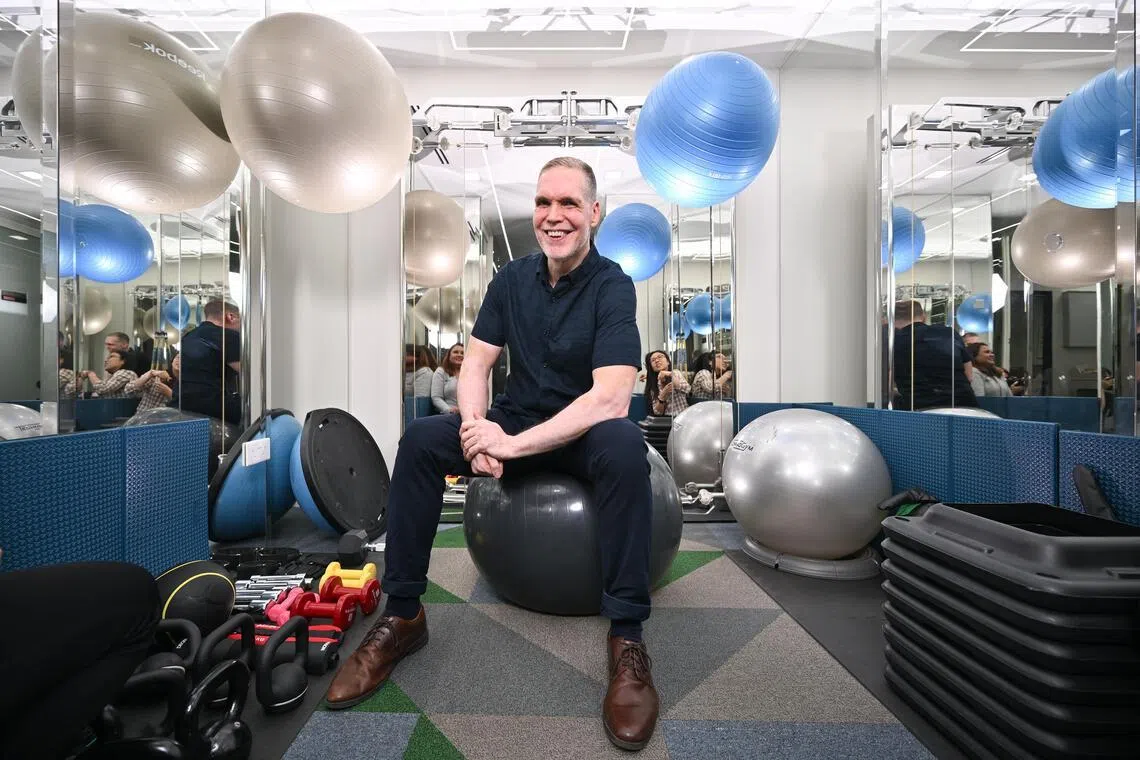
SINGAPORE – Mr Martin John went from serving coffee to celebrities in his youth to treating their aches and pains as an osteopath.
The Briton said that his clients in the UK included top athletes, dancers, gymnasts and celebrities – a far cry from his humble beginnings as a child growing up in government-subsidised housing in North London with two siblings.
To earn an extra buck, he had worked in gyms and cafes, and “ended up serving some very bad coffee or giving gym tours to a few famous faces like Ewan McGregor, Pierce Brosnan, Chris Evans and Kate Moss”, he said.
He is now based in Singapore, practising at Orchard Health Clinic in Palais Renaissance.
He had arrived in the Republic in 2003 on a one-way ticket with just $2,000 and no safety net. After working at various jobs for six years, he set up the clinic in 2009.
The clinic now serves more than 10,000 clients a year.
“I’d hit a ceiling back home, with high taxes, student loans, and this weird culture that looks down on ambition,” said the 53-year-old, who holds an osteopathy degree from the British School of Osteopathy, and a master’s in business administration from Anglia Ruskin University in Cambridge.
“I wanted to see more of the world, meet people who think differently. What struck me was how Singapore actually celebrates people who build something. That drive and optimism made me want to stay and be part of this perspective-changing culture.”
Early on in his practice, a patient offered $100,000 to invest in the clinic.
“After talking it through with my wife, we turned it down. She believed in me more than I believed in myself, and she was certain we could build it on our own.
“We did it, slowly, step by step, from a rented room and a second-hand car, to a clinic in Orchard Road, a team, a family, and eventually a home,” said Mr John, a Singapore permanent resident.
His wife, who is a Singaporean, runs the administration for the clinic, which employs 20 people. They have three children aged two to six.
A: My business is my most valuable asset, which represents two decades of trust. You can buy property or shares, but you can’t buy the loyalty of people who entrust you with their health and walk away stronger.
Besides that, I invest in gold for stability and as long-term insurance, equities for growth and exposure to innovation, and fixed coupon notes for steady, predictable income.
Cryptocurrency is a smaller part of the mix, and is more a calculated bet on where the future may head. I work with a trusted banker to ensure my portfolio stays balanced and productive.
A: Yes, some artwork, although I see them more as pieces I enjoy living with than as serious investments.
A few works that mean the most to me are a Takashi Murakami piece which is colourful and playful, and brings a lightness into the space; Damien Hirst’s Cherry Blossoms series, which is elegant yet modern and adds a vibrant energy to the home; and BE@RBRICK figures which I collected before my three children were born.
For me, these aren’t about financial return. They’re about joy, memories and surrounding myself with things that make daily life richer.
A: I collected comics like Alan Moore’s Watchmen and Neil Gaiman’s Sandman. My mum wasn’t thrilled about the piles of them at home but, for me, they were more than entertainment – they opened up the imagination, showed me how ideas could shape entire worlds, and taught me to look beyond the obvious.
A: Early on, I was too emotional with investing, reacting to uncertainty instead of riding it out. Once I started learning from the people around me, especially my wife, I became more disciplined. That shift has made all the difference in how I approach money today.
A: Taking the leap to buy our first home together in Singapore. At the time, it felt overwhelming, both the commitment and the mortgage, but it changed everything for me.
The house grew in value but, more than that, it became the place where our family and our life really took shape. It taught me that the best financial decisions are often the ones that give you roots and meaning, not just returns.
A: I grew up in an environment where money vanished as quickly as it appeared, and tomorrow never felt certain. That cycle of living for the day was everywhere, and breaking out of it took time, grit and a conscious choice to do things differently.
That led me to joining the British Army, the Coldstream Guards regiment in London. It was neither glamorous nor enjoyable, and much of it was hard, but it was transformative. The Guards drilled into me the discipline and perspective I never saw growing up: that wealth – whether financial or personal – isn’t built in a moment, it’s built by showing up, committing, and sticking through the discomfort until something lasting takes shape.
A: We got our council house (government-subsidised housing in the UK) as my brother had cerebral palsy and needed multiple operations and constant care. Our family depended on the government for stability and, in that environment, wanting more felt wrong – as if ambition itself was a betrayal.
What I’ve learnt since is very different: Money isn’t about greed or showing off. It’s about freedom – the freedom to choose your path, to care for the people you love and to build something that lasts. That’s what I’d want my younger self to understand.
A: Home is a four-bedroom condominium in Serangoon Gardens. The address and space matter less than what the place represents: years of work turning into a place where family, purpose and daily life all come together.
A: A Skoda Kodiaq. With three children, it’s less about looking sleek and more about fitting everyone – school bags, sports gear and the occasional flat-pack furniture included. It’s not a flashy car, but it does the real job: moving the whole family as one.
A: It would start quietly – a slow morning coffee and time to read, to let my mind wander. Then a mix of things I value most: time with my wife and children, meaningful work with my team, and space to learn or write so I feel I’ve grown that day. If it ends with good food from my wife, children laughing, and a moment to reflect, that’s a perfect balance for me.
A: I’d invest it with a long-term view of wanting it to grow steadily, not just for me but for my children. Part of it would go into a trust so they have security and choice in the future. Beyond that, I’d use it to create the kind of freedom that money should bring: more time with family, more space to learn and the ability to keep building something that lasts.
A: I’d take $10 for a coffee and croissant, then hand the other $90 to my wife. She’s used to making something out of nothing, and somehow always makes it go further than I ever could.