
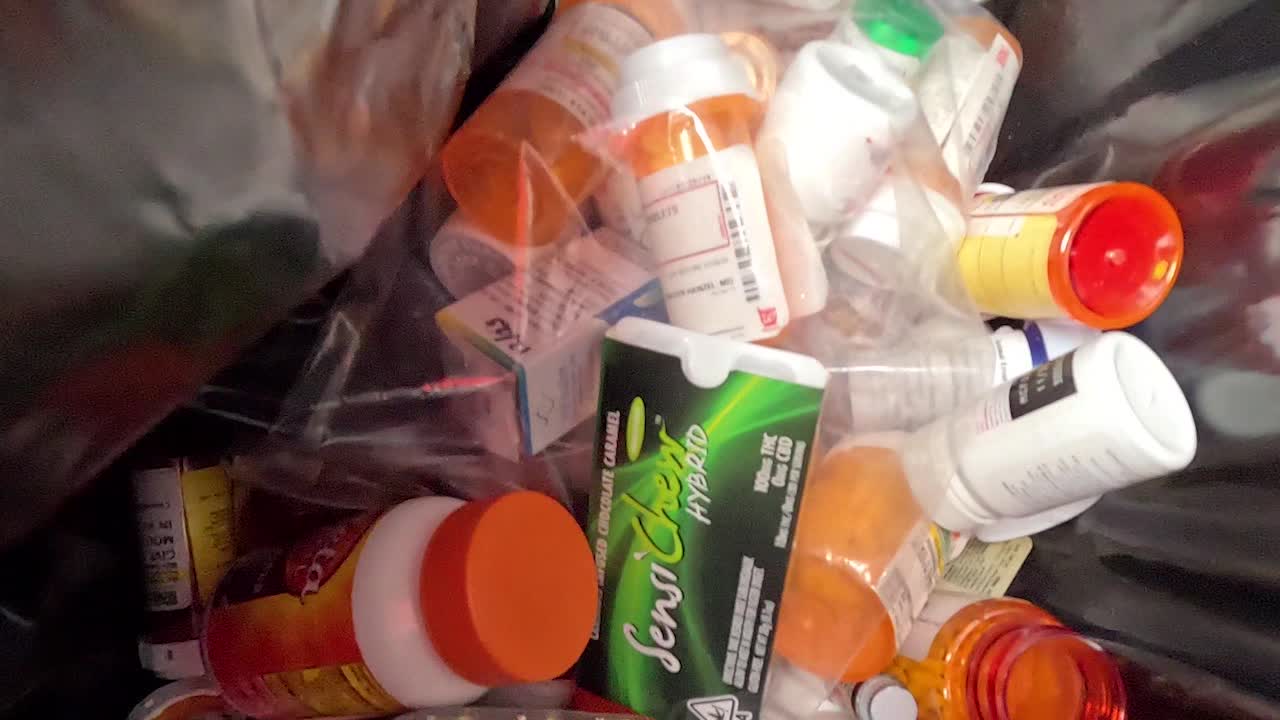
Minnesotans turned in bags of old medications Saturday as part of National Prescription Drug Take Back Day, an effort aimed at keeping unused prescriptions out of homes and the wrong hands.
There were drop‑off sites across the state. 5 EYEWITNESS NEWS talked to people at two locations — one that the Ramsey County Sheriff’s Office hosted in St. Paul outside the Midway Target, and the other that the Hennepin County Sheriff’s Office hosted in Minneapolis at the University of Minnesota’s Off‑Campus Safety Center in Dinkytown.
“Some people are coming with one small bag and others are coming with five or six bags, because they’ve just been waiting for a place to dispose,” said Jonessa Wisniewski with Ramsey County’s Opioid Prevention and Unified Services Coalition (OPUS).
Along with pills, used syringes were also collected.
“Twice a year we do see and bring in 400 pounds or more of syringes, needles and medication from people,” Wisniewski said.
Everything collected is sealed, weighed and prepared for safe disposal.
“I’m dropping off some medication that I no longer need, and it’s out of date, and it’s a good place to do that,” said Dennis Gerharstein, who stopped by one of the sites.
According to the Drug Enforcement Administration (DEA), Minnesota’s twice‑a‑year Take Back events collected thousands of pounds in 2025:
Oct. 25, 2025: 8,850 lbs. of medicationApril 26, 2025: 10,496 lbs of medicationPast 29 Take Back Days: 310,289 lbs. collected statewide
The DEA says the goal of Take Back Day is simple: clear out unused, expired or unneeded prescriptions before they can be misused and encourage families to make safe disposal a year‑round habit.
“We also encourage families to use this day as a time to sit down together and have conversations about the consequences that can come from prescription misuse, as well as the dangers that can come from taking a pill of unknown origin. For families with young children, it’s an opportunity to talk about prescription safety — only taking pills given by a trusted adult, or showing little children how similar candy and medication can often look. Let’s raise awareness and make the most of this day to not only clean out our medicine cabinets and drawers but also to start or continue the dialogue on prescription drug safety,” said a DEA spokesperson.
Lt. Jeremy Gunia with the Hennepin County Sheriff’s Office said clearing out medicine cabinets is more than routine housekeeping.
“Unwanted and unused prescription drugs can sometimes fall into the hands of unwanted people, and it can lead to drug abuse,” Gunia said.
Federal and state data show why events like this matter. The Substance Abuse and Mental Health Services Administration (SAMHSA) reports that opioids such as oxycodone, hydrocodone, codeine and morphine are among the most commonly misused prescription pain medications.
According to Minnesota’s Dose of Reality campaign, those drugs have killed more than 3,500 Minnesotans in the last 15 years — nearly 70% of them involving medications that were prescribed. The agency reports prescription drug misuse can be a gateway to street drugs.
RELATED: Fentanyl on the rise in Minnesota
The DEA also warns about the rise of counterfeit pills. In 2025, DEA lab testing found that 29% of counterfeit pills contained a potentially lethal dose of fentanyl — down from 76% the year before, but still considered a major threat.
For college students, the timing of the event is especially relevant.
“You know, we’re entering finals time right now, and sometimes people use medications or alcohol to numb some of that as a repair for finals,” said Nicholas Juarez with the UMN Department of Public Safety. “But again, this is just another opportunity for students to be aware that there are safe ways to dispose of unwanted medication instead of misusing it.”
Ramsey County officials echoed that message.
“We like to say if you are absolutely not using those medications, or even if they’re expired, get them out of your house so kids or adults, neighbors, friends are not exploring,” Wisniewski said.
Beyond collecting old prescriptions, agencies also focused on education. Ramsey County gave out naloxone nasal kits, the medication that can reverse an opioid overdose.
HCSO handed out deactivation bags called Deterra that neutralize pills.
“There’s charcoal in here that deactivates the opioids or the drugs. It can hold up to 45 pills, so they can take it home. They can put the pills in there, add some water, you swish it around, and then you’re able to throw this just right in the garbage,” Gunia explained.
Law enforcement also reminded people what not to do with old medications.
“We’ve been told you can’t flush it down the toilet, don’t throw it in the trash, and there’s really no other way to get rid of it,” Juarez said.
This year marks the 30th Take Back Day. The next one is in October.
Help and support resources
SAMHSA’s National Helpline: a free, confidential, 24/7 treatment referral and information service for individuals and families facing mental or substance use disorders. Call 1‑800‑662‑HELP (4357) for support in English or Spanish.
9‑8‑8 Suicide & Crisis Lifeline: available 24/7 for anyone experiencing emotional distress, mental health struggles, or concerns related to alcohol or drug use. Call or text 9‑8‑8 to connect with trained counselors.
For Related Stories: Drugs Hennepin County Sheriff’s Office Kamaria Braye Prescriptions Ramsey County Sheriff’s Office