
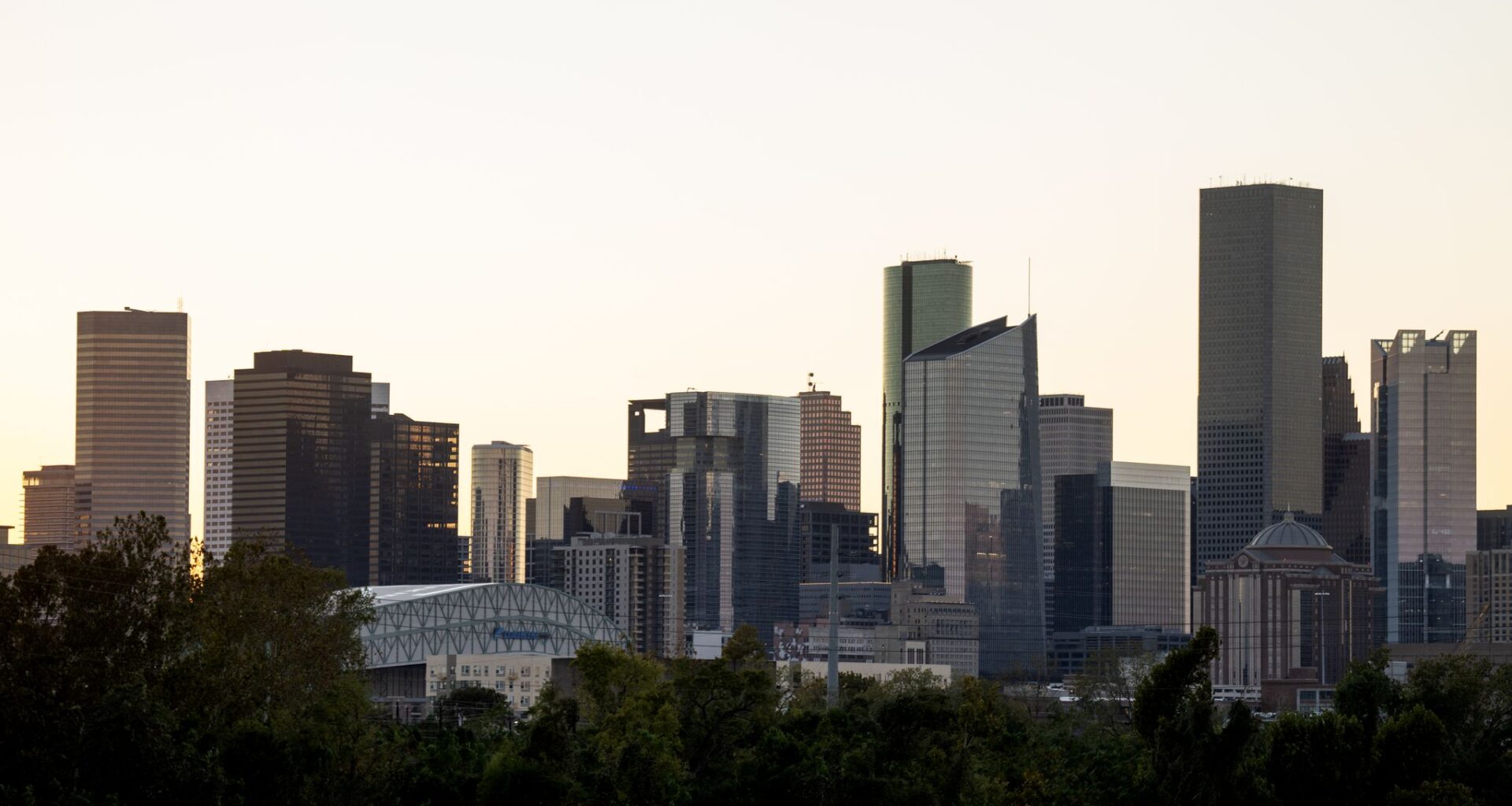
The downtown Houston skyline is seen looking west toward U.S. 59, Sunday, Nov. 9, 2025.
Jason Fochtman/Houston Chronicle
Houstonians are feeling a financial strain as confidence in the economy drops the most in a single year since the oil bust of the 1980s, according to a new survey by Rice University’s Kinder Institute for Urban Research.
The 45th annual Kinder Houston Area Survey, which measures the attitudes of thousands of Harris, Fort Bend and Montgomery County residents, found that residents in all three counties most commonly identified the economy as the “biggest problem” facing the Houston area.
In recent years, Harris County residents most often said that crime was the area’s biggest problem, while Fort Bend and Montgomery County residents pointed to traffic as their most pressing concern.
Article continues below this ad
This year’s results were particularly concerning because, unlike in other years, there wasn’t a single incident researchers could point to that clearly dampened attitudes toward the economy, said Dan Potter, director of the institute’s Houston Population Research Center, which conducts the annual study.
SUBURBAN SPRAWL: Houston suburbs are still booming. But how long will it last?
Rather, the concerns appear to reflect a sense of broader financial insecurity that is extending to a larger number of Houstonians.
“There’s no singularity to point to here, and that creates additional levels of concern because whatever forces are at play that are dragging economic perceptions down, it’s unclear if those are over,” Potter said.
Article continues below this ad
Economic uncertainty
Last year, nearly 75% of Houstonians felt that job opportunities in the area were “good or excellent,” according to the Kinder survey. This year, that number dropped to 48%, the largest single-year decline since the oil bust between 1982 and 1983.
A quarter of respondents said the economy was the biggest problem facing the area, up from roughly 16% in 2025. And the percent of residents who said they were “finding it difficult to get by” rose across income brackets, with especially notable increases among those who made less than $25,000 a year.
Potter said that while researchers cannot pinpoint a single event that triggered a downturn in attitudes toward personal finances, the responses appear to reflect other data points that indicate challenges facing the local and national economies.
Article continues below this ad
The Federal Reserve Bank of Dallas reported that Houston’s labor market contracted by 0.1% between 2024 and 2025, mirroring losses felt across the rest of the state and country.
“We appreciate that our responses are (people’s) perceptions, so we wanted to know if this is sort of an indirect sentiment of the political climate or a general national malaise,” Potter said. “And I think in particular, when you look at jobs created this past year, the sentiment matches the circumstances.”
Closer than we believe
This year, for the first time, Kinder researchers polled Houstonians not only on their own attitudes, but also on how they thought people with different political beliefs might answer certain questions.
In an era of increasing political and social division, Potter said, researchers thought it might be helpful to gauge people’s perceptions of each other’s beliefs and compare them to reality. The results were illuminating.
Article continues below this ad
“What we ended up finding here was that we do not know what other people are thinking,” Potter said. “And oftentimes, what we think they are thinking is wildly off, and on important issues as well.”
Across the board, respondents misjudged how closely those who disagree with them hold their beliefs on sensitive social, political and cultural issues.
BOOMING NEIGHBORHOODS: Midtown is Houston’s fastest-growing neighborhood. It’s also becoming one of the most diverse.
On the issue of whether people supported universal background checks on gun buyers, for example, Democratic respondents assumed that only a third of Republicans were in favor of the measure, while Republicans predicted that 75% of Democrats were supportive.
In reality, over 90% of both Republican and Democratic respondents supported universal background checks, according to the survey.
Article continues below this ad
“Not only are the two groups aligned on the issue, they have nearly universal support for it, and yet we walk around talking as if it’s a third rail issue or some controversial stance,” Potter said. “It’s a moment to recognize our power and ability to drive government… and when we don’t understand how aligned we are, we give up that power.”
Community connectedness
The Kinder Institute’s survey also queried Houstonians on their attitudes toward environmental issues and social connections.
A majority of residents expressed at least moderate concerns about extreme weather, pollution and contamination in their community, with lower-income residents particularly worried about effects on their health.
Residents’ responses also reflected a growing acceptance of the LGBTQ+ community and indicated that those who felt more connected to their neighbors and communities tended to report stronger levels of physical and mental health.
ICE IN HOUSTON: Gulfton, Houston’s ‘Ellis Island,’ is hurting under ICE fears
Responses showed that those who feel closer with their neighbors also feel safer in their communities.
“The Greater Houston area has overcome more than its fair share of challenges,” the report concludes. “For the region to truly succeed, it must find ways to contend with the economic, environmental, and social challenges of the current moment together, because when we are connected with one another and united in our efforts, our communities will prosper.”
Read the full report at the Kinder Institute’s website.