
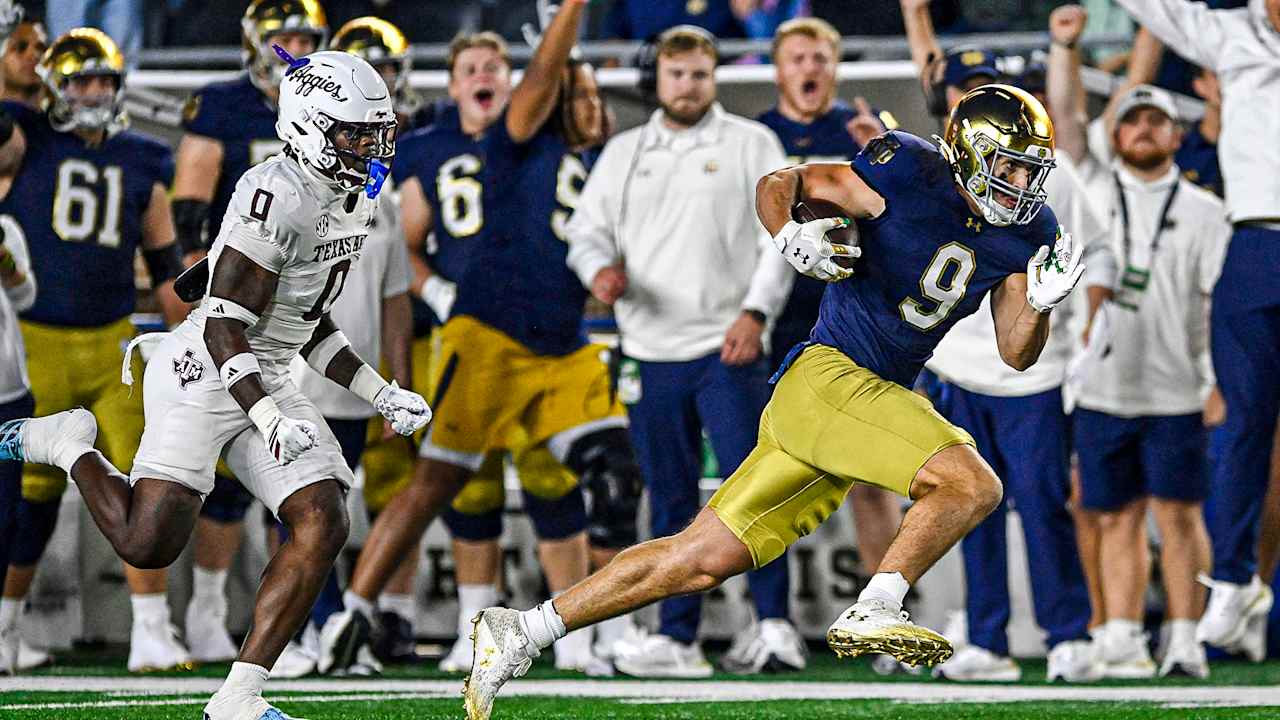
After dropping breadcrumbs throughout the offseason, the Patriots kept their word about adding at tight end by selecting Notre Dame’s Eli Raridon with the 95th overall pick in the third round.
During the first three rounds, nine tight ends heard their names called, the most tight ends drafted inside the top 100 since 2006. In all, 19 tight ends were drafted, the most in the NFL Draft since 2002. Part of that is because of the talent and depth of this particular class, which we highlighted throughout the process. But it’s also a copycat league, and with multiple tight end sets en vogue, the draft turned into tight end mania.
The reasoning for tight end mania could stem from offenses reacting to defenses getting lighter to stop the pass by featuring heavy personnel at a high rate. In 2025, offenses used two or fewer wide receivers at the highest rate since 2014 (41.7%), while teams ran the ball at the highest rate since 2011 (40.8%). The Rams might’ve been the trailblazers for heavy groupings, as LA played 41.2% of their offensive sets with two-plus tight ends and played a league-high 30.5% of their offensive snaps in 13 personnel (1 RB, 1 WR, 3 TEs).
Due to these trends, there was also an uptick in traditional “Y” tight end prospects who went early in the draft. For example, top 100 picks in Texas A&M’s Nate Boerkircher (Jags), Michigan’s Marlin Klein (Texans), and Ohio State’s Will Kacmarek (Dolphins) all were selected much earlier than consensus projections because they profile as plus-blockers in the run game with receiving upside.
As for how this all relates to the Patriots, we discussed the possibility of them selecting a successor to 31-year-old Hunter Henry all draft season. When ranking the top tight ends in this year’s class, we also banged the drum for New England to target a prospect who could be deployed as an in-line option. If defenses don’t need to respect the offense’s ability to run out of tight end-heavy formations, they can keep their lighter personnel on the field, negating the mismatches offenses want to create in the passing game.
Last season, the Patriots were just 24th in rush EPA out of multiple tight ends sets, which might’ve been why they were only 20th in multi-tight end usage (29.6%). Although he’s still developing his technique and play strength, Raridon flashed as a blocker and has room to grow into his 6-6, 245-pound frame. Plus, he brings a complementary skill set as a field-stretching receiver to go along with Henry (chain-mover), vet Julian Hill (blocking specialist), and New England can mix FB Reggie Gilliam in as well as a lead blocker.
The 22-year-old Notre Dame product has significant upside as a receiver thanks to his athletic profile, large hands, and catch radius. Raridon registered an elite 9.52 out of 10 relative athletic score at the combine, with a 4.62-second 40-yard dash (81st percentile) and elite explosiveness (36-inch vertical). He also has 10.75-inch hands (95th percentile) and an 80-inch wingspan (68th percentile), allowing him to create a quarterback-friendly target down the field.
Let’s break down the film to illustrate how Raridon’s game can translate to the next level.
Although he only had one season of college production due to injuries earlier in his career, Raridon broke out with 32 catches for 482 receiving yards as a fourth-year senior in 2025.
The Patriots third-rounder found success as a field-stretcher, averaging 15.1 yards per catch while leading this year’s tight end class with eight receptions over 20 yards (on eight targets). Raridon’s downfield route tree consisted mostly of digs or crossers (17.4%), nine routes (9%), and post-corner routes (7.1%). Although he doesn’t have dynamic change-of-direction talent to separate at the first level, the Irish allowed Raridon to open his long strides to challenge defenders in the middle of the field with his vertical speed.