
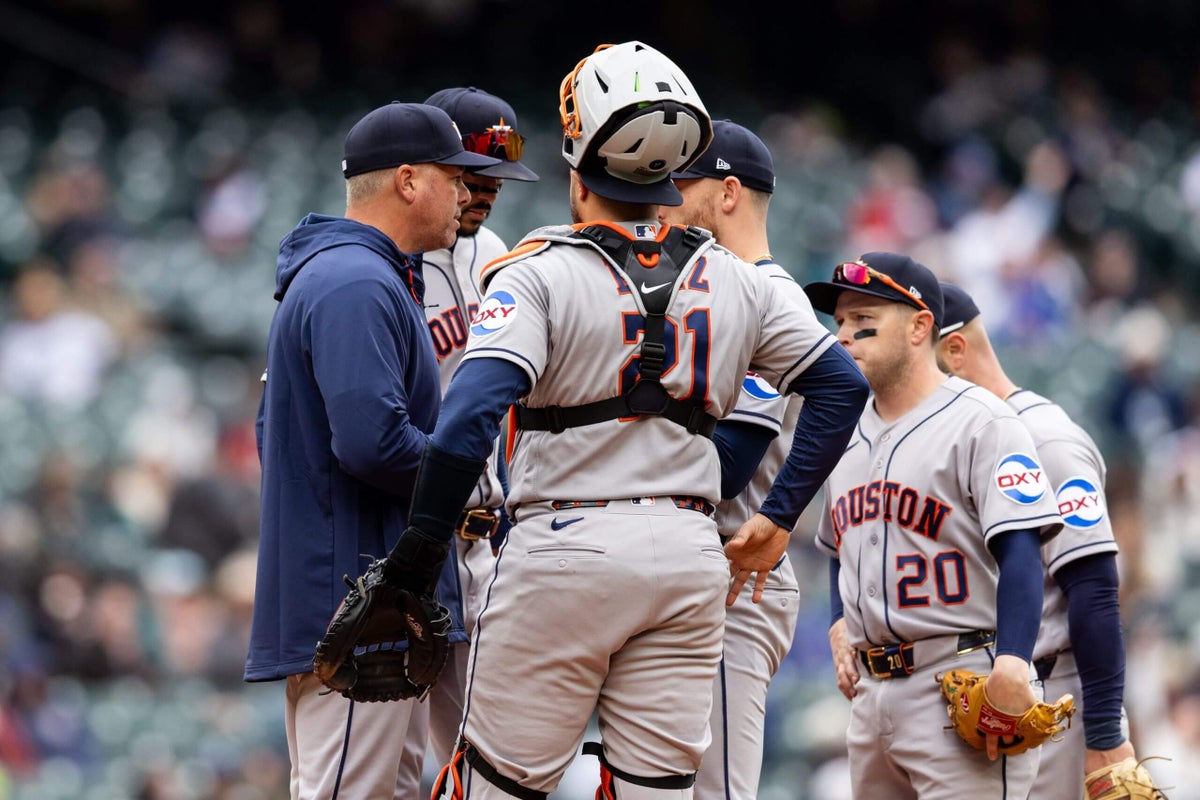
HOUSTON — Pitching has propelled the Houston Astros through their golden era. From 2018 to 2025, no American League staff posted a lower ERA than Houston’s 3.61 mark. No team in the sport struck out more batters per nine innings than the Astros, who totaled 9.55 during those eight seasons.
Sustaining that success for a ninth season has been difficult. Injuries have rendered the 2026 staff unrecognizable, robbing it of a Cy Young Award finalist, a celebrated closer and two starting pitchers being paid $30.8 million.
The results have been horrific. The Astros have baseball’s highest ERA, WHIP and walk rate. Opponents have an .831 OPS against them. Houston has allowed six or more runs in 18 of the season’s first 29 games — and just six of those games have featured a starting pitcher finishing six innings.
With an offense boasting the American League’s highest OPS, it is fair to assign most of the blame for Houston’s 11-18 start to the pitching staff. How did it get this bad? Here’s a look by the numbers.
21 pitchers used
Bennett Sousa’s seventh-inning appearance on Saturday made him the 21st Astros pitcher to appear across the team’s first 29 games. Only the Chicago White Sox, Chicago Cubs, Washington Nationals and Baltimore Orioles have deployed more. The White Sox and Nationals are in various stages of a rebuild. The Orioles and Cubs are, like the Astros, combating numerous injuries.
Houston used a franchise-record 33 pitchers last season, one both defined and derailed by injuries. This year is careening toward the same trajectory — with more ineffectiveness mixed in. Nine of the 15 Astros on the injured list are pitchers, including three-fifths of the season-opening starting rotation and six-time All-Star closer Josh Hader.
Sousa opened the season there after injuring his oblique in spring training. His activation on Saturday should supply some more proven depth to a bullpen in need of it. That manager Joe Espada summoned him in the seventh inning of a one-run game for his first appearance showed how much Sousa is valued.
However, in a scene fitting for this frustrating season, Sousa issued a four-pitch walk to the first hitter he faced. Three more followed before he exited the mound.
158 walks
No Astros pitching staff has walked 600 batters since 2013, a 111-loss season during which embarrassing records seemed part of the plan. That club was constructed to lose.
This one purports itself as a pennant contender — and as of Monday is on pace to issue 882 walks in a 162-game season. The franchise record is 679, set in 1975 by a team that finished 64-97.
“We need to get better,” catcher Christian Vázquez said. “We’re trying everything. The pitching coaches are working hard for this. We need to continue to get better. We’re in the big leagues for a reason. Everybody is a big leaguer here and needs to find a way to get better.”
Houston issued 508 walks last season, five below the league average. Reasons for the staff’s regression vary. Team officials have mentioned the introduction of ABS, which has shrunk the strike zone and increased walk rates across the sport, but every team in baseball is dealing with that change.
“Obviously, we’re facing nine big-league hitters every time we go out there — we’re not going to throw the ball down the middle just because the strike zone is smaller,” starter Spencer Arrighetti said. “Guys are going to try to pitch effectively around the zone and not the heart of the zone.
“I mean, you see it, you either give up four home runs or walk four people in an outing. There’s really, really good pitchers that are being affected by the strike zone in different ways. As a staff, we’re trying to limit it as much as possible without giving in to hitters.”
Ryan Weiss, Bryan Abreu, Lance McCullers Jr., Mike Burrows, Tatsuya Imai and AJ Blubaugh have all walked at least 10 batters this season. Only McCullers and Abreu played a meaningful role on last season’s pitching staff.
Weiss, Burrows and Imai arrived this offseason as part of a plan to stockpile pitching that, through 29 games, has not worked.
A 6.04 ERA from those six offseason additions
Only three of these pitchers remain on Houston’s 26-man roster, though Imai is scheduled to make a minor-league rehab appearance on Tuesday, after which he will presumably rejoin the major-league rotation. The team jettisoned Rule 5 pick Roddery Muñoz after three appearances and is still awaiting Nate Pearson’s debut after an offseason elbow procedure.
Imai headlined the sextet of major-league pitchers that general manager Dana Brown signed or acquired this winter. Weiss and Burrows were brought in to supply starting pitching depth. They have combined to yield 35 earned runs in 49 2/3 innings.
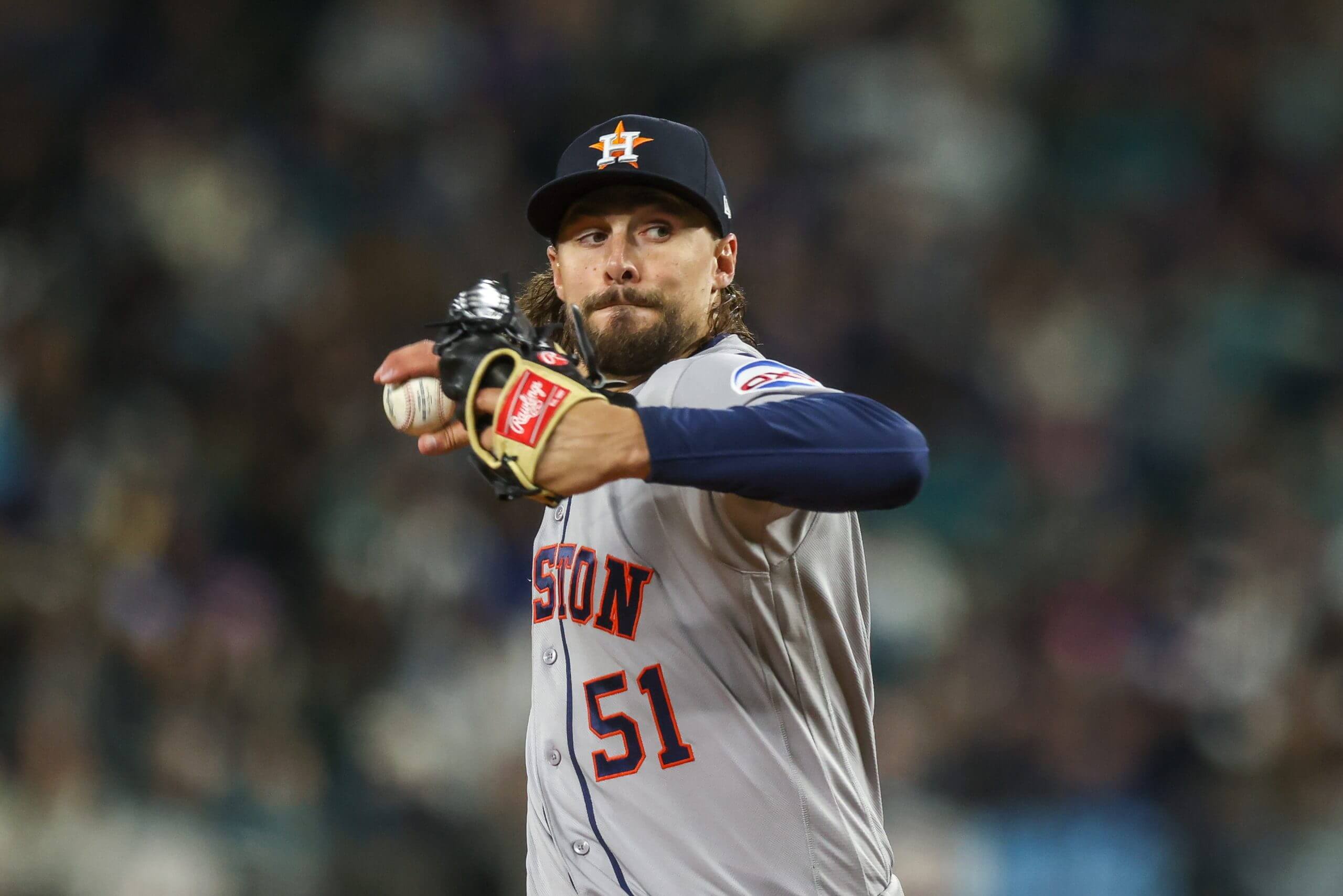
Ryan Weiss has a 6.50 ERA through 18 innings. (Jack Compton / Getty Images)
For now, Kai-Wei Teng is the group’s lone saving grace. Brown acquired him from the San Francisco Giants with intentions of making him a swingman, but Teng began the season as a middle reliever. His early success, along with anemic performances elsewhere, has forced the Astros to consider stretching Teng out as a starter.
Teng will start Tuesday night’s game in Baltimore. He hasn’t thrown more than 39 pitches in an outing this season, so it stands to reason Teng will function as the opener of a bullpen game. If his success continues, though, more traditional starts could loom.
56.6 first-strike percentage
Only the Cincinnati Reds are throwing fewer first-pitch strikes than the Astros. This shouldn’t be a surprise — Cincinnati is also the only club throwing fewer total strikes than Houston — but the Astros’ constant lack of count leverage has been one of Brown’s and Espada’s main frustrations across the start of this season.
“The biggest problem is we’re falling behind guys and then, even when we get ahead of guys, we’re not throwing that quality pitch to put them away and limit our pitch count,” Brown said this weekend.
“It seems like we’ll get ahead of a guy 0-2, 1-2, and then we’ll play around with them and then, before you know it, it’s 3-2. We have to get more aggressive at strike one and then we have to put guys away sooner when we get ahead. It’s increasing our pitch counts and causing a lot more walks.”
3.99 pitches per plate appearance
To Brown’s point, that is the third-highest mark in baseball.
A .323 batting average on balls in play
Poor luck is not an acceptable explanation for struggles to this extent, but it has played a part in this pitching disaster. Since 1911, only 14 teams have posted a higher full-season BABIP than the .323 mark Houston currently has. One of them is the Philadelphia Phillies, who lead the sport with a .354 mark.
Houston’s pitching staff is yielding contact 73.4 percent of the time — the 10th-lowest mark in the sport — but has baseball’s second-highest batting average on balls in play. For reference, five of the nine pitching staffs allowing less contact than the Astros also have a BABIP below the league average of .290.
Houston, however, has one 33 points higher.
A 4.56 expected ERA
Again, this exercise isn’t meant to blame everything on bad fortune, but with 133 games remaining, it’s worth pointing out peripherals that could portend a positive regression. Things are bad, but it’s difficult to envision Houston having a 5.97 ERA all season.
Yet that is the number this staff has earned. According to FanGraphs, though, the Astros’ expected ERA is 4.56. The statistic takes into account the quality and amount of contact while removing external factors like defense, weather or the ballpark.
Of the 10 pitching staffs with the highest ERA in baseball, only the Phillies have a larger disparity between their ERA and expected ERA.
Bryan Abreu’s 18.7 percent chase rate
Picking a poster child for the staff’s struggles is unfair, yet Abreu has earned the label after 29 games. He is not the root cause of Houston’s pitching collapse, but his decline from dominant reliever to designated mop-up man is something few in the organization could’ve foreseen.
No straightforward explanation exists for Abreu’s downturn. His fastball velocity is two miles per hour below his career average, something both Abreu and team officials have attributed to poor mechanics. Even at his best, Abreu has never been a command artist, but walking 13 batters and throwing 50.2 percent of his pitches for strikes across 10 appearances is untenable.
That Abreu has thrown just 42 percent of his fastballs inside the strike zone has neutralized his slider’s effectiveness, given opposing hitters little reason to swing — they’re doing so just 37.6 percent of the time — and, as a result, no chase for someone who sorely needs it.
A 27.1 percent team chase rate
It is the third-lowest chase rate in the sport and nearly 3 percent below league average. It is never as simple as “generate chase in two-strike counts,” but failing to get opponents outside the strike zone is a primary reason for so many prolonged plate appearances.
Last season, Houston generated chase at a league-average 28.2 percent. Among qualified pitchers, both Valdez and Hunter Brown had top-20 chase rates. Abreu generated chase at a 29.9 percent clip. Hader did so 37.8 percent of the time.
Valdez is a Detroit Tiger, and Hader hasn’t thrown a pitch this season. Abreu is amid a profound struggle. Brown just resumed playing catch in his recovery from a Grade 2 shoulder strain — perhaps the only positive this pitching staff can take into May.