
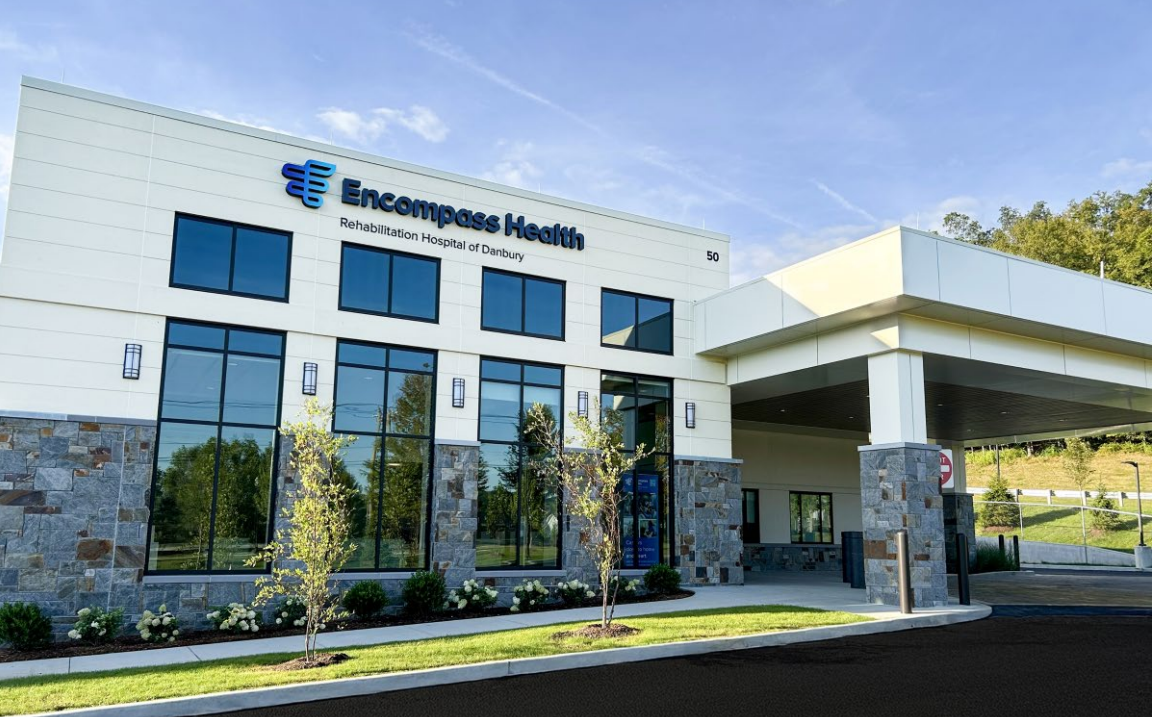
Encompass Health’s Danbury facility, which opened in October 2025, has already exceeded projections and shows the demand for inpatient rehab in Connecticut, company officials told state regulators at hearing on April 16, 2026.
Encompass Health/Encompass Health/Office of Health Strategy
When Josh Brooks’ 91-year-old neighbor in Branford had a health crisis a few years ago, she had one request for post-hospital rehab.

“She didn’t want to go to New Haven,” said Brooks, Branford’s first selectman. “She didn’t want to be that far. She didn’t want to go — she wanted to be home or as close to home as possible.”
Article continues below this ad
A new $70 million rehab hospital in Branford proposed by for-profit Encompass Health would offer shoreline residents a welcome option for recovery after hospital care, Brooks said, speaking at a state regulatory hearing on the project on April 16. If approved, the new 50-bed hospital would rise on a Main Street property that was once home to Hilltop Orchards.
“The town of Branford not only fully supports the Encompass facility, but is excited about the opportunity,” Brooks said.
But positive statements by Brooks and other local officials were countered by hours of testimony at the hearing in opposition to the Encompass Branford project by nonprofit competitors who warned of disruption to the state’s health system. The nonprofits, acting as “intervenors” in the hearing, also raised questions about the for-profit firm’s safety practices.
“Encompass will try to attract the better reimbursed Medicare and commercial populations currently being served while the majority of Medicaid patients remain with the existing providers with a significant potential negative financial impact on the existing not-for-profit providers,” Gaylord Chief Strategy Officer George Kyriacou said.
Article continues below this ad
Nonprofits question for-profit at hearing
Representatives of Gaylord, located in Wallingford, and New Britain’s Hospital for Special Care joined forces to grill Encompass executives at the April hearing, which was hosted by state health regulator the Office of Health Strategy. Encompass, based in Alabama, needs approval from the regulator to build the new hospital under the state’s Certificate of Need law.
Make CT Insider a preferred source on Google to see more of our journalism when you search.
Add Preferred Source
A new hospital competing for scarce nurses and other medical staff in a tight market will push struggling providers to the edge, the nonprofits told regulators at the hearing.
Article continues below this ad
“Approving an additional for-profit (rehab hospital), which will aggressively compete for scarce clinicians in our state, risks undermining our ability to continue as a going concern,” said Laurie Rudman CFO at Hospital for Special Care. The 236-bed New Britain rehab hospital projects $6 million in operating losses for fiscal 2026, she added.
“These losses are not sustainable for an independent, not-for-profit healthcare whose mission is to care for the state’s most fragile patients,” Rudman said.
Encompass officials countered that there was a documented need in Connecticut for more beds in “inpatient rehabilitation facilities,” which offer shorter-term and less intensive care than “long-term acute care hospitals” like Gaylord and Hospital for Special Care. Facilities like the one proposed for Branford have an average length of stay of 12 days and are aimed at treating patients recovering from ailments like fractures rather than those with complex medical needs.
“We are confident that if granted the CON for Branford, that patients receiving care there would not only get the great clinical care that they deserve, but also a great overall experience,” said Mathew Gooch, president of Encompass’s Northeast Region.
Article continues below this ad
Nonprofits highlight need, staffing issues
The entry into Connecticut of the for-profit company — the nation’s largest operator of inpatient rehabilitation facilities — also stirred controversy in Danbury several years ago, drawing opposition from Nuvance Health’s Danbury Hospital. The for-profit provider was not needed in the area and could raise costs, the hospital said.
After a study of the region’s rehab capacity, the regulators disagreed. “Encompass Danbury will address a gap in care for western Connecticut residents,” OHS said in its final approval, dated April 19, 2023.
The Danbury hospital opened in September of 2025 and has exceeded its projected volume numbers every month since, Gooch said, “which demonstrates an unmet need for services in the state of Connecticut.”
Article continues below this ad
In statements after the hearing, both Gaylord and Hospital for Special Care urged the state to reject Encompass’s Branford application. Among the hundreds of pages of materials submitted as part of the CON process was a link to a joint New York Times-KFF News investigation that found a range of safety issues at the company’s hospitals elsewhere in the country. (Encompass countered with filings alleging bias in the reporting.)
“We do not believe Encompass Health has demonstrated a genuine community need for a new rehabilitation hospital in Branford, and we stand firmly behind the concerns raised in our testimony,” said Sonja LaBarbera, president and CEO of Gaylord Specialty Healthcare. “Approving this proposal without clear evidence of unmet demand risks fragmenting an already finite healthcare workforce in Connecticut, straining specialized staff capacity, and increasing healthcare costs across the state without meaningfully improving access or quality of care.”
The Hospital for Special Care also cited staffing concerns in a statement, along with doubts about the need for a new facility in the state.
“Opening a new facility that will pull clinical staff from other facilities (that are already struggling to meet patient care demands due to staffing shortages) should not be permitted,” the statement said. “Adding another inpatient rehabilitation facility to the market, when there is a different 42-bed inpatient rehabilitation facility in Waterbury, CT that is due to open relatively soon, is premature at best.”
For-profit PAM Health is nearing completion of a $35 million acute care and rehabilitation center at the corner of Harpers Ferry Road and Reidville Drive in Waterbury.
Encompass did not respond to a request for comment through their website, but company officials told regulators at the hearing there was both a need and a demand for their services.
Article continues below this ad
Experts says scrutiny needed for health projects
The next step in the regulatory process is a May 4 final call for documents relating to the Encompass Branford application, which was filed on July 25 of last year. A decision is expected to come in the following months or years: OHS approved Encompass Danbury’s application in April 2023 following a public hearing in October 2021.
With Connecticut’s rapidly aging population, the need for rehab services is likely to grow and regulators need to address concerns about access and quality, said Quinnipiac University Professor Angela Mattie, an expert on the state’s health system.
“People like to have health care in their backyard, there’s no doubt about that,” Mattie said. “But where’s the workforce going to come from? What type of patients are they going to have? What are the metrics that are going to be in place for quality and safety related to this?” Rehabilitation care is of increasing importance to an older population and regulators need to play a role as new players move into the state, she added.
Article continues below this ad
“In general, getting the patient out quicker from an acute care hospital into a rehab facility is a good thing in terms of cost and quality and what the data says. But the real question is whether this project provides value,” Mattie said. “This organization should be able to answer those questions, because you don’t want to over-bed in a state that’s already faced with workforce shortages.”
With reforms planned in Hartford for the Office of Health Strategy and the CON process, oversight needs to remain a priority in health care, Mattie said. “This is exactly why the CON process is in place — to identify answers, data-driven answers to questions,” she said.