
By Esme Yeh /
Staff reporter
Labor groups and unions rallied on Workers’ Day yesterday, calling for pension reform to prevent poverty among older people caused by wage polarization and structural unemployment.
They demanded that pensions be increased and the labor insurance’s mandatory coverage be extended to all workers, including live-in workers, migrant workers and those working for companies with fewer than five employees.
Demonstrators gathered on Ketagalan Boulevard in Taipei and marched to the Legislative Yuan, while another march was held concurrently in Kaohsiung.
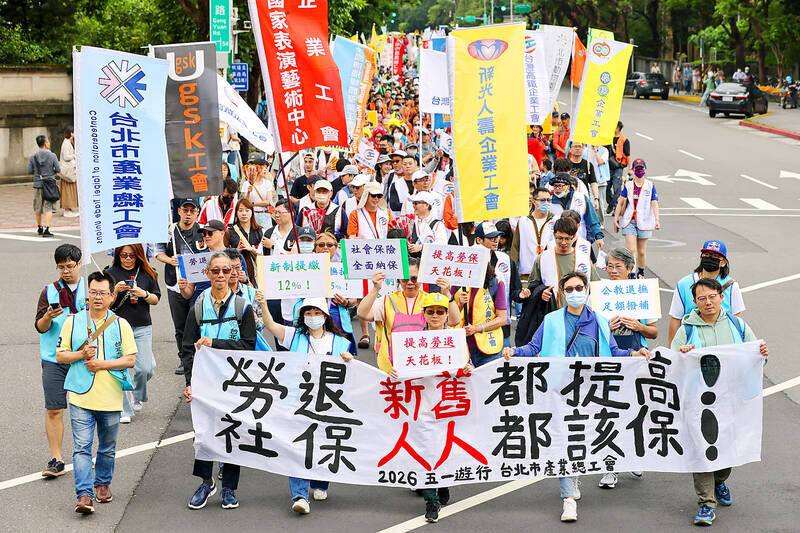
Photo: Ritchie B. Tongo, EPA
Taiwan Confederation of Trade Unions president Tai Kuo-jung (戴國榮), the leader of both events, said industrial transformations driven by artificial intelligence and the net zero transition are posing challenges to labor markets worldwide.
Such challenges include unstable employment, wage polarization and structural unemployment, Tai said.
Demographic changes such an aging society and a low birthrate would also create a financial gap in pension systems, he said.
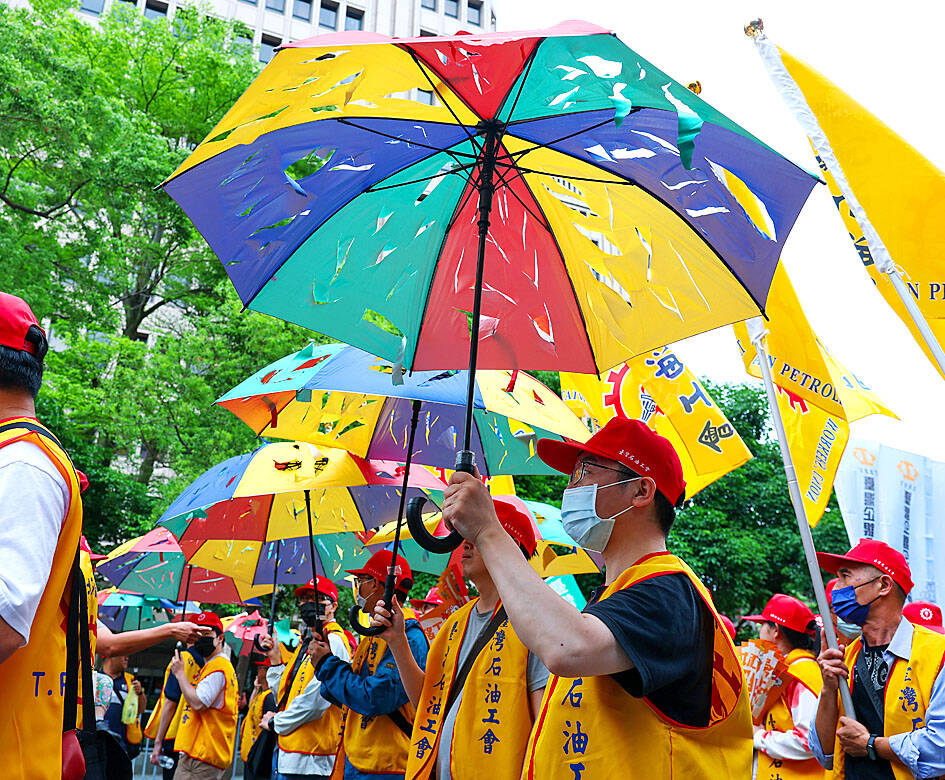
Photo: CNA
A more comprehensive social safety net must be established to ensure financial security in old age, Tai said.
The marchers put forward eight demands aimed at preventing poverty among older people through pension reform.
First, the rate of mandatory pension contribution by employers should be raised from 6 percent to 12 percent of employee salaries.

Photo: CNA
Second, the upper limit of years of service used in calculating pension payouts should be abolished, allowing workers to accrue retirement benefits for every year worked.
Third, the cap on severance pay should be increased to support unemployed workers’ lives.
Fourth, the maximum insured salary under the labor insurance program should be raised from NT$45,800 to NT$48,200, while the maximum salary eligible for mandatory pension contribution by employers should be increased from NT$150,000 to NT$313,000.
Fifth, mandatory labor insurance should be extended to all workers, including live-in workers, migrant workers and those working for a small company with fewer than five employees.
Sixth, the new labor pension system should be applied to all migrant workers, requiring employers to contribute to migrant workers’ pension in line with local workers’ pensions.
Seventh, the Public Service Pension Fund should be fully appropriated, and reparation payments for civil servants and teachers should be reinstated in line with those of military personnel.
Eighth, the rate of private-school teachers’ total pension contribution should be raised from 12 percent to 15 percent of twice the base salary, in line with that of public school teachers.
The Ministry of Labor should respond to the demands and establish a mechanism facilitating substantive dialogue among employees, employers and authorities, Tai said.
Tu Kai (杜愷), member of the Mandarin Educators Rights Union of the Mandarin Training Center at National Taiwan Normal University, said the union joined the march to call for fair compensation and employment contracts for teachers of Mandarin.
The ministry in 2024 confirmed that Mandarin teachers are eligible for protection under the Labor Standards Act (勞動基準法), he said.
Mandarin teachers teaching regular classes at colleges should be considered open-ended employees under the act, Tu said.
However, many college language centers continue to illegally offer Mandarin teachers three-month fixed-term contracts, he said.
These colleges are passing on their operational costs to Mandarin teachers via fixed-term employment, Tu said.
Some Mandarin teachers were not informed about whether they could continue to teach their classes until two days before the spring semester began this year, he said.
“We hope reasonable monthly working hours can be guaranteed to ensure wages that can sustain a living,” he added.