
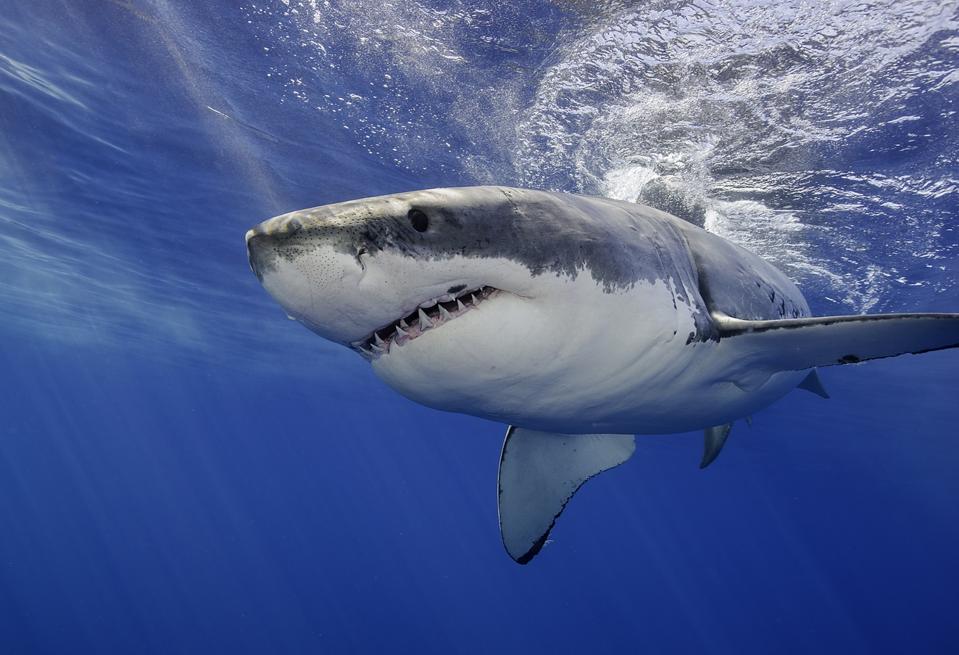
The white shark (Carcharodon carcharias) is often framed as a lone, coastal icon of places like Cape Cod or South Africa. But its life is far more expansive than a single shoreline.
Beginning in 2012, scientists working with OCEARCH launched a coordinated long-term tagging effort, fitting the white sharks with satellite-linked tags that transmit location data to orbiting satellites and acoustic tags that ping underwater receivers. They record depth, temperature and movement patterns, allowing researchers to reconstruct not just where a shark travels but how it uses the water column. Ninety-two sharks, spanning every life stage from young-of-the-year to fully mature adults, were tagged between Nova Scotia and Florida. The new study shows that sixty-two percent of those sharks entered the Gulf of Mexico or passed through the Straits of Florida. And this was not a brief stopover: most activity occurred between December and mid-May, firmly establishing the Gulf as an overwintering habitat.
This is huge because for years, white sharks in the Gulf were considered occasional visitors but that narrative no longer holds because these animals are returning year after year. In fact, two-thirds of the sharks that entered the Gulf came back in subsequent winters; this repeat visitation is scientifically known as “philopatry,” or the tendency to return to a familiar area. So, where exactly are they going? Most sharks moved through the Straits of Florida and then north along the outer West Florida Shelf, where they spent over 90 percent of their time in epipelagic waters (the sunlit upper layer of the ocean), but also made periodic dives into mesopelagic depths approaching 1,640 feet (500 meters). These vertical oscillations, particularly around Pulley Ridge, suggest active foraging. Pulley Ridge is a deep coral reef system off southwestern Florida that supports a diversity of commercially important fishes, such as jacks and groupers. It sits along a dynamic boundary shaped by the Loop Current, a powerful flow of warm water that enters through the Yucatán Channel and exits via the Straits of Florida to help form the Gulf Stream. Eddies spun off from this current can concentrate nutrients and prey; for a predator that must meet high metabolic demands in warm water, these oceanographic features may function like buffet lines. With all this context, it’s no wonder that this area emerged as a hotspot. Sharks showed more tortuous, localized movements there, a hallmark of area-restricted search behavior.
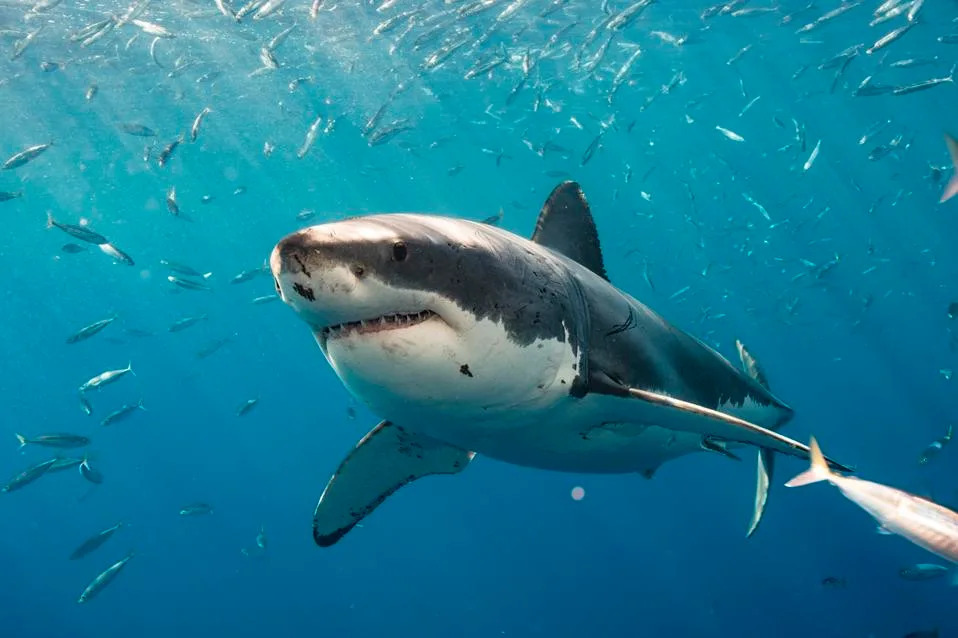
The revealed patterns reshape how we think about migration, reproduction and conservation in a changing ocean.
getty
Temperature also appears to be part of the story. Tagged sharks in the Gulf experienced waters ranging from 6.8°C to over 31 °C (44.2°F to over 87.8°F) but spent more than half their time in water warmer than 69.8°F (21°C). Warmer water increases metabolic rate, meaning the sharks need reliable prey intake to keep going. Yet the Gulf has no pinniped colonies, unlike the seal-rich aggregation sites off the northeastern United States. Which leads us to ask, what are they eating? Historical stomach content analyses and recent observations suggest a generalist approach. Dolphins, other sharks and large bony fishes are all on the menu! In March 2024, multiple white sharks were observed scavenging on a sperm whale carcass on the West Florida Shelf. Opportunism seems to be key here.
The data also hint at reproductive possibilities. Mature males and females both use the Gulf in winter, and some females undertook deep offshore excursions similar to those associated with gestation in other populations. Could mating occur in the Gulf? There is indirect evidence that it might. If so, the Gulf is not just a feeding ground but potentially part of the species’ reproductive landscape.
There are no lines in the ocean delineating where one country stops and another stops; sharks have no care for our made up landmass and ocean names. Thus, sharks tagged in Canada can end up in Mexican waters or along Cuba’s northern coast. No big deal, except conservation policies are typically bounded by national jurisdictions. What happens when a shark protected in US waters crosses into regions with different management frameworks? Possibly death. Encouragingly, the western North Atlantic white shark population appears to be rebuilding after historical declines. But that recovery makes understanding habitat use even more urgent. The Gulf of Mexico is warming, experiencing more intense tropical storms and recurrent harmful algal blooms. If this region serves as a critical overwintering habitat across all life stages, any sort of environmental change might alter migration timing or prey availability. Will sharks shift farther north in winter as temperatures rise, or will they double down on shelf edge refuges shaped by ocean currents? Right now, we cannot answer that question.
In the end, this research underscores that the lives of these mysterious predators are defined by connectivity. From Atlantic Canada to the Straits of Florida to Pulley Ridge and occasionally into Cuban waters, white sharks are weaving together ecosystems that we too often study in isolation. If we want science-based policy that matches biological reality, we have to follow the animals. We might need a bigger boat… and more scientific funding.
This article was originally published on Forbes.com