
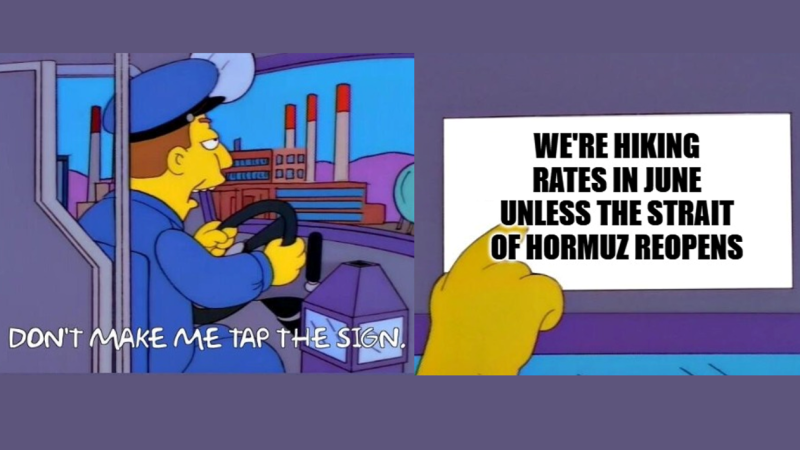
Don’t ask me why, but this week’s European Central Bank meeting got me thinking about a meme from The Simpsons. The one with the bus driver who silently taps a sign reading “Don’t talk to the driver” every time a passenger strikes up conversation.
Christine Lagarde could have saved herself a lot of effort this week by doing much the same. A gentle tap on a banner saying “We’re hiking in June unless energy prices collapse” would probably have covered most of the questions.
She didn’t put it quite that bluntly, of course. But she did say the Governing Council had a lengthy discussion about hiking. She said the ECB is moving away from its previous baseline, towards a world implicitly associated with higher interest rates. And, most tellingly, she said “directionally” that she knew where rates were heading.
If that still wasn’t explicit enough, an inevitable “ECB sources” quote soon followed, suggesting a June hike is highly likely.
What stood out more to me, though, was Lagarde’s suggestion that the ECB would have “a lot more information” on how the crisis is feeding through to inflation by the June meeting, just six weeks away.
That feels optimistic.
Yes, headline inflation is going higher. It’s already at 3% and our team expects it to push towards 4%, broadly consistent with the ECB’s “adverse” March scenario, and the one Lagarde now appears to be emphasising.
And yes, consumer inflation expectations have jumped, too. Data this week showed households expect inflation of 3% three years out, up from 2.5%, matching the highs of 2022. Something similar has happened in the UK.
That’s already two of the three warning lights Carsten Brzeski identified in his ECB preview.
But neither tells us much about persistence, nor about the strength of second‑round effects. And that will take time. Food inflation – one of the clearest channels for energy prices to feed through – is unlikely to peak before next winter.
It may take even longer for inflation pressures to show up in prices less directly affected by energy. Think services that are repriced annually. Or wages, which in Europe are governed by slow, multi‑year bargaining processes.
True, the ECB and other central banks will see more survey data by June. So far, those hint at only partial pass-through from higher input costs to output prices. But most businesses, like the rest of us, still don’t really know how this crisis will affect them – let alone where the crisis itself is headed.
It’s not at all clear that we will be much the wiser by June. There’s a growing view in energy markets that the current stalemate could drag on. Dated Brent – physical oil ready for delivery – is trading around $122/bbl, some $10 higher than a week ago.
Then again, geopolitical experts point to a planned meeting between Presidents Trump and Xi in mid-May, and whether the US will want it to be overshadowed by events in and around the Gulf. That raises at least the possibility of a deal that allows some tankers to move again.
Our own updated oil forecasts are based loosely on a scenario where disruption to oil flows reduces from 70% today to 35% through May. If that entails a fragile, volatile truce in the Strait without a broader conflict resolution, then I think it would pose a significant dilemma for central banks in June.
The question is what matters more, the volume of oil already lost along with the supply‑chain impact that has already been baked in? Or the flow of oil and gas going forward, which – even if uncertain and only partially restored – could push energy prices lower over the summer?
For June, my money is on the former. As long as markets are pricing rate hikes this year – and as long as that keeps inflation expectations contained – there’s only so long central banks will feel able to stay on the sidelines. A June ECB hike is our base case, and after this week’s meeting, it is for the Bank of England, too.
Whether those hikes come about because officials have more clarity on the inflation outlook, I’m not so convinced. And whether those hikes are repeated again in September and beyond is equally questionable, in the sort of base case scenario described above.
A lot can still happen over the next six weeks; a gradual return of oil flows is one of many scenarios, each as (im)plausible as the next. A decisive reopening of the Strait of Hormuz and a sharp fall in energy prices is no doubt a wildcard.
If that happens, well, central banks might just take inspiration from another of those famous Simpsons memes…